

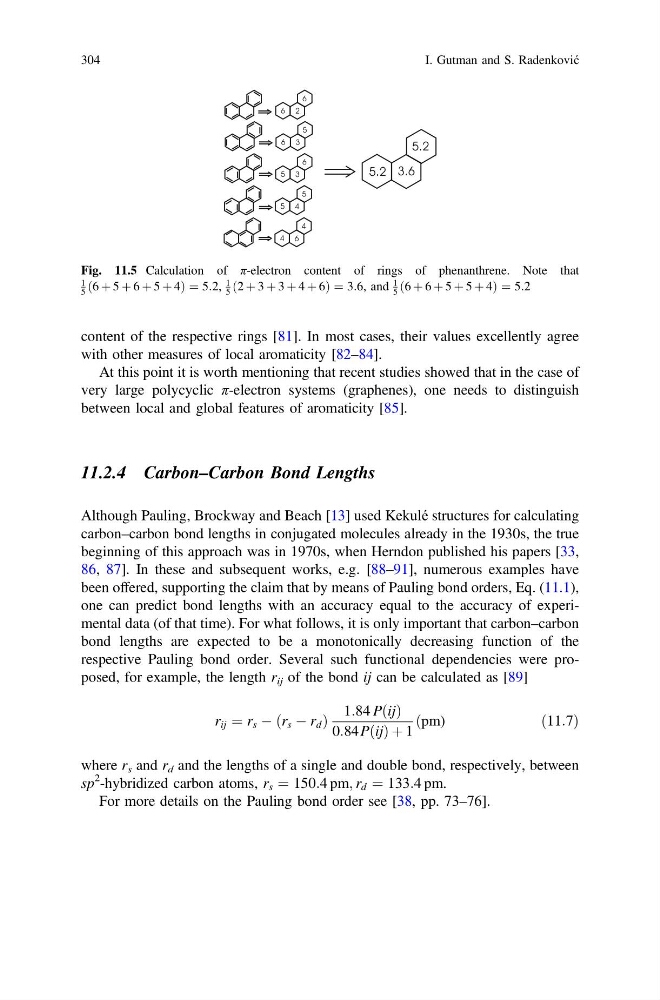
content of the respective rings [81]. In most cases, their values excellently agree
with other measures of local aromaticity [82–84].
At this point it is worth mentioning that recent studies showed that in the case of
very large polycyclic π-electron systems (graphenes), one needs to distinguish
between local and global features of aromaticity [85].
11.2.4 Carbon–Carbon Bond Lengths
Although Pauling, Brockway and Beach [13] used Kekulé structures for calculating
carbon–carbon bond lengths in conjugated molecules already in the 1930s, the true
beginning of this approach was in 1970s, when Herndon published his papers [33,
86, 87]. In these and subsequent works, e.g. [88–91], numerous examples have
been offered, supporting the claim that by means of Pauling bond orders, Eq. (11.1),
one can predict bond lengths with an accuracy equal to the accuracy of experimental data (of that time). For what follows, it is only important that carbon–carbon
bond lengths are expected to be a monotonically decreasing function of the
respective Pauling bond order. Several such functional dependencies were proposed, for example, the length r ij of the bond ij can be calculated as [89]
r ij ¼ r s À ðr s À r d Þ
1:84 PðijÞ
0:84PðijÞ þ 1
ðpm)
ð11:7Þ
where r s and r d and the lengths of a single and double bond, respectively, between
sp
2 -hybridized carbon atoms, r s ¼ 150:4 pm; r d ¼ 133:4 pm.
For more details on the Pauling bond order see [38, pp. 73–76].
Fig. 11.5 Calculation of π-electron content of rings of phenanthrene. Note that
1
5 ð6 þ 5 þ 6 þ 5 þ 4Þ ¼ 5:2,
1
5 ð2 þ 3 þ 3 þ 4 þ 6Þ ¼ 3:6, and
1
5 ð6 þ 6 þ 5 þ 5 þ 4Þ ¼ 5:2
304
I. Gutman and S. Radenković
with other measures of local aromaticity [82–84].
At this point it is worth mentioning that recent studies showed that in the case of
very large polycyclic π-electron systems (graphenes), one needs to distinguish
between local and global features of aromaticity [85].
11.2.4 Carbon–Carbon Bond Lengths
Although Pauling, Brockway and Beach [13] used Kekulé structures for calculating
carbon–carbon bond lengths in conjugated molecules already in the 1930s, the true
beginning of this approach was in 1970s, when Herndon published his papers [33,
86, 87]. In these and subsequent works, e.g. [88–91], numerous examples have
been offered, supporting the claim that by means of Pauling bond orders, Eq. (11.1),
one can predict bond lengths with an accuracy equal to the accuracy of experimental data (of that time). For what follows, it is only important that carbon–carbon
bond lengths are expected to be a monotonically decreasing function of the
respective Pauling bond order. Several such functional dependencies were proposed, for example, the length r ij of the bond ij can be calculated as [89]
r ij ¼ r s À ðr s À r d Þ
1:84 PðijÞ
0:84PðijÞ þ 1
ðpm)
ð11:7Þ
where r s and r d and the lengths of a single and double bond, respectively, between
sp
2 -hybridized carbon atoms, r s ¼ 150:4 pm; r d ¼ 133:4 pm.
For more details on the Pauling bond order see [38, pp. 73–76].
Fig. 11.5 Calculation of π-electron content of rings of phenanthrene. Note that
1
5 ð6 þ 5 þ 6 þ 5 þ 4Þ ¼ 5:2,
1
5 ð2 þ 3 þ 3 þ 4 þ 6Þ ¼ 3:6, and
1
5 ð6 þ 6 þ 5 þ 5 þ 4Þ ¼ 5:2
304
I. Gutman and S. Radenković