

ILAðRÞ ¼
2 KðBH À RÞ
KðBHÞ
ð11:5Þ
where BH is a benzenoid molecule and BH − R is the fragment obtained by deleting
the ring R from BH. The ring R is usually assumed to be 6-membered.
It can be easily seen that 2K (BH − R) is just the number of Kekulé structures of
BH in which the ring R possesses three double bonds. For example, for the five
rings of benzo[a]pyrene (see Fig. 11.2), ILA(A) = 4/9, ILA(B) = 6/9, ILA(C) = 6/9,
ILA(D) = 4/9, and ILA(E) = 2/9. Consequently, the ring E would be the least
aromatic domain of benzo[a]pyrene, whereas the rings B and C would have the
greatest aromatic character.
The simple ILA-approach was eventually extended to the “conjugated circuit
model” [66–70].
A “conjugated circuit” is a cyclic arrangement of single and double bonds in a
Kekulé structure, such that each single bond is followed by a double bond, and vice
versa. (In mathematics, this is called an alternating cycle of a perfect matching
[28]). In Kekulé structures of benzenoid hydrocarbons, only conjugated circuits of
size 4n + 2 (i.e., 6, 10, 14, 18, …) may occur [71]. For example, the Kekulé
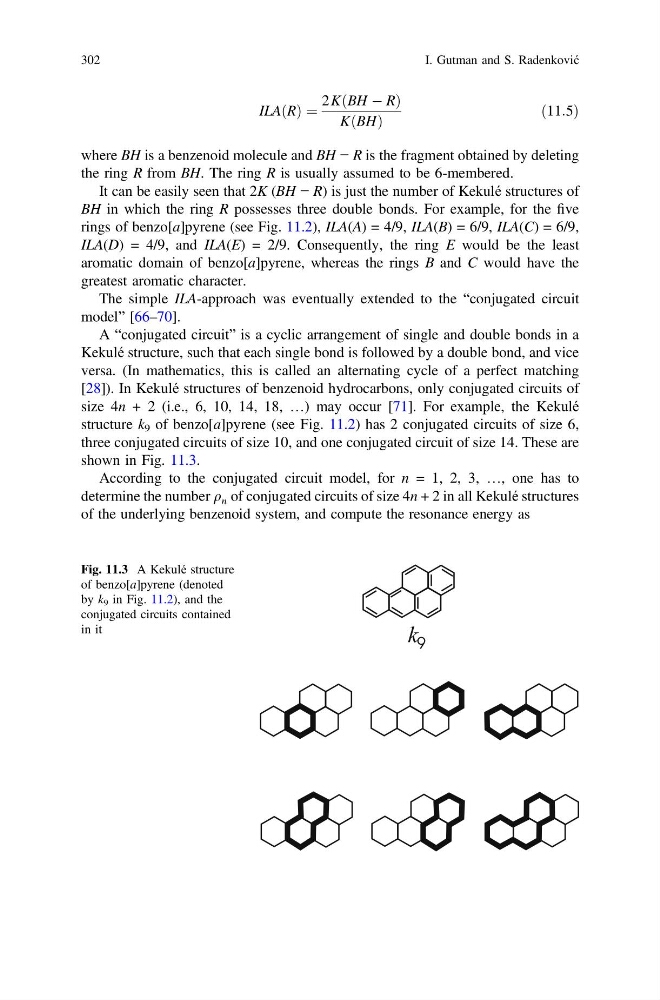
structure k 9 of benzo[a]pyrene (see Fig. 11.2) has 2 conjugated circuits of size 6,
three conjugated circuits of size 10, and one conjugated circuit of size 14. These are
shown in Fig. 11.3.
According to the conjugated circuit model, for n = 1, 2, 3, …, one has to
determine the number q n of conjugated circuits of size 4n + 2 in all Kekulé structures
of the underlying benzenoid system, and compute the resonance energy as
Fig. 11.3 A Kekulé structure
of benzo[a]pyrene (denoted
by k 9 in Fig. 11.2), and the
conjugated circuits contained
in it
302
I. Gutman and S. Radenković
2 KðBH À RÞ
KðBHÞ
ð11:5Þ
where BH is a benzenoid molecule and BH − R is the fragment obtained by deleting
the ring R from BH. The ring R is usually assumed to be 6-membered.
It can be easily seen that 2K (BH − R) is just the number of Kekulé structures of
BH in which the ring R possesses three double bonds. For example, for the five
rings of benzo[a]pyrene (see Fig. 11.2), ILA(A) = 4/9, ILA(B) = 6/9, ILA(C) = 6/9,
ILA(D) = 4/9, and ILA(E) = 2/9. Consequently, the ring E would be the least
aromatic domain of benzo[a]pyrene, whereas the rings B and C would have the
greatest aromatic character.
The simple ILA-approach was eventually extended to the “conjugated circuit
model” [66–70].
A “conjugated circuit” is a cyclic arrangement of single and double bonds in a
Kekulé structure, such that each single bond is followed by a double bond, and vice
versa. (In mathematics, this is called an alternating cycle of a perfect matching
[28]). In Kekulé structures of benzenoid hydrocarbons, only conjugated circuits of
size 4n + 2 (i.e., 6, 10, 14, 18, …) may occur [71]. For example, the Kekulé
structure k 9 of benzo[a]pyrene (see Fig. 11.2) has 2 conjugated circuits of size 6,
three conjugated circuits of size 10, and one conjugated circuit of size 14. These are
shown in Fig. 11.3.
According to the conjugated circuit model, for n = 1, 2, 3, …, one has to
determine the number q n of conjugated circuits of size 4n + 2 in all Kekulé structures
of the underlying benzenoid system, and compute the resonance energy as
Fig. 11.3 A Kekulé structure
of benzo[a]pyrene (denoted
by k 9 in Fig. 11.2), and the
conjugated circuits contained
in it
302
I. Gutman and S. Radenković