

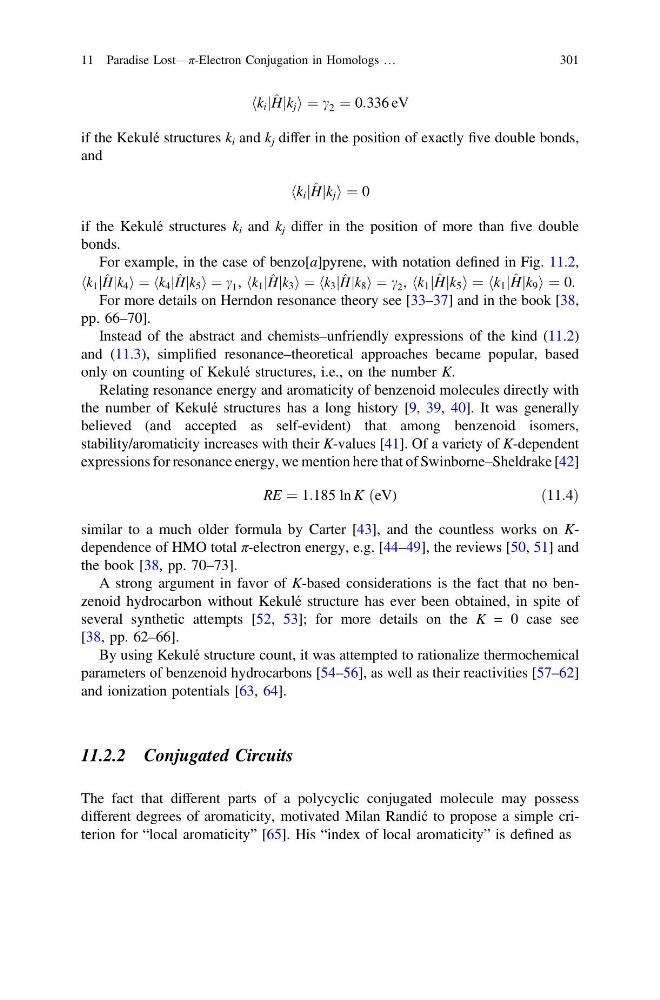
hk i j ^
Hjk j i ¼ c 2 ¼ 0:336 eV
if the Kekulé structures k i and k j differ in the position of exactly five double bonds,
and
hk i j ^
Hjk j i ¼ 0
if the Kekulé structures k i and k j differ in the position of more than five double
bonds.
For example, in the case of benzo[a]pyrene, with notation defined in Fig. 11.2,
hk 1 j ^
Hjk 4 i ¼ hk 4 j ^
Hjk 5 i ¼ c 1 , hk 1 j ^
Hjk 3 i ¼ hk 3 j ^
Hjk 8 i ¼ c 2 , hk 1 j ^
Hjk 5 i ¼ hk 1 j ^
Hjk 9 i ¼ 0.
For more details on Herndon resonance theory see [33–37] and in the book [38,
pp. 66–70].
Instead of the abstract and chemists–unfriendly expressions of the kind (11.2)
and (11.3), simplified resonance–theoretical approaches became popular, based
only on counting of Kekulé structures, i.e., on the number K.
Relating resonance energy and aromaticity of benzenoid molecules directly with
the number of Kekulé structures has a long history [9, 39, 40]. It was generally
believed (and accepted as self-evident) that among benzenoid isomers,
stability/aromaticity increases with their K-values [41]. Of a variety of K-dependent
expressions for resonance energy, we mention here that of Swinborne–Sheldrake [42]
RE ¼ 1:185 ln K ðeV)
ð11:4Þ
similar to a much older formula by Carter [43], and the countless works on Kdependence of HMO total π-electron energy, e.g. [44–49], the reviews [50, 51] and
the book [38, pp. 70–73].
A strong argument in favor of K-based considerations is the fact that no benzenoid hydrocarbon without Kekulé structure has ever been obtained, in spite of
several synthetic attempts [52, 53]; for more details on the K = 0 case see
[38, pp. 62–66].
By using Kekulé structure count, it was attempted to rationalize thermochemical
parameters of benzenoid hydrocarbons [54–56], as well as their reactivities [57–62]
and ionization potentials [63, 64].
11.2.2 Conjugated Circuits
The fact that different parts of a polycyclic conjugated molecule may possess
different degrees of aromaticity, motivated Milan Randić to propose a simple criterion for “local aromaticity” [65]. His “index of local aromaticity” is defined as
11 Paradise Lost—π-Electron Conjugation in Homologs …
301
Hjk j i ¼ c 2 ¼ 0:336 eV
if the Kekulé structures k i and k j differ in the position of exactly five double bonds,
and
hk i j ^
Hjk j i ¼ 0
if the Kekulé structures k i and k j differ in the position of more than five double
bonds.
For example, in the case of benzo[a]pyrene, with notation defined in Fig. 11.2,
hk 1 j ^
Hjk 4 i ¼ hk 4 j ^
Hjk 5 i ¼ c 1 , hk 1 j ^
Hjk 3 i ¼ hk 3 j ^
Hjk 8 i ¼ c 2 , hk 1 j ^
Hjk 5 i ¼ hk 1 j ^
Hjk 9 i ¼ 0.
For more details on Herndon resonance theory see [33–37] and in the book [38,
pp. 66–70].
Instead of the abstract and chemists–unfriendly expressions of the kind (11.2)
and (11.3), simplified resonance–theoretical approaches became popular, based
only on counting of Kekulé structures, i.e., on the number K.
Relating resonance energy and aromaticity of benzenoid molecules directly with
the number of Kekulé structures has a long history [9, 39, 40]. It was generally
believed (and accepted as self-evident) that among benzenoid isomers,
stability/aromaticity increases with their K-values [41]. Of a variety of K-dependent
expressions for resonance energy, we mention here that of Swinborne–Sheldrake [42]
RE ¼ 1:185 ln K ðeV)
ð11:4Þ
similar to a much older formula by Carter [43], and the countless works on Kdependence of HMO total π-electron energy, e.g. [44–49], the reviews [50, 51] and
the book [38, pp. 70–73].
A strong argument in favor of K-based considerations is the fact that no benzenoid hydrocarbon without Kekulé structure has ever been obtained, in spite of
several synthetic attempts [52, 53]; for more details on the K = 0 case see
[38, pp. 62–66].
By using Kekulé structure count, it was attempted to rationalize thermochemical
parameters of benzenoid hydrocarbons [54–56], as well as their reactivities [57–62]
and ionization potentials [63, 64].
11.2.2 Conjugated Circuits
The fact that different parts of a polycyclic conjugated molecule may possess
different degrees of aromaticity, motivated Milan Randić to propose a simple criterion for “local aromaticity” [65]. His “index of local aromaticity” is defined as
11 Paradise Lost—π-Electron Conjugation in Homologs …
301