

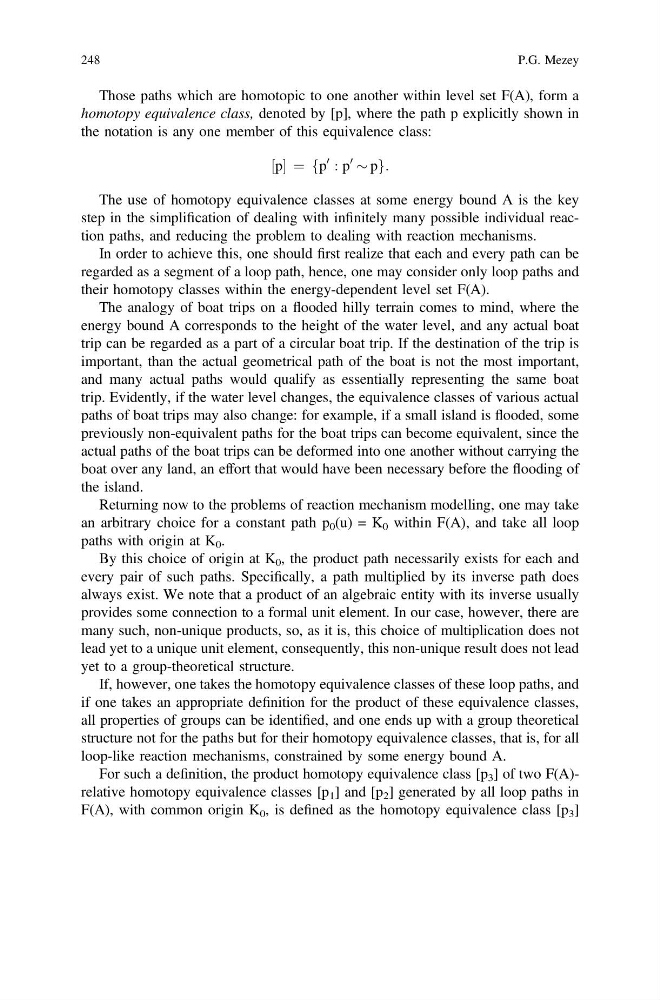
Those paths which are homotopic to one another within level set F(A), form a
homotopy equivalence class, denoted by [p], where the path p explicitly shown in
the notation is any one member of this equivalence class:
p
½ ¼ p
0
: p
0
$ p
f
g :
The use of homotopy equivalence classes at some energy bound A is the key
step in the simplification of dealing with infinitely many possible individual reaction paths, and reducing the problem to dealing with reaction mechanisms.
In order to achieve this, one should first realize that each and every path can be
regarded as a segment of a loop path, hence, one may consider only loop paths and
their homotopy classes within the energy-dependent level set F(A).
The analogy of boat trips on a flooded hilly terrain comes to mind, where the
energy bound A corresponds to the height of the water level, and any actual boat
trip can be regarded as a part of a circular boat trip. If the destination of the trip is
important, than the actual geometrical path of the boat is not the most important,
and many actual paths would qualify as essentially representing the same boat
trip. Evidently, if the water level changes, the equivalence classes of various actual
paths of boat trips may also change: for example, if a small island is flooded, some
previously non-equivalent paths for the boat trips can become equivalent, since the
actual paths of the boat trips can be deformed into one another without carrying the
boat over any land, an effort that would have been necessary before the flooding of
the island.
Returning now to the problems of reaction mechanism modelling, one may take
an arbitrary choice for a constant path p 0 (u) = K 0 within F(A), and take all loop
paths with origin at K 0 .
By this choice of origin at K 0 , the product path necessarily exists for each and
every pair of such paths. Specifically, a path multiplied by its inverse path does
always exist. We note that a product of an algebraic entity with its inverse usually
provides some connection to a formal unit element. In our case, however, there are
many such, non-unique products, so, as it is, this choice of multiplication does not
lead yet to a unique unit element, consequently, this non-unique result does not lead
yet to a group-theoretical structure.
If, however, one takes the homotopy equivalence classes of these loop paths, and
if one takes an appropriate definition for the product of these equivalence classes,
all properties of groups can be identified, and one ends up with a group theoretical
structure not for the paths but for their homotopy equivalence classes, that is, for all
loop-like reaction mechanisms, constrained by some energy bound A.
For such a definition, the product homotopy equivalence class [p 3 ] of two F(A)relative homotopy equivalence classes [p 1 ] and [p 2 ] generated by all loop paths in
F(A), with common origin K 0 , is defined as the homotopy equivalence class [p 3 ]
248
P.G. Mezey
homotopy equivalence class, denoted by [p], where the path p explicitly shown in
the notation is any one member of this equivalence class:
p
½ ¼ p
0
: p
0
$ p
f
g :
The use of homotopy equivalence classes at some energy bound A is the key
step in the simplification of dealing with infinitely many possible individual reaction paths, and reducing the problem to dealing with reaction mechanisms.
In order to achieve this, one should first realize that each and every path can be
regarded as a segment of a loop path, hence, one may consider only loop paths and
their homotopy classes within the energy-dependent level set F(A).
The analogy of boat trips on a flooded hilly terrain comes to mind, where the
energy bound A corresponds to the height of the water level, and any actual boat
trip can be regarded as a part of a circular boat trip. If the destination of the trip is
important, than the actual geometrical path of the boat is not the most important,
and many actual paths would qualify as essentially representing the same boat
trip. Evidently, if the water level changes, the equivalence classes of various actual
paths of boat trips may also change: for example, if a small island is flooded, some
previously non-equivalent paths for the boat trips can become equivalent, since the
actual paths of the boat trips can be deformed into one another without carrying the
boat over any land, an effort that would have been necessary before the flooding of
the island.
Returning now to the problems of reaction mechanism modelling, one may take
an arbitrary choice for a constant path p 0 (u) = K 0 within F(A), and take all loop
paths with origin at K 0 .
By this choice of origin at K 0 , the product path necessarily exists for each and
every pair of such paths. Specifically, a path multiplied by its inverse path does
always exist. We note that a product of an algebraic entity with its inverse usually
provides some connection to a formal unit element. In our case, however, there are
many such, non-unique products, so, as it is, this choice of multiplication does not
lead yet to a unique unit element, consequently, this non-unique result does not lead
yet to a group-theoretical structure.
If, however, one takes the homotopy equivalence classes of these loop paths, and
if one takes an appropriate definition for the product of these equivalence classes,
all properties of groups can be identified, and one ends up with a group theoretical
structure not for the paths but for their homotopy equivalence classes, that is, for all
loop-like reaction mechanisms, constrained by some energy bound A.
For such a definition, the product homotopy equivalence class [p 3 ] of two F(A)relative homotopy equivalence classes [p 1 ] and [p 2 ] generated by all loop paths in
F(A), with common origin K 0 , is defined as the homotopy equivalence class [p 3 ]
248
P.G. Mezey