

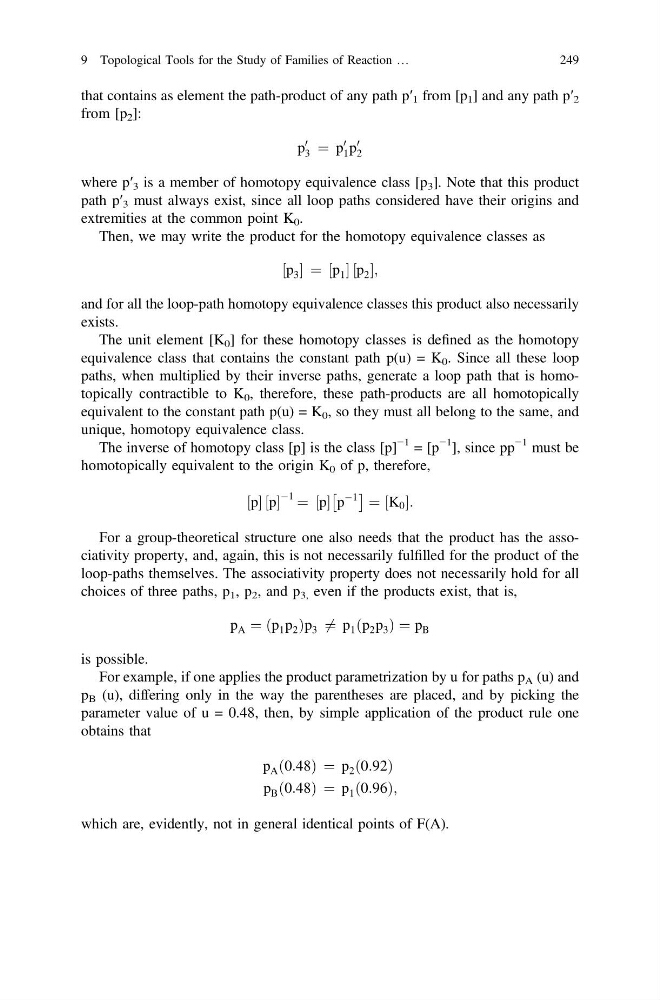
that contains as element the path-product of any path p′ 1 from [p 1 ] and any path p′ 2
from [p 2 ]:
p
0
3 ¼ p
0
1 p
0
2
where p′ 3 is a member of homotopy equivalence class [p 3 ]. Note that this product
path p′ 3 must always exist, since all loop paths considered have their origins and
extremities at the common point K 0 .
Then, we may write the product for the homotopy equivalence classes as
p 3
½ ¼ p 1
½ p 2
½ ;
and for all the loop-path homotopy equivalence classes this product also necessarily
exists.
The unit element [K 0 ] for these homotopy classes is defined as the homotopy
equivalence class that contains the constant path p(u) = K 0 . Since all these loop
paths, when multiplied by their inverse paths, generate a loop path that is homotopically contractible to K 0 , therefore, these path-products are all homotopically
equivalent to the constant path p(u) = K 0 , so they must all belong to the same, and
unique, homotopy equivalence class.
The inverse of homotopy class [p] is the class [p]
−1 = [p
−1 ], since pp
−1 must be
homotopically equivalent to the origin K 0 of p, therefore,
p
½ p
½
À1 ¼ p
½ p
À1
 à ¼ K 0
½ :
For a group-theoretical structure one also needs that the product has the associativity property, and, again, this is not necessarily fulfilled for the product of the
loop-paths themselves. The associativity property does not necessarily hold for all
choices of three paths, p 1 , p 2 , and p 3, even if the products exist, that is,
p A ¼ p 1 p 2
ð
Þp 3 6 ¼ p 1 p 2 p 3
ð
Þ ¼ p B
is possible.
For example, if one applies the product parametrization by u for paths p A (u) and
p B (u), differing only in the way the parentheses are placed, and by picking the
parameter value of u = 0.48, then, by simple application of the product rule one
obtains that
p A 0:48
ð
Þ ¼ p 2 0:92
ð
Þ
p B 0:48
ð
Þ ¼ p 1 0:96
ð
Þ;
which are, evidently, not in general identical points of F(A).
9 Topological Tools for the Study of Families of Reaction …
249
from [p 2 ]:
p
0
3 ¼ p
0
1 p
0
2
where p′ 3 is a member of homotopy equivalence class [p 3 ]. Note that this product
path p′ 3 must always exist, since all loop paths considered have their origins and
extremities at the common point K 0 .
Then, we may write the product for the homotopy equivalence classes as
p 3
½ ¼ p 1
½ p 2
½ ;
and for all the loop-path homotopy equivalence classes this product also necessarily
exists.
The unit element [K 0 ] for these homotopy classes is defined as the homotopy
equivalence class that contains the constant path p(u) = K 0 . Since all these loop
paths, when multiplied by their inverse paths, generate a loop path that is homotopically contractible to K 0 , therefore, these path-products are all homotopically
equivalent to the constant path p(u) = K 0 , so they must all belong to the same, and
unique, homotopy equivalence class.
The inverse of homotopy class [p] is the class [p]
−1 = [p
−1 ], since pp
−1 must be
homotopically equivalent to the origin K 0 of p, therefore,
p
½ p
½
À1 ¼ p
½ p
À1
 à ¼ K 0
½ :
For a group-theoretical structure one also needs that the product has the associativity property, and, again, this is not necessarily fulfilled for the product of the
loop-paths themselves. The associativity property does not necessarily hold for all
choices of three paths, p 1 , p 2 , and p 3, even if the products exist, that is,
p A ¼ p 1 p 2
ð
Þp 3 6 ¼ p 1 p 2 p 3
ð
Þ ¼ p B
is possible.
For example, if one applies the product parametrization by u for paths p A (u) and
p B (u), differing only in the way the parentheses are placed, and by picking the
parameter value of u = 0.48, then, by simple application of the product rule one
obtains that
p A 0:48
ð
Þ ¼ p 2 0:92
ð
Þ
p B 0:48
ð
Þ ¼ p 1 0:96
ð
Þ;
which are, evidently, not in general identical points of F(A).
9 Topological Tools for the Study of Families of Reaction …
249