

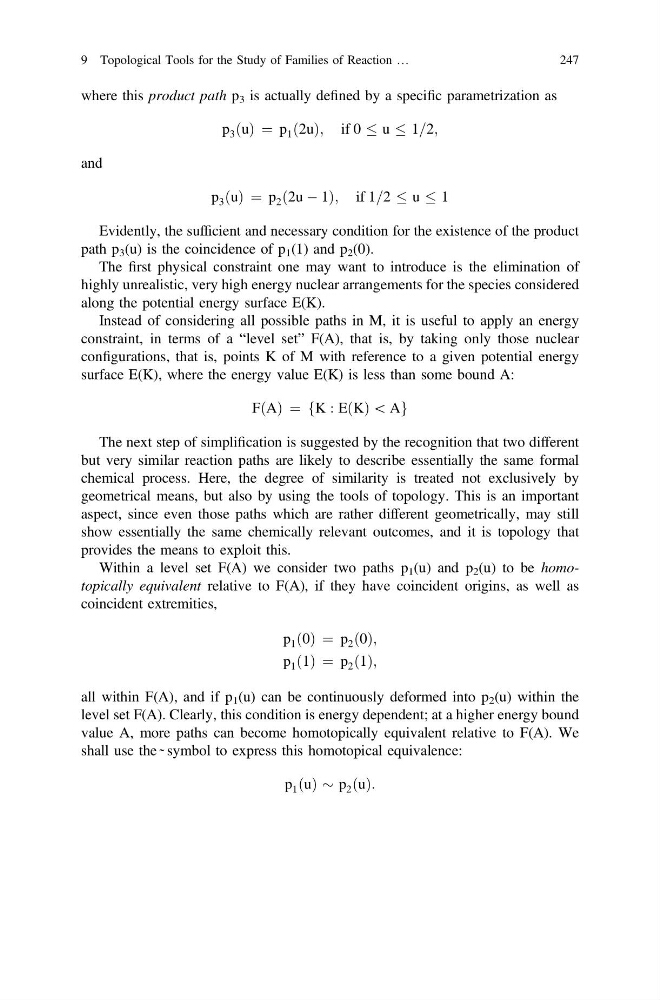
where this product path p 3 is actually defined by a specific parametrization as
p 3 u
ð Þ ¼ p 1 2u
ð Þ; if 0 u 1=2;
and
p 3 u
ð Þ ¼ p 2 2u À 1
ð
Þ; if 1=2 u 1
Evidently, the sufficient and necessary condition for the existence of the product
path p 3 (u) is the coincidence of p 1 (1) and p 2 (0).
The first physical constraint one may want to introduce is the elimination of
highly unrealistic, very high energy nuclear arrangements for the species considered
along the potential energy surface E(K).
Instead of considering all possible paths in M, it is useful to apply an energy
constraint, in terms of a “level set” F(A), that is, by taking only those nuclear
configurations, that is, points K of M with reference to a given potential energy
surface E(K), where the energy value E(K) is less than some bound A:
F A
ð Þ ¼ K : E K
ð Þ \ A
f
g
The next step of simplification is suggested by the recognition that two different
but very similar reaction paths are likely to describe essentially the same formal
chemical process. Here, the degree of similarity is treated not exclusively by
geometrical means, but also by using the tools of topology. This is an important
aspect, since even those paths which are rather different geometrically, may still
show essentially the same chemically relevant outcomes, and it is topology that
provides the means to exploit this.
Within a level set F(A) we consider two paths p 1 (u) and p 2 (u) to be homotopically equivalent relative to F(A), if they have coincident origins, as well as
coincident extremities,
p 1 0
ð Þ ¼ p 2 0
ð Þ;
p 1 1
ð Þ ¼ p 2 1
ð Þ;
all within F(A), and if p 1 (u) can be continuously deformed into p 2 (u) within the
level set F(A). Clearly, this condition is energy dependent; at a higher energy bound
value A, more paths can become homotopically equivalent relative to F(A). We
shall use the ̴ symbol to express this homotopical equivalence:
p 1 u
ð Þ $ p 2 u
ð Þ:
9 Topological Tools for the Study of Families of Reaction …
247
p 3 u
ð Þ ¼ p 1 2u
ð Þ; if 0 u 1=2;
and
p 3 u
ð Þ ¼ p 2 2u À 1
ð
Þ; if 1=2 u 1
Evidently, the sufficient and necessary condition for the existence of the product
path p 3 (u) is the coincidence of p 1 (1) and p 2 (0).
The first physical constraint one may want to introduce is the elimination of
highly unrealistic, very high energy nuclear arrangements for the species considered
along the potential energy surface E(K).
Instead of considering all possible paths in M, it is useful to apply an energy
constraint, in terms of a “level set” F(A), that is, by taking only those nuclear
configurations, that is, points K of M with reference to a given potential energy
surface E(K), where the energy value E(K) is less than some bound A:
F A
ð Þ ¼ K : E K
ð Þ \ A
f
g
The next step of simplification is suggested by the recognition that two different
but very similar reaction paths are likely to describe essentially the same formal
chemical process. Here, the degree of similarity is treated not exclusively by
geometrical means, but also by using the tools of topology. This is an important
aspect, since even those paths which are rather different geometrically, may still
show essentially the same chemically relevant outcomes, and it is topology that
provides the means to exploit this.
Within a level set F(A) we consider two paths p 1 (u) and p 2 (u) to be homotopically equivalent relative to F(A), if they have coincident origins, as well as
coincident extremities,
p 1 0
ð Þ ¼ p 2 0
ð Þ;
p 1 1
ð Þ ¼ p 2 1
ð Þ;
all within F(A), and if p 1 (u) can be continuously deformed into p 2 (u) within the
level set F(A). Clearly, this condition is energy dependent; at a higher energy bound
value A, more paths can become homotopically equivalent relative to F(A). We
shall use the ̴ symbol to express this homotopical equivalence:
p 1 u
ð Þ $ p 2 u
ð Þ:
9 Topological Tools for the Study of Families of Reaction …
247