

clusters, in singlet and triplet ground state multiplicities, as building blocks. The
reasoning of this strategy is simple; the integral of the Fukui function in each basin is
a measure of the “abundance” of it around the attractor associated to the basin. It is
therefore reasonable to assume that at a given distance between the fragments, an
assembling of them that makes small the total distance between the attractors corresponding to the more populated basins (f k large) translates into a large overlap of
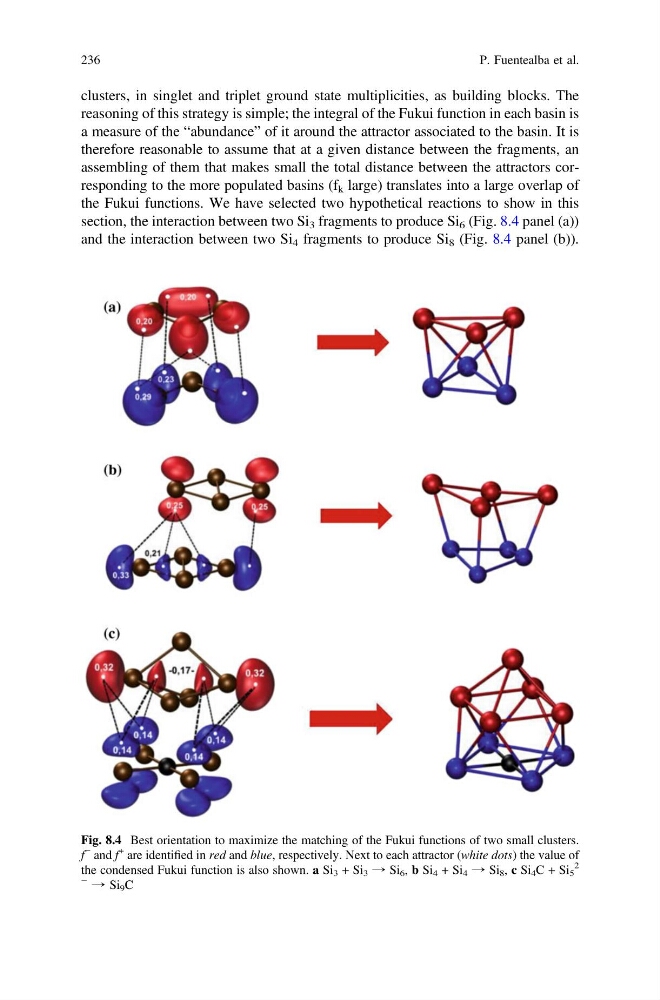
the Fukui functions. We have selected two hypothetical reactions to show in this
section, the interaction between two Si 3 fragments to produce Si 6 (Fig. 8.4 panel (a))
and the interaction between two Si 4 fragments to produce Si 8 (Fig. 8.4 panel (b)).
Fig. 8.4 Best orientation to maximize the matching of the Fukui functions of two small clusters.
f
− and f
+ are identified in red and blue, respectively. Next to each attractor (white dots) the value of
the condensed Fukui function is also shown. a Si 3 + Si 3 → Si 6 , b Si 4 + Si 4 → Si 8 , c Si 4 C + Si 5
2
− → Si 9 C
236
P. Fuentealba et al.
reasoning of this strategy is simple; the integral of the Fukui function in each basin is
a measure of the “abundance” of it around the attractor associated to the basin. It is
therefore reasonable to assume that at a given distance between the fragments, an
assembling of them that makes small the total distance between the attractors corresponding to the more populated basins (f k large) translates into a large overlap of
the Fukui functions. We have selected two hypothetical reactions to show in this
section, the interaction between two Si 3 fragments to produce Si 6 (Fig. 8.4 panel (a))
and the interaction between two Si 4 fragments to produce Si 8 (Fig. 8.4 panel (b)).
Fig. 8.4 Best orientation to maximize the matching of the Fukui functions of two small clusters.
f
− and f
+ are identified in red and blue, respectively. Next to each attractor (white dots) the value of
the condensed Fukui function is also shown. a Si 3 + Si 3 → Si 6 , b Si 4 + Si 4 → Si 8 , c Si 4 C + Si 5
2
− → Si 9 C
236
P. Fuentealba et al.