

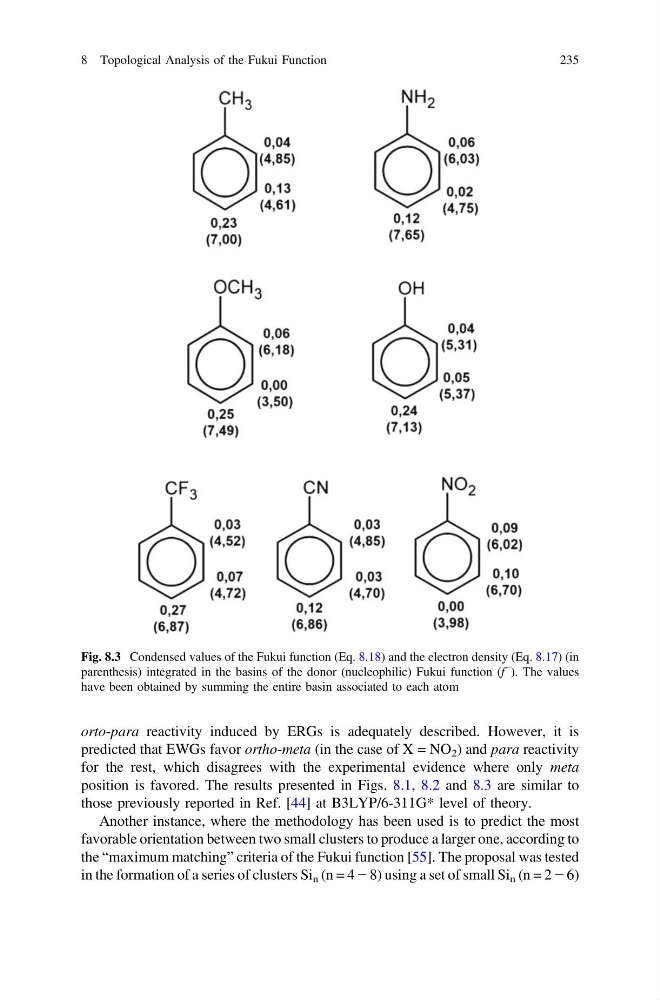
orto-para reactivity induced by ERGs is adequately described. However, it is
predicted that EWGs favor ortho-meta (in the case of X = NO 2 ) and para reactivity
for the rest, which disagrees with the experimental evidence where only meta
position is favored. The results presented in Figs. 8.1, 8.2 and 8.3 are similar to
those previously reported in Ref. [44] at B3LYP/6-311G* level of theory.
Another instance, where the methodology has been used is to predict the most
favorable orientation between two small clusters to produce a larger one, according to
the “maximum matching” criteria of the Fukui function [55]. The proposal was tested
in the formation of a series of clusters Si n (n = 4 − 8) using a set of small Si n (n = 2 − 6)
Fig. 8.3 Condensed values of the Fukui function (Eq. 8.18) and the electron density (Eq. 8.17) (in
parenthesis) integrated in the basins of the donor (nucleophilic) Fukui function (f
−
). The values
have been obtained by summing the entire basin associated to each atom
8 Topological Analysis of the Fukui Function
235
predicted that EWGs favor ortho-meta (in the case of X = NO 2 ) and para reactivity
for the rest, which disagrees with the experimental evidence where only meta
position is favored. The results presented in Figs. 8.1, 8.2 and 8.3 are similar to
those previously reported in Ref. [44] at B3LYP/6-311G* level of theory.
Another instance, where the methodology has been used is to predict the most
favorable orientation between two small clusters to produce a larger one, according to
the “maximum matching” criteria of the Fukui function [55]. The proposal was tested
in the formation of a series of clusters Si n (n = 4 − 8) using a set of small Si n (n = 2 − 6)
Fig. 8.3 Condensed values of the Fukui function (Eq. 8.18) and the electron density (Eq. 8.17) (in
parenthesis) integrated in the basins of the donor (nucleophilic) Fukui function (f
−
). The values
have been obtained by summing the entire basin associated to each atom
8 Topological Analysis of the Fukui Function
235