

In the complete set of LAs these basins are symmetric and located above and below
the atom, perpendicular to the molecular plane. This reactivity description predicts
equal probability of being attacked by a nucleophile from above or below. The
same could be extrapolated for LBs H 2 O and H 2 S, but in these cases the reactivity
should describe an electrophilic attack. In cases where this does not happen, as in
NH 3 and HONH 2 , there is a clear chemical interpretation: it is expected that
nucleophiles will primarily be attacked in the lone pair of the N.
Electrophilic aromatic substitution (EAS) reactions are among the most thoroughly studied classes of organic reactions from a mechanistic point of view.
Therefore, even though they are classic and widely used as reference, they are still
an adequate starting point for evaluate any local descriptor of reactivity. Such
reactions have been rationalized using empirical reactivity rules derived from resonance theory [52], methods based on the frontier molecular orbitals (FMOs)
theory, and electrostatic potentials [53]. The isosurfaces and condensed values for
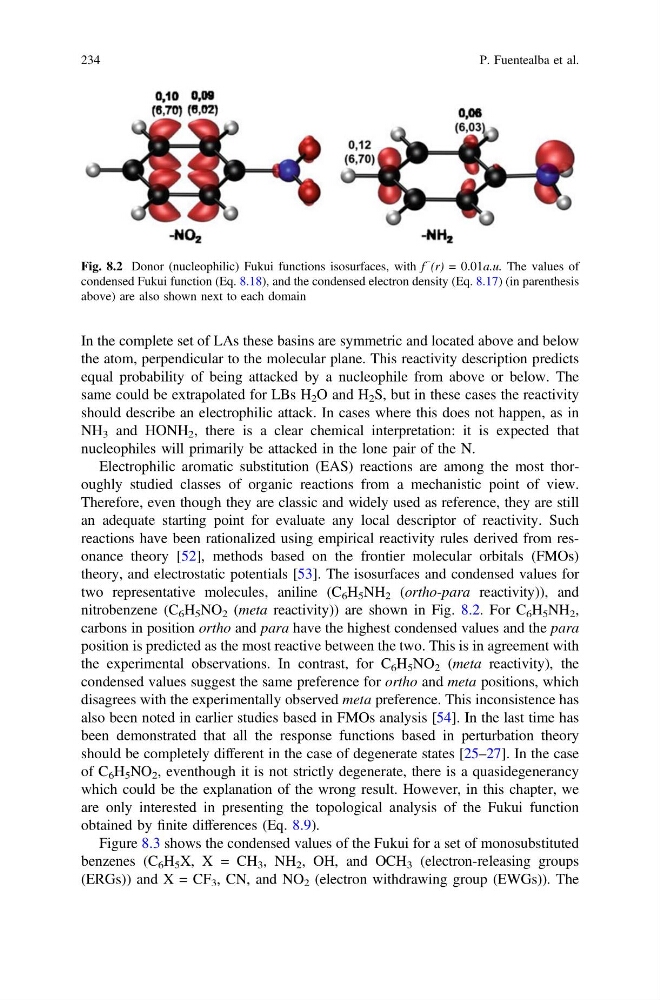
two representative molecules, aniline (C 6 H 5 NH 2 (ortho-para reactivity)), and
nitrobenzene (C 6 H 5 NO 2 (meta reactivity)) are shown in Fig. 8.2. For C 6 H 5 NH 2 ,
carbons in position ortho and para have the highest condensed values and the para
position is predicted as the most reactive between the two. This is in agreement with
the experimental observations. In contrast, for C 6 H 5 NO 2 (meta reactivity), the
condensed values suggest the same preference for ortho and meta positions, which
disagrees with the experimentally observed meta preference. This inconsistence has
also been noted in earlier studies based in FMOs analysis [54]. In the last time has
been demonstrated that all the response functions based in perturbation theory
should be completely different in the case of degenerate states [25–27]. In the case
of C 6 H 5 NO 2 , eventhough it is not strictly degenerate, there is a quasidegenerancy
which could be the explanation of the wrong result. However, in this chapter, we
are only interested in presenting the topological analysis of the Fukui function
obtained by finite differences (Eq. 8.9).
Figure 8.3 shows the condensed values of the Fukui for a set of monosubstituted
benzenes (C 6 H 5 X, X = CH 3 , NH 2 , OH, and OCH 3 (electron-releasing groups
(ERGs)) and X = CF 3 , CN, and NO 2 (electron withdrawing group (EWGs)). The
Fig. 8.2 Donor (nucleophilic) Fukui functions isosurfaces, with f
− (r) = 0.01a.u. The values of
condensed Fukui function (Eq. 8.18), and the condensed electron density (Eq. 8.17) (in parenthesis
above) are also shown next to each domain
234
P. Fuentealba et al.
the atom, perpendicular to the molecular plane. This reactivity description predicts
equal probability of being attacked by a nucleophile from above or below. The
same could be extrapolated for LBs H 2 O and H 2 S, but in these cases the reactivity
should describe an electrophilic attack. In cases where this does not happen, as in
NH 3 and HONH 2 , there is a clear chemical interpretation: it is expected that
nucleophiles will primarily be attacked in the lone pair of the N.
Electrophilic aromatic substitution (EAS) reactions are among the most thoroughly studied classes of organic reactions from a mechanistic point of view.
Therefore, even though they are classic and widely used as reference, they are still
an adequate starting point for evaluate any local descriptor of reactivity. Such
reactions have been rationalized using empirical reactivity rules derived from resonance theory [52], methods based on the frontier molecular orbitals (FMOs)
theory, and electrostatic potentials [53]. The isosurfaces and condensed values for
two representative molecules, aniline (C 6 H 5 NH 2 (ortho-para reactivity)), and
nitrobenzene (C 6 H 5 NO 2 (meta reactivity)) are shown in Fig. 8.2. For C 6 H 5 NH 2 ,
carbons in position ortho and para have the highest condensed values and the para
position is predicted as the most reactive between the two. This is in agreement with
the experimental observations. In contrast, for C 6 H 5 NO 2 (meta reactivity), the
condensed values suggest the same preference for ortho and meta positions, which
disagrees with the experimentally observed meta preference. This inconsistence has
also been noted in earlier studies based in FMOs analysis [54]. In the last time has
been demonstrated that all the response functions based in perturbation theory
should be completely different in the case of degenerate states [25–27]. In the case
of C 6 H 5 NO 2 , eventhough it is not strictly degenerate, there is a quasidegenerancy
which could be the explanation of the wrong result. However, in this chapter, we
are only interested in presenting the topological analysis of the Fukui function
obtained by finite differences (Eq. 8.9).
Figure 8.3 shows the condensed values of the Fukui for a set of monosubstituted
benzenes (C 6 H 5 X, X = CH 3 , NH 2 , OH, and OCH 3 (electron-releasing groups
(ERGs)) and X = CF 3 , CN, and NO 2 (electron withdrawing group (EWGs)). The
Fig. 8.2 Donor (nucleophilic) Fukui functions isosurfaces, with f
− (r) = 0.01a.u. The values of
condensed Fukui function (Eq. 8.18), and the condensed electron density (Eq. 8.17) (in parenthesis
above) are also shown next to each domain
234
P. Fuentealba et al.