

performed using the PBE0 [48] functional and the 6-311G* basis set implemented
in the G09 package of programs [49]. For topological analysis, we have used the
Multiwfn program [50] and the isosurfaces have been plotted with VMD 1.9.1
visualization software [51].
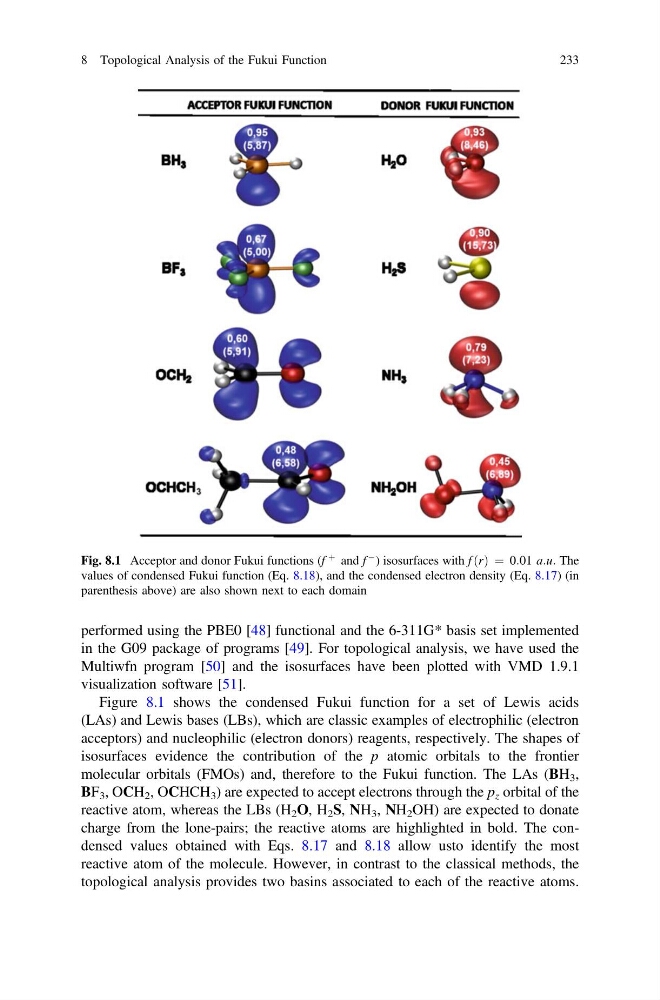
Figure 8.1 shows the condensed Fukui function for a set of Lewis acids
(LAs) and Lewis bases (LBs), which are classic examples of electrophilic (electron
acceptors) and nucleophilic (electron donors) reagents, respectively. The shapes of
isosurfaces evidence the contribution of the p atomic orbitals to the frontier
molecular orbitals (FMOs) and, therefore to the Fukui function. The LAs (BH 3 ,
BF 3 , OCH 2 , OCHCH 3 ) are expected to accept electrons through the p z orbital of the
reactive atom, whereas the LBs (H 2 O, H 2 S, NH 3 , NH 2 OH) are expected to donate
charge from the lone-pairs; the reactive atoms are highlighted in bold. The condensed values obtained with Eqs. 8.17 and 8.18 allow usto identify the most
reactive atom of the molecule. However, in contrast to the classical methods, the
topological analysis provides two basins associated to each of the reactive atoms.
Fig. 8.1 Acceptor and donor Fukui functions (f
þ and f
À ) isosurfaces with f ðrÞ ¼ 0:01 a:u: The
values of condensed Fukui function (Eq. 8.18), and the condensed electron density (Eq. 8.17) (in
parenthesis above) are also shown next to each domain
8 Topological Analysis of the Fukui Function
233
in the G09 package of programs [49]. For topological analysis, we have used the
Multiwfn program [50] and the isosurfaces have been plotted with VMD 1.9.1
visualization software [51].
Figure 8.1 shows the condensed Fukui function for a set of Lewis acids
(LAs) and Lewis bases (LBs), which are classic examples of electrophilic (electron
acceptors) and nucleophilic (electron donors) reagents, respectively. The shapes of
isosurfaces evidence the contribution of the p atomic orbitals to the frontier
molecular orbitals (FMOs) and, therefore to the Fukui function. The LAs (BH 3 ,
BF 3 , OCH 2 , OCHCH 3 ) are expected to accept electrons through the p z orbital of the
reactive atom, whereas the LBs (H 2 O, H 2 S, NH 3 , NH 2 OH) are expected to donate
charge from the lone-pairs; the reactive atoms are highlighted in bold. The condensed values obtained with Eqs. 8.17 and 8.18 allow usto identify the most
reactive atom of the molecule. However, in contrast to the classical methods, the
topological analysis provides two basins associated to each of the reactive atoms.
Fig. 8.1 Acceptor and donor Fukui functions (f
þ and f
À ) isosurfaces with f ðrÞ ¼ 0:01 a:u: The
values of condensed Fukui function (Eq. 8.18), and the condensed electron density (Eq. 8.17) (in
parenthesis above) are also shown next to each domain
8 Topological Analysis of the Fukui Function
233