

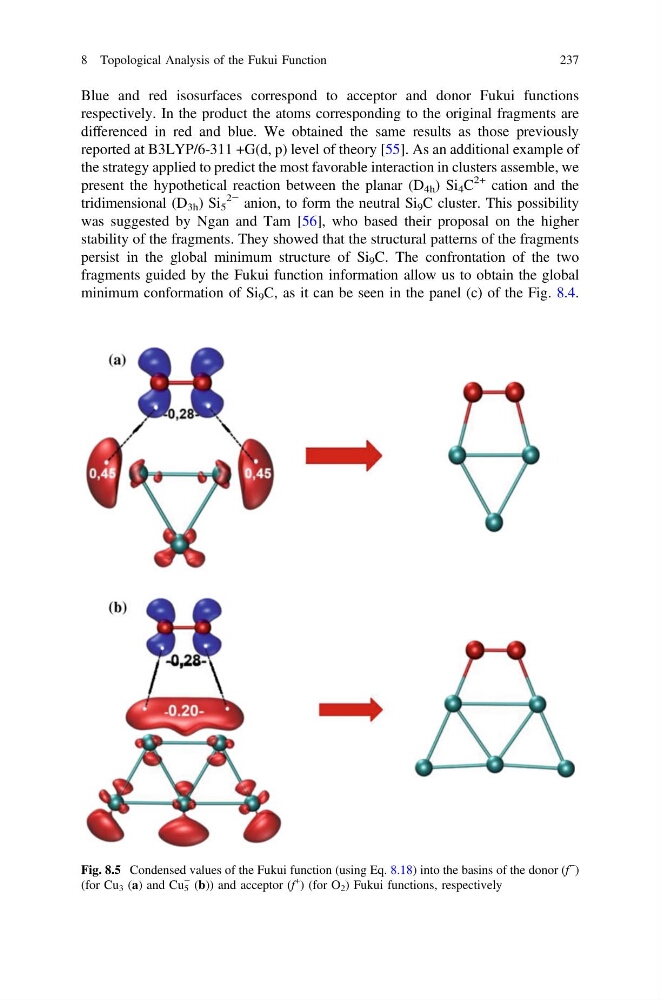
Blue and red isosurfaces correspond to acceptor and donor Fukui functions
respectively. In the product the atoms corresponding to the original fragments are
differenced in red and blue. We obtained the same results as those previously
reported at B3LYP/6-311 +G(d, p) level of theory [55]. As an additional example of
the strategy applied to predict the most favorable interaction in clusters assemble, we
present the hypothetical reaction between the planar (D 4h ) Si 4 C
2+ cation and the
tridimensional (D 3h ) Si 5
2− anion, to form the neutral Si 9 C cluster. This possibility
was suggested by Ngan and Tam [56], who based their proposal on the higher
stability of the fragments. They showed that the structural patterns of the fragments
persist in the global minimum structure of Si 9 C. The confrontation of the two
fragments guided by the Fukui function information allow us to obtain the global
minimum conformation of Si 9 C, as it can be seen in the panel (c) of the Fig. 8.4.
Fig. 8.5 Condensed values of the Fukui function (using Eq. 8.18) into the basins of the donor (f
−
)
(for Cu 3 (a) and Cu 5
− (b)) and acceptor (f
+ ) (for O 2 ) Fukui functions, respectively
8 Topological Analysis of the Fukui Function
237
respectively. In the product the atoms corresponding to the original fragments are
differenced in red and blue. We obtained the same results as those previously
reported at B3LYP/6-311 +G(d, p) level of theory [55]. As an additional example of
the strategy applied to predict the most favorable interaction in clusters assemble, we
present the hypothetical reaction between the planar (D 4h ) Si 4 C
2+ cation and the
tridimensional (D 3h ) Si 5
2− anion, to form the neutral Si 9 C cluster. This possibility
was suggested by Ngan and Tam [56], who based their proposal on the higher
stability of the fragments. They showed that the structural patterns of the fragments
persist in the global minimum structure of Si 9 C. The confrontation of the two
fragments guided by the Fukui function information allow us to obtain the global
minimum conformation of Si 9 C, as it can be seen in the panel (c) of the Fig. 8.4.
Fig. 8.5 Condensed values of the Fukui function (using Eq. 8.18) into the basins of the donor (f
−
)
(for Cu 3 (a) and Cu 5
− (b)) and acceptor (f
+ ) (for O 2 ) Fukui functions, respectively
8 Topological Analysis of the Fukui Function
237