

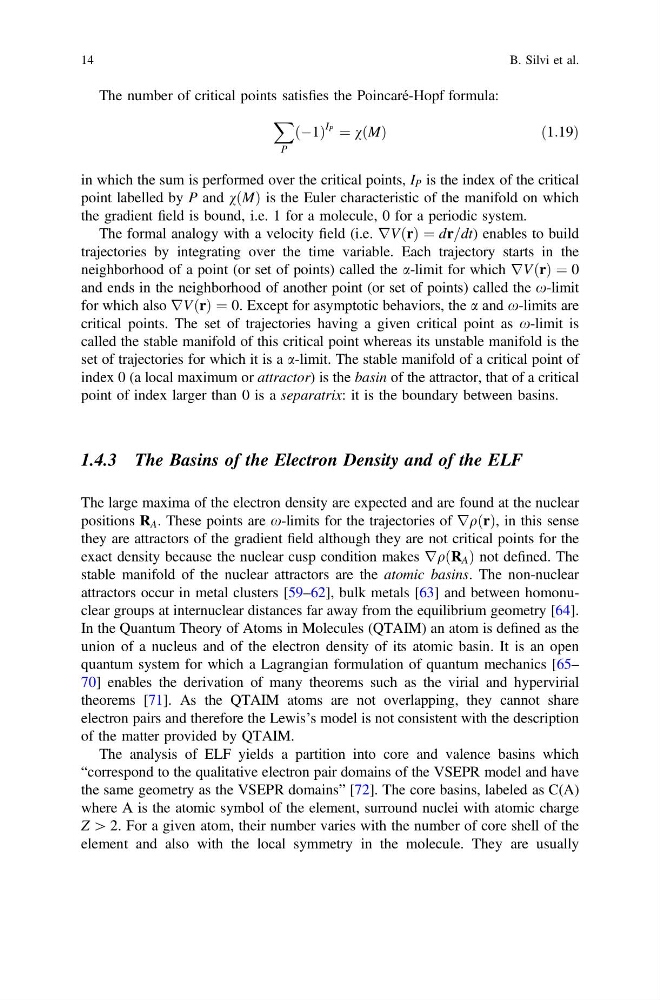
The number of critical points satisfies the Poincaré-Hopf formula:
X
P
ðÀ1Þ
I P
¼ vðMÞ
ð 1:19Þ
in which the sum is performed over the critical points, I P is the index of the critical
point labelled by P and vðMÞ is the Euler characteristic of the manifold on which
the gradient field is bound, i.e. 1 for a molecule, 0 for a periodic system.
The formal analogy with a velocity field (i.e. rVðrÞ ¼ dr=dt) enables to build
trajectories by integrating over the time variable. Each trajectory starts in the
neighborhood of a point (or set of points) called the a-limit for which rVðrÞ ¼ 0
and ends in the neighborhood of another point (or set of points) called the x-limit
for which also rVðrÞ ¼ 0. Except for asymptotic behaviors, the a and x-limits are
critical points. The set of trajectories having a given critical point as x-limit is
called the stable manifold of this critical point whereas its unstable manifold is the
set of trajectories for which it is a a-limit. The stable manifold of a critical point of
index 0 (a local maximum or attractor) is the basin of the attractor, that of a critical
point of index larger than 0 is a separatrix: it is the boundary between basins.
1.4.3 The Basins of the Electron Density and of the ELF
The large maxima of the electron density are expected and are found at the nuclear
positions R A . These points are x-limits for the trajectories of rqðrÞ, in this sense
they are attractors of the gradient field although they are not critical points for the
exact density because the nuclear cusp condition makes rqðR A Þ not defined. The
stable manifold of the nuclear attractors are the atomic basins. The non-nuclear
attractors occur in metal clusters [59–62], bulk metals [63] and between homonuclear groups at internuclear distances far away from the equilibrium geometry [64].
In the Quantum Theory of Atoms in Molecules (QTAIM) an atom is defined as the
union of a nucleus and of the electron density of its atomic basin. It is an open
quantum system for which a Lagrangian formulation of quantum mechanics [65–
70] enables the derivation of many theorems such as the virial and hypervirial
theorems [71]. As the QTAIM atoms are not overlapping, they cannot share
electron pairs and therefore the Lewis’s model is not consistent with the description
of the matter provided by QTAIM.
The analysis of ELF yields a partition into core and valence basins which
“correspond to the qualitative electron pair domains of the VSEPR model and have
the same geometry as the VSEPR domains” [72]. The core basins, labeled as C(A)
where A is the atomic symbol of the element, surround nuclei with atomic charge
Z [ 2. For a given atom, their number varies with the number of core shell of the
element and also with the local symmetry in the molecule. They are usually
14
B. Silvi et al.
X
P
ðÀ1Þ
I P
¼ vðMÞ
ð 1:19Þ
in which the sum is performed over the critical points, I P is the index of the critical
point labelled by P and vðMÞ is the Euler characteristic of the manifold on which
the gradient field is bound, i.e. 1 for a molecule, 0 for a periodic system.
The formal analogy with a velocity field (i.e. rVðrÞ ¼ dr=dt) enables to build
trajectories by integrating over the time variable. Each trajectory starts in the
neighborhood of a point (or set of points) called the a-limit for which rVðrÞ ¼ 0
and ends in the neighborhood of another point (or set of points) called the x-limit
for which also rVðrÞ ¼ 0. Except for asymptotic behaviors, the a and x-limits are
critical points. The set of trajectories having a given critical point as x-limit is
called the stable manifold of this critical point whereas its unstable manifold is the
set of trajectories for which it is a a-limit. The stable manifold of a critical point of
index 0 (a local maximum or attractor) is the basin of the attractor, that of a critical
point of index larger than 0 is a separatrix: it is the boundary between basins.
1.4.3 The Basins of the Electron Density and of the ELF
The large maxima of the electron density are expected and are found at the nuclear
positions R A . These points are x-limits for the trajectories of rqðrÞ, in this sense
they are attractors of the gradient field although they are not critical points for the
exact density because the nuclear cusp condition makes rqðR A Þ not defined. The
stable manifold of the nuclear attractors are the atomic basins. The non-nuclear
attractors occur in metal clusters [59–62], bulk metals [63] and between homonuclear groups at internuclear distances far away from the equilibrium geometry [64].
In the Quantum Theory of Atoms in Molecules (QTAIM) an atom is defined as the
union of a nucleus and of the electron density of its atomic basin. It is an open
quantum system for which a Lagrangian formulation of quantum mechanics [65–
70] enables the derivation of many theorems such as the virial and hypervirial
theorems [71]. As the QTAIM atoms are not overlapping, they cannot share
electron pairs and therefore the Lewis’s model is not consistent with the description
of the matter provided by QTAIM.
The analysis of ELF yields a partition into core and valence basins which
“correspond to the qualitative electron pair domains of the VSEPR model and have
the same geometry as the VSEPR domains” [72]. The core basins, labeled as C(A)
where A is the atomic symbol of the element, surround nuclei with atomic charge
Z [ 2. For a given atom, their number varies with the number of core shell of the
element and also with the local symmetry in the molecule. They are usually
14
B. Silvi et al.