

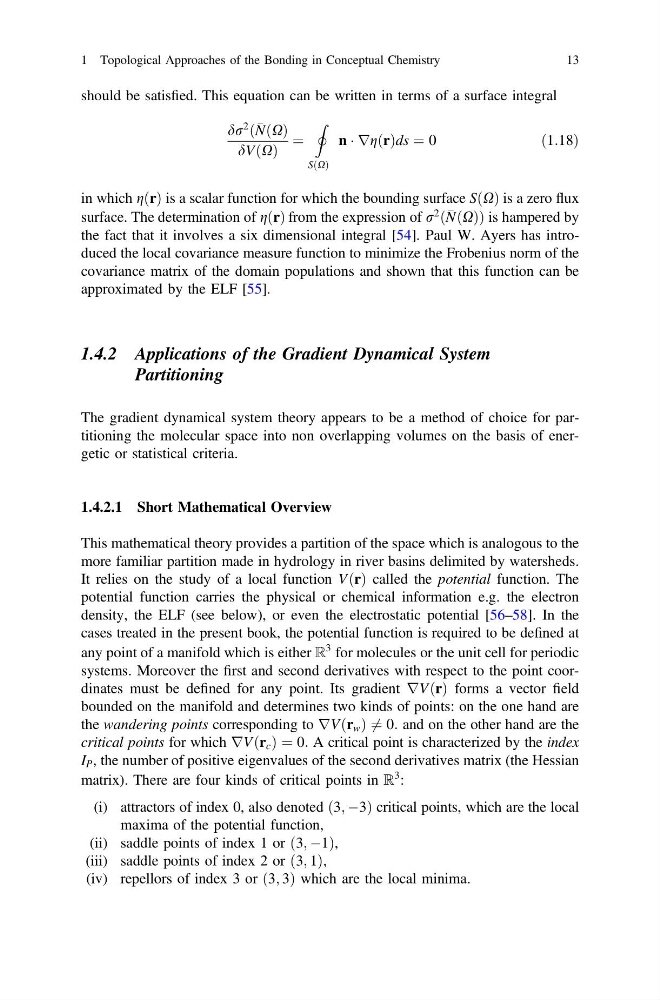
should be satisfied. This equation can be written in terms of a surface integral
dr
2
ð
NðXÞ
dVðXÞ
¼
I
SðXÞ
n Á rgðrÞds ¼ 0
ð1:18Þ
in which gðrÞ is a scalar function for which the bounding surface SðXÞ is a zero flux
surface. The determination of gðrÞ from the expression of r
2
ð
NðXÞÞ is hampered by
the fact that it involves a six dimensional integral [54]. Paul W. Ayers has introduced the local covariance measure function to minimize the Frobenius norm of the
covariance matrix of the domain populations and shown that this function can be
approximated by the ELF [55].
1.4.2 Applications of the Gradient Dynamical System
Partitioning
The gradient dynamical system theory appears to be a method of choice for partitioning the molecular space into non overlapping volumes on the basis of energetic or statistical criteria.
1.4.2.1 Short Mathematical Overview
This mathematical theory provides a partition of the space which is analogous to the
more familiar partition made in hydrology in river basins delimited by watersheds.
It relies on the study of a local function VðrÞ called the potential function. The
potential function carries the physical or chemical information e.g. the electron
density, the ELF (see below), or even the electrostatic potential [56–58]. In the
cases treated in the present book, the potential function is required to be defined at
any point of a manifold which is either R
3 for molecules or the unit cell for periodic
systems. Moreover the first and second derivatives with respect to the point coordinates must be defined for any point. Its gradient rVðrÞ forms a vector field
bounded on the manifold and determines two kinds of points: on the one hand are
the wandering points corresponding to rVðr w Þ 6 ¼ 0: and on the other hand are the
critical points for which rVðr c Þ ¼ 0: A critical point is characterized by the index
I P , the number of positive eigenvalues of the second derivatives matrix (the Hessian
matrix). There are four kinds of critical points in R
3 :
(i) attractors of index 0, also denoted ð3; À3Þ critical points, which are the local
maxima of the potential function,
(ii) saddle points of index 1 or ð3; À1Þ,
(iii) saddle points of index 2 or ð3; 1Þ,
(iv) repellors of index 3 or ð3; 3Þ which are the local minima.
1 Topological Approaches of the Bonding in Conceptual Chemistry
13
dr
2
ð
NðXÞ
dVðXÞ
¼
I
SðXÞ
n Á rgðrÞds ¼ 0
ð1:18Þ
in which gðrÞ is a scalar function for which the bounding surface SðXÞ is a zero flux
surface. The determination of gðrÞ from the expression of r
2
ð
NðXÞÞ is hampered by
the fact that it involves a six dimensional integral [54]. Paul W. Ayers has introduced the local covariance measure function to minimize the Frobenius norm of the
covariance matrix of the domain populations and shown that this function can be
approximated by the ELF [55].
1.4.2 Applications of the Gradient Dynamical System
Partitioning
The gradient dynamical system theory appears to be a method of choice for partitioning the molecular space into non overlapping volumes on the basis of energetic or statistical criteria.
1.4.2.1 Short Mathematical Overview
This mathematical theory provides a partition of the space which is analogous to the
more familiar partition made in hydrology in river basins delimited by watersheds.
It relies on the study of a local function VðrÞ called the potential function. The
potential function carries the physical or chemical information e.g. the electron
density, the ELF (see below), or even the electrostatic potential [56–58]. In the
cases treated in the present book, the potential function is required to be defined at
any point of a manifold which is either R
3 for molecules or the unit cell for periodic
systems. Moreover the first and second derivatives with respect to the point coordinates must be defined for any point. Its gradient rVðrÞ forms a vector field
bounded on the manifold and determines two kinds of points: on the one hand are
the wandering points corresponding to rVðr w Þ 6 ¼ 0: and on the other hand are the
critical points for which rVðr c Þ ¼ 0: A critical point is characterized by the index
I P , the number of positive eigenvalues of the second derivatives matrix (the Hessian
matrix). There are four kinds of critical points in R
3 :
(i) attractors of index 0, also denoted ð3; À3Þ critical points, which are the local
maxima of the potential function,
(ii) saddle points of index 1 or ð3; À1Þ,
(iii) saddle points of index 2 or ð3; 1Þ,
(iv) repellors of index 3 or ð3; 3Þ which are the local minima.
1 Topological Approaches of the Bonding in Conceptual Chemistry
13