

and
N k ðr i Þ ¼
Z
VðriÞ\XA
q a ðrÞdr
Z
VðriÞ\XB
q a ðr
0 Þdr
0 þ
Z
VðriÞ\XA
q b ðrÞdr
Z
VðriÞ\XB
q b ðr
0 Þdr
0 ¼
1
2
n A ðn V À n A Þ
ð1:16Þ
with n A ¼
R
Vðr i Þ\X A
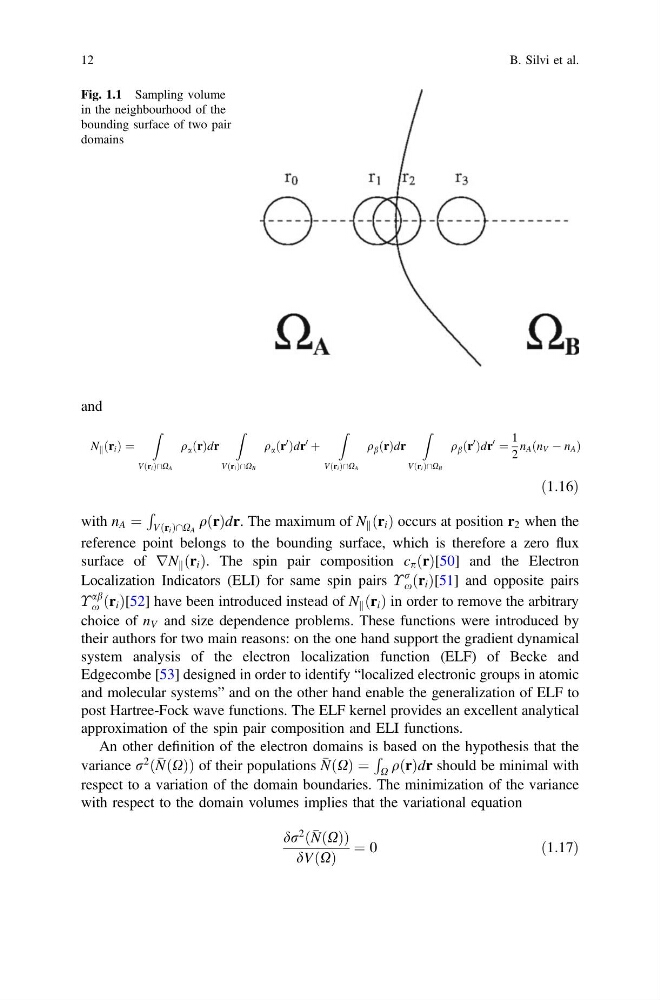
qðrÞdr. The maximum of N k ðr i Þ occurs at position r 2 when the
reference point belongs to the bounding surface, which is therefore a zero flux
surface of rN k ðr i Þ. The spin pair composition c p ðrÞ[50] and the Electron
Localization Indicators (ELI) for same spin pairs Ç
r
x ðr i Þ[51] and opposite pairs
Ç
ab
x ðr i Þ[52] have been introduced instead of N k ðr i Þ in order to remove the arbitrary
choice of n V and size dependence problems. These functions were introduced by
their authors for two main reasons: on the one hand support the gradient dynamical
system analysis of the electron localization function (ELF) of Becke and
Edgecombe [53] designed in order to identify “localized electronic groups in atomic
and molecular systems” and on the other hand enable the generalization of ELF to
post Hartree-Fock wave functions. The ELF kernel provides an excellent analytical
approximation of the spin pair composition and ELI functions.
An other definition of the electron domains is based on the hypothesis that the
variance r
2
ð
NðXÞÞ of their populations
NðXÞ ¼
R
X qðrÞdr should be minimal with
respect to a variation of the domain boundaries. The minimization of the variance
with respect to the domain volumes implies that the variational equation
dr
2
ð
NðXÞÞ
dVðXÞ
¼ 0
ð1:17Þ
Fig. 1.1 Sampling volume
in the neighbourhood of the
bounding surface of two pair
domains
12
B. Silvi et al.
N k ðr i Þ ¼
Z
VðriÞ\XA
q a ðrÞdr
Z
VðriÞ\XB
q a ðr
0 Þdr
0 þ
Z
VðriÞ\XA
q b ðrÞdr
Z
VðriÞ\XB
q b ðr
0 Þdr
0 ¼
1
2
n A ðn V À n A Þ
ð1:16Þ
with n A ¼
R
Vðr i Þ\X A
qðrÞdr. The maximum of N k ðr i Þ occurs at position r 2 when the
reference point belongs to the bounding surface, which is therefore a zero flux
surface of rN k ðr i Þ. The spin pair composition c p ðrÞ[50] and the Electron
Localization Indicators (ELI) for same spin pairs Ç
r
x ðr i Þ[51] and opposite pairs
Ç
ab
x ðr i Þ[52] have been introduced instead of N k ðr i Þ in order to remove the arbitrary
choice of n V and size dependence problems. These functions were introduced by
their authors for two main reasons: on the one hand support the gradient dynamical
system analysis of the electron localization function (ELF) of Becke and
Edgecombe [53] designed in order to identify “localized electronic groups in atomic
and molecular systems” and on the other hand enable the generalization of ELF to
post Hartree-Fock wave functions. The ELF kernel provides an excellent analytical
approximation of the spin pair composition and ELI functions.
An other definition of the electron domains is based on the hypothesis that the
variance r
2
ð
NðXÞÞ of their populations
NðXÞ ¼
R
X qðrÞdr should be minimal with
respect to a variation of the domain boundaries. The minimization of the variance
with respect to the domain volumes implies that the variational equation
dr
2
ð
NðXÞÞ
dVðXÞ
¼ 0
ð1:17Þ
Fig. 1.1 Sampling volume
in the neighbourhood of the
bounding surface of two pair
domains
12
B. Silvi et al.