

gathered in a single “super-bassin”, although it may be interesting to consider the
basins of the external core shells, the subvalence basins, to explains geometrical
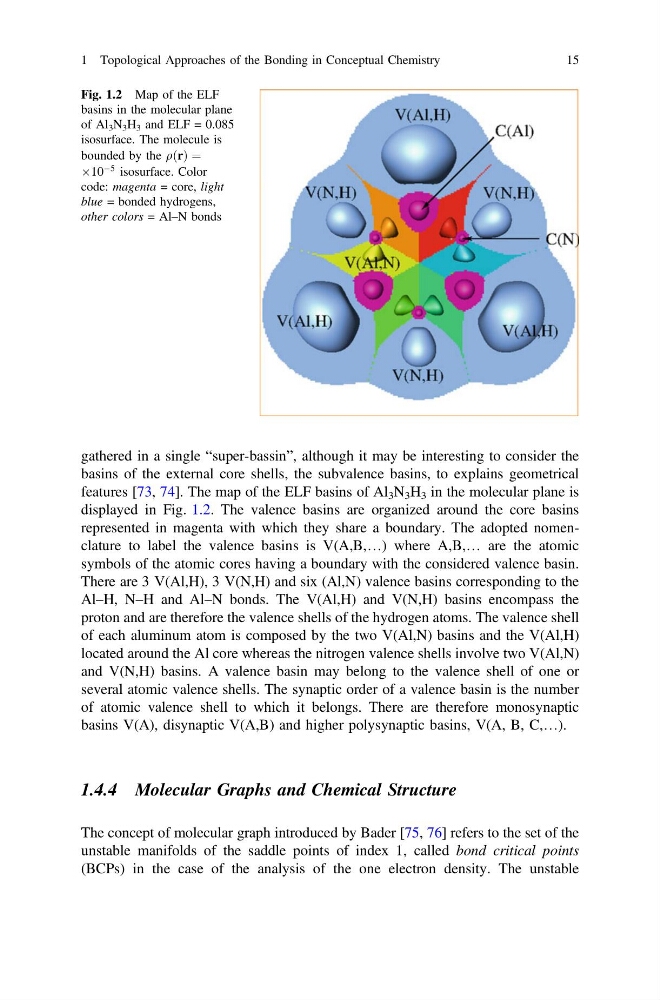
features [73, 74]. The map of the ELF basins of Al 3 N 3 H 3 in the molecular plane is
displayed in Fig. 1.2. The valence basins are organized around the core basins
represented in magenta with which they share a boundary. The adopted nomenclature to label the valence basins is V(A,B,…) where A,B,… are the atomic
symbols of the atomic cores having a boundary with the considered valence basin.
There are 3 V(Al,H), 3 V(N,H) and six (Al,N) valence basins corresponding to the
Al–H, N–H and Al–N bonds. The V(Al,H) and V(N,H) basins encompass the
proton and are therefore the valence shells of the hydrogen atoms. The valence shell
of each aluminum atom is composed by the two V(Al,N) basins and the V(Al,H)
located around the Al core whereas the nitrogen valence shells involve two V(Al,N)
and V(N,H) basins. A valence basin may belong to the valence shell of one or
several atomic valence shells. The synaptic order of a valence basin is the number
of atomic valence shell to which it belongs. There are therefore monosynaptic
basins V(A), disynaptic V(A,B) and higher polysynaptic basins, V(A, B, C,…).
1.4.4 Molecular Graphs and Chemical Structure
The concept of molecular graph introduced by Bader [75, 76] refers to the set of the
unstable manifolds of the saddle points of index 1, called bond critical points
(BCPs) in the case of the analysis of the one electron density. The unstable
Fig. 1.2 Map of the ELF
basins in the molecular plane
of Al 3 N 3 H 3 and ELF = 0.085
isosurface. The molecule is
bounded by the qðrÞ ¼
Â10
À5 isosurface. Color
code: magenta = core, light
blue = bonded hydrogens,
other colors = Al–N bonds
1 Topological Approaches of the Bonding in Conceptual Chemistry
15
basins of the external core shells, the subvalence basins, to explains geometrical
features [73, 74]. The map of the ELF basins of Al 3 N 3 H 3 in the molecular plane is
displayed in Fig. 1.2. The valence basins are organized around the core basins
represented in magenta with which they share a boundary. The adopted nomenclature to label the valence basins is V(A,B,…) where A,B,… are the atomic
symbols of the atomic cores having a boundary with the considered valence basin.
There are 3 V(Al,H), 3 V(N,H) and six (Al,N) valence basins corresponding to the
Al–H, N–H and Al–N bonds. The V(Al,H) and V(N,H) basins encompass the
proton and are therefore the valence shells of the hydrogen atoms. The valence shell
of each aluminum atom is composed by the two V(Al,N) basins and the V(Al,H)
located around the Al core whereas the nitrogen valence shells involve two V(Al,N)
and V(N,H) basins. A valence basin may belong to the valence shell of one or
several atomic valence shells. The synaptic order of a valence basin is the number
of atomic valence shell to which it belongs. There are therefore monosynaptic
basins V(A), disynaptic V(A,B) and higher polysynaptic basins, V(A, B, C,…).
1.4.4 Molecular Graphs and Chemical Structure
The concept of molecular graph introduced by Bader [75, 76] refers to the set of the
unstable manifolds of the saddle points of index 1, called bond critical points
(BCPs) in the case of the analysis of the one electron density. The unstable
Fig. 1.2 Map of the ELF
basins in the molecular plane
of Al 3 N 3 H 3 and ELF = 0.085
isosurface. The molecule is
bounded by the qðrÞ ¼
Â10
À5 isosurface. Color
code: magenta = core, light
blue = bonded hydrogens,
other colors = Al–N bonds
1 Topological Approaches of the Bonding in Conceptual Chemistry
15