

2.4 Towards a QCT Protein Force Field
2.4.1 Topological Energy Partitioning
An early and important result in the development of QTAIM was that an atom in a
molecule has its own (atomic) virial theorem. This means that, for any given
topological atom, there is a (simple) relation between the kinetic energy of this atom
and its potential energy. This in turn means that the potential energy of an atom (i.e.
interacting with itself and all remaining atoms) can be trivially calculated from the
atom’s kinetic energy (which we already know to be well defined). As a further
consequence, the total energy of an atom (which is the sum of kinetic and potential
energy) can be calculated from the kinetic energy alone. The sum of all total atomic
energies forming a molecule then yields the total energy of that molecule. However,
all of this is only true if the forces on the atomic nuclei vanish. If not, one is left
with a residual virial term consisting of nuclear position vectors dotted into
non-vanishing forces on the nuclei. Partitioning the latter (molecular) quantity over
the respective atoms has always been a problem, until in 2001 the potential energy
of an atom was calculated [40] independently from the kinetic energy.
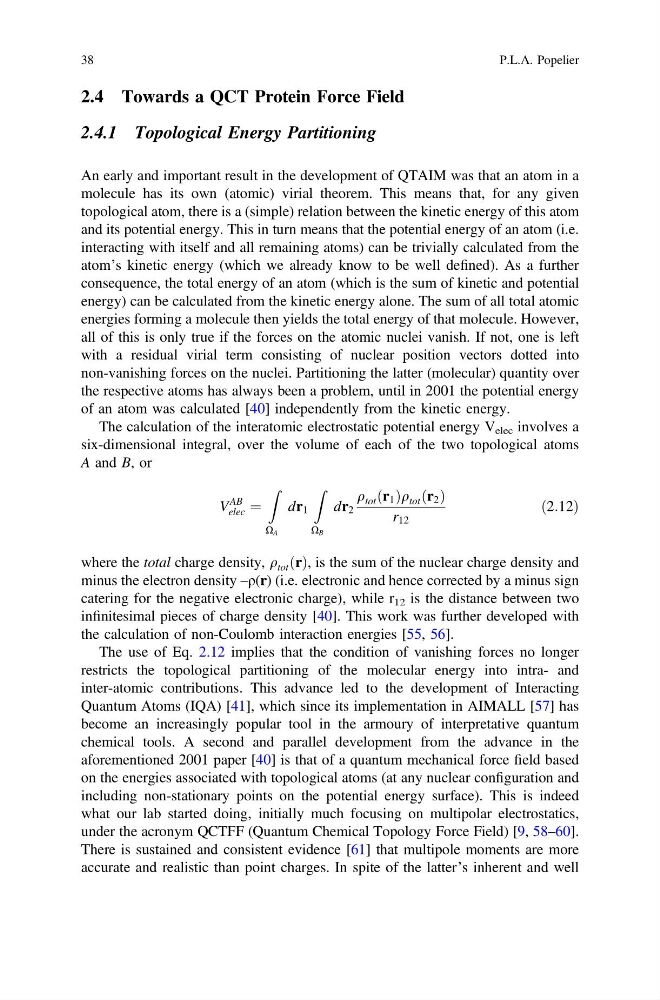
The calculation of the interatomic electrostatic potential energy V elec involves a
six-dimensional integral, over the volume of each of the two topological atoms
A and B, or
V
AB
elec ¼
Z
X A
dr 1
Z
X B
dr 2
q tot r 1 Þq tot ðr 2
ð
Þ
r 12
ð2:12Þ
where the total charge density, q tot ðrÞ, is the sum of the nuclear charge density and
minus the electron density –ρ(r) (i.e. electronic and hence corrected by a minus sign
catering for the negative electronic charge), while r 12 is the distance between two
infinitesimal pieces of charge density [40]. This work was further developed with
the calculation of non-Coulomb interaction energies [55, 56].
The use of Eq. 2.12 implies that the condition of vanishing forces no longer
restricts the topological partitioning of the molecular energy into intra- and
inter-atomic contributions. This advance led to the development of Interacting
Quantum Atoms (IQA) [41], which since its implementation in AIMALL [57] has
become an increasingly popular tool in the armoury of interpretative quantum
chemical tools. A second and parallel development from the advance in the
aforementioned 2001 paper [40] is that of a quantum mechanical force field based
on the energies associated with topological atoms (at any nuclear configuration and
including non-stationary points on the potential energy surface). This is indeed
what our lab started doing, initially much focusing on multipolar electrostatics,
under the acronym QCTFF (Quantum Chemical Topology Force Field) [9, 58–60].
There is sustained and consistent evidence [61] that multipole moments are more
accurate and realistic than point charges. In spite of the latter’s inherent and well
38
P.L.A. Popelier
2.4.1 Topological Energy Partitioning
An early and important result in the development of QTAIM was that an atom in a
molecule has its own (atomic) virial theorem. This means that, for any given
topological atom, there is a (simple) relation between the kinetic energy of this atom
and its potential energy. This in turn means that the potential energy of an atom (i.e.
interacting with itself and all remaining atoms) can be trivially calculated from the
atom’s kinetic energy (which we already know to be well defined). As a further
consequence, the total energy of an atom (which is the sum of kinetic and potential
energy) can be calculated from the kinetic energy alone. The sum of all total atomic
energies forming a molecule then yields the total energy of that molecule. However,
all of this is only true if the forces on the atomic nuclei vanish. If not, one is left
with a residual virial term consisting of nuclear position vectors dotted into
non-vanishing forces on the nuclei. Partitioning the latter (molecular) quantity over
the respective atoms has always been a problem, until in 2001 the potential energy
of an atom was calculated [40] independently from the kinetic energy.
The calculation of the interatomic electrostatic potential energy V elec involves a
six-dimensional integral, over the volume of each of the two topological atoms
A and B, or
V
AB
elec ¼
Z
X A
dr 1
Z
X B
dr 2
q tot r 1 Þq tot ðr 2
ð
Þ
r 12
ð2:12Þ
where the total charge density, q tot ðrÞ, is the sum of the nuclear charge density and
minus the electron density –ρ(r) (i.e. electronic and hence corrected by a minus sign
catering for the negative electronic charge), while r 12 is the distance between two
infinitesimal pieces of charge density [40]. This work was further developed with
the calculation of non-Coulomb interaction energies [55, 56].
The use of Eq. 2.12 implies that the condition of vanishing forces no longer
restricts the topological partitioning of the molecular energy into intra- and
inter-atomic contributions. This advance led to the development of Interacting
Quantum Atoms (IQA) [41], which since its implementation in AIMALL [57] has
become an increasingly popular tool in the armoury of interpretative quantum
chemical tools. A second and parallel development from the advance in the
aforementioned 2001 paper [40] is that of a quantum mechanical force field based
on the energies associated with topological atoms (at any nuclear configuration and
including non-stationary points on the potential energy surface). This is indeed
what our lab started doing, initially much focusing on multipolar electrostatics,
under the acronym QCTFF (Quantum Chemical Topology Force Field) [9, 58–60].
There is sustained and consistent evidence [61] that multipole moments are more
accurate and realistic than point charges. In spite of the latter’s inherent and well
38
P.L.A. Popelier