

documented limitations some researchers are still looking (e.g. Ref. [62]) for the
“magic point charge” that accurately reproduces the molecular electrostatic
potential, even if that point charge is then just a mathematical number without any
connection to the physical process of charge transfer. We believe that the atomic
monopole is primarily a measure of charge transfer; at long range this monopole
becomes increasingly representative of the electrostatic potential that this atom
generates.
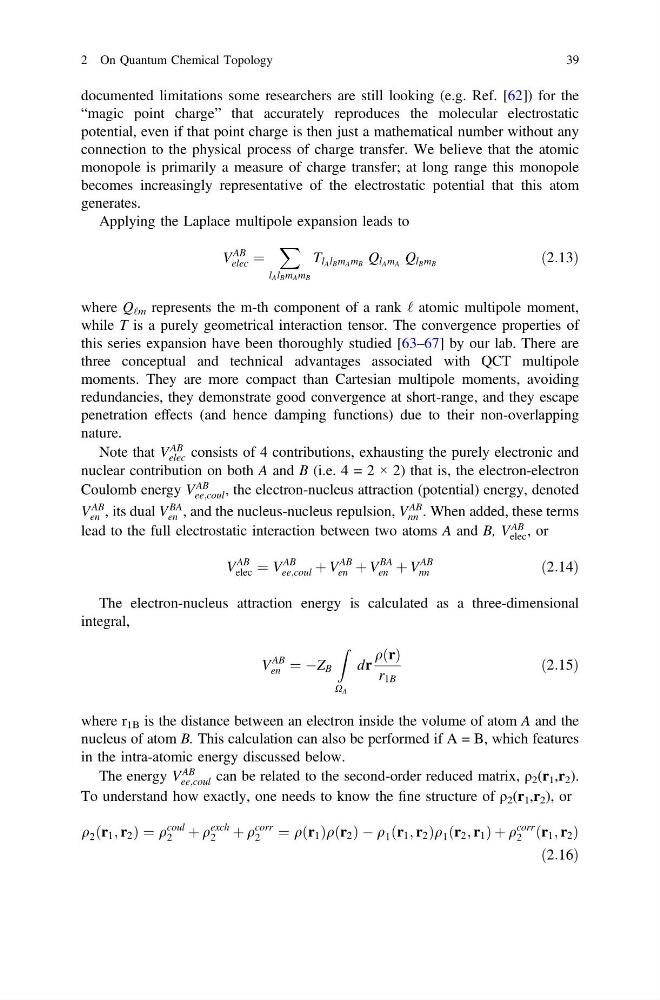
Applying the Laplace multipole expansion leads to
V
AB
elec ¼
X
l A l B m A m B
T l A l B m A m B Q l A m A Q l B m B
ð2:13Þ
where Q ‘m represents the m-th component of a rank ‘ atomic multipole moment,
while T is a purely geometrical interaction tensor. The convergence properties of
this series expansion have been thoroughly studied [63–67] by our lab. There are
three conceptual and technical advantages associated with QCT multipole
moments. They are more compact than Cartesian multipole moments, avoiding
redundancies, they demonstrate good convergence at short-range, and they escape
penetration effects (and hence damping functions) due to their non-overlapping
nature.
Note that V
AB
elec consists of 4 contributions, exhausting the purely electronic and
nuclear contribution on both A and B (i.e. 4 = 2 × 2) that is, the electron-electron
Coulomb energy V
AB
ee;coul , the electron-nucleus attraction (potential) energy, denoted
V
AB
en , its dual V
BA
en , and the nucleus-nucleus repulsion, V
AB
nn . When added, these terms
lead to the full electrostatic interaction between two atoms A and B, V
AB
elec , or
V
AB
elec ¼ V
AB
ee;coul þ V
AB
en þ V
BA
en þ V
AB
nn
ð2:14Þ
The electron-nucleus attraction energy is calculated as a three-dimensional
integral,
V
AB
en ¼ ÀZ B
Z
X A
dr
qðrÞ
r 1B
ð2:15Þ
where r 1B is the distance between an electron inside the volume of atom A and the
nucleus of atom B. This calculation can also be performed if A = B, which features
in the intra-atomic energy discussed below.
The energy V
AB
ee;coul can be related to the second-order reduced matrix, ρ 2 (r 1 ,r 2 ).
To understand how exactly, one needs to know the fine structure of ρ 2 (r 1 ,r 2 ), or
q 2 ðr 1 ; r 2 Þ ¼ q
coul
2
þ q
exch
2
þ q
corr
2
¼ qðr 1 Þqðr 2 Þ À q 1 ðr 1 ; r 2 Þq 1 ðr 2 ; r 1 Þ þ q
corr
2 ðr 1 ; r 2 Þ
ð2:16Þ
2 On Quantum Chemical Topology
39
“magic point charge” that accurately reproduces the molecular electrostatic
potential, even if that point charge is then just a mathematical number without any
connection to the physical process of charge transfer. We believe that the atomic
monopole is primarily a measure of charge transfer; at long range this monopole
becomes increasingly representative of the electrostatic potential that this atom
generates.
Applying the Laplace multipole expansion leads to
V
AB
elec ¼
X
l A l B m A m B
T l A l B m A m B Q l A m A Q l B m B
ð2:13Þ
where Q ‘m represents the m-th component of a rank ‘ atomic multipole moment,
while T is a purely geometrical interaction tensor. The convergence properties of
this series expansion have been thoroughly studied [63–67] by our lab. There are
three conceptual and technical advantages associated with QCT multipole
moments. They are more compact than Cartesian multipole moments, avoiding
redundancies, they demonstrate good convergence at short-range, and they escape
penetration effects (and hence damping functions) due to their non-overlapping
nature.
Note that V
AB
elec consists of 4 contributions, exhausting the purely electronic and
nuclear contribution on both A and B (i.e. 4 = 2 × 2) that is, the electron-electron
Coulomb energy V
AB
ee;coul , the electron-nucleus attraction (potential) energy, denoted
V
AB
en , its dual V
BA
en , and the nucleus-nucleus repulsion, V
AB
nn . When added, these terms
lead to the full electrostatic interaction between two atoms A and B, V
AB
elec , or
V
AB
elec ¼ V
AB
ee;coul þ V
AB
en þ V
BA
en þ V
AB
nn
ð2:14Þ
The electron-nucleus attraction energy is calculated as a three-dimensional
integral,
V
AB
en ¼ ÀZ B
Z
X A
dr
qðrÞ
r 1B
ð2:15Þ
where r 1B is the distance between an electron inside the volume of atom A and the
nucleus of atom B. This calculation can also be performed if A = B, which features
in the intra-atomic energy discussed below.
The energy V
AB
ee;coul can be related to the second-order reduced matrix, ρ 2 (r 1 ,r 2 ).
To understand how exactly, one needs to know the fine structure of ρ 2 (r 1 ,r 2 ), or
q 2 ðr 1 ; r 2 Þ ¼ q
coul
2
þ q
exch
2
þ q
corr
2
¼ qðr 1 Þqðr 2 Þ À q 1 ðr 1 ; r 2 Þq 1 ðr 2 ; r 1 Þ þ q
corr
2 ðr 1 ; r 2 Þ
ð2:16Þ
2 On Quantum Chemical Topology
39