

we are interested in is whether the topological atom is also a quantum atom. A way
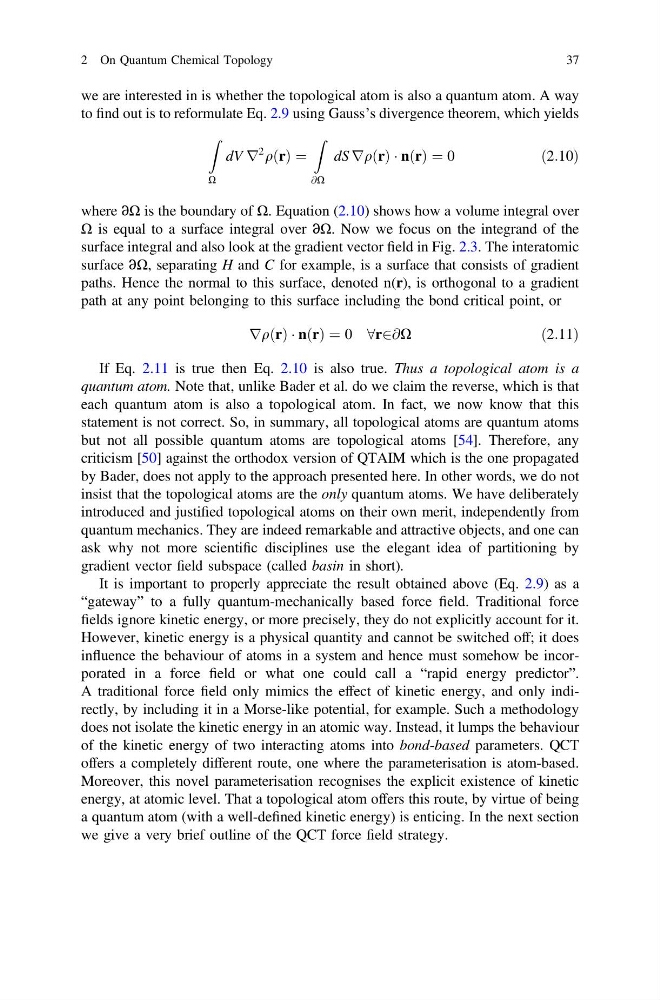
to find out is to reformulate Eq. 2.9 using Gauss’s divergence theorem, which yields
Z
X
dV r
2
qðrÞ ¼
Z
@X
dS rqðrÞ Á nðrÞ ¼ 0
ð2:10Þ
where ∂Ω is the boundary of Ω. Equation (2.10) shows how a volume integral over
Ω is equal to a surface integral over ∂Ω. Now we focus on the integrand of the
surface integral and also look at the gradient vector field in Fig. 2.3. The interatomic
surface ∂Ω, separating H and C for example, is a surface that consists of gradient
paths. Hence the normal to this surface, denoted n(r), is orthogonal to a gradient
path at any point belonging to this surface including the bond critical point, or
rqðrÞ Á nðrÞ ¼ 0 8r2@X
ð2:11Þ
If Eq. 2.11 is true then Eq. 2.10 is also true. Thus a topological atom is a
quantum atom. Note that, unlike Bader et al. do we claim the reverse, which is that
each quantum atom is also a topological atom. In fact, we now know that this
statement is not correct. So, in summary, all topological atoms are quantum atoms
but not all possible quantum atoms are topological atoms [54]. Therefore, any
criticism [50] against the orthodox version of QTAIM which is the one propagated
by Bader, does not apply to the approach presented here. In other words, we do not
insist that the topological atoms are the only quantum atoms. We have deliberately
introduced and justified topological atoms on their own merit, independently from
quantum mechanics. They are indeed remarkable and attractive objects, and one can
ask why not more scientific disciplines use the elegant idea of partitioning by
gradient vector field subspace (called basin in short).
It is important to properly appreciate the result obtained above (Eq. 2.9) as a
“gateway” to a fully quantum-mechanically based force field. Traditional force
fields ignore kinetic energy, or more precisely, they do not explicitly account for it.
However, kinetic energy is a physical quantity and cannot be switched off; it does
influence the behaviour of atoms in a system and hence must somehow be incorporated in a force field or what one could call a “rapid energy predictor”.
A traditional force field only mimics the effect of kinetic energy, and only indirectly, by including it in a Morse-like potential, for example. Such a methodology
does not isolate the kinetic energy in an atomic way. Instead, it lumps the behaviour
of the kinetic energy of two interacting atoms into bond-based parameters. QCT
offers a completely different route, one where the parameterisation is atom-based.
Moreover, this novel parameterisation recognises the explicit existence of kinetic
energy, at atomic level. That a topological atom offers this route, by virtue of being
a quantum atom (with a well-defined kinetic energy) is enticing. In the next section
we give a very brief outline of the QCT force field strategy.
2 On Quantum Chemical Topology
37
to find out is to reformulate Eq. 2.9 using Gauss’s divergence theorem, which yields
Z
X
dV r
2
qðrÞ ¼
Z
@X
dS rqðrÞ Á nðrÞ ¼ 0
ð2:10Þ
where ∂Ω is the boundary of Ω. Equation (2.10) shows how a volume integral over
Ω is equal to a surface integral over ∂Ω. Now we focus on the integrand of the
surface integral and also look at the gradient vector field in Fig. 2.3. The interatomic
surface ∂Ω, separating H and C for example, is a surface that consists of gradient
paths. Hence the normal to this surface, denoted n(r), is orthogonal to a gradient
path at any point belonging to this surface including the bond critical point, or
rqðrÞ Á nðrÞ ¼ 0 8r2@X
ð2:11Þ
If Eq. 2.11 is true then Eq. 2.10 is also true. Thus a topological atom is a
quantum atom. Note that, unlike Bader et al. do we claim the reverse, which is that
each quantum atom is also a topological atom. In fact, we now know that this
statement is not correct. So, in summary, all topological atoms are quantum atoms
but not all possible quantum atoms are topological atoms [54]. Therefore, any
criticism [50] against the orthodox version of QTAIM which is the one propagated
by Bader, does not apply to the approach presented here. In other words, we do not
insist that the topological atoms are the only quantum atoms. We have deliberately
introduced and justified topological atoms on their own merit, independently from
quantum mechanics. They are indeed remarkable and attractive objects, and one can
ask why not more scientific disciplines use the elegant idea of partitioning by
gradient vector field subspace (called basin in short).
It is important to properly appreciate the result obtained above (Eq. 2.9) as a
“gateway” to a fully quantum-mechanically based force field. Traditional force
fields ignore kinetic energy, or more precisely, they do not explicitly account for it.
However, kinetic energy is a physical quantity and cannot be switched off; it does
influence the behaviour of atoms in a system and hence must somehow be incorporated in a force field or what one could call a “rapid energy predictor”.
A traditional force field only mimics the effect of kinetic energy, and only indirectly, by including it in a Morse-like potential, for example. Such a methodology
does not isolate the kinetic energy in an atomic way. Instead, it lumps the behaviour
of the kinetic energy of two interacting atoms into bond-based parameters. QCT
offers a completely different route, one where the parameterisation is atom-based.
Moreover, this novel parameterisation recognises the explicit existence of kinetic
energy, at atomic level. That a topological atom offers this route, by virtue of being
a quantum atom (with a well-defined kinetic energy) is enticing. In the next section
we give a very brief outline of the QCT force field strategy.
2 On Quantum Chemical Topology
37