

which in this case are atoms. Such a relation is robust under moderate geometric
deviations (shrinking and elongation) from the local energy minimum geometry.
It should be pointed out that a gradient path can always be characterised and
classified by the types of the two critical points that it manifestly connects. This was
done exhaustively [13] and for the first time in 2003. This classification focuses on
how many gradient paths can originate from a source critical point and how many
gradient paths can terminate at the sink critical point.
The attentive reader may ask how a gradient can originate at a critical point if, at
that point, the gradient vanishes and hence the gradient path construction of Fig. 2.2
collapses at r i . In other words, if there is no gradient there is no directional guidance. This is true but, in practice, the gradient path starts from a position
infinitesimally close to the bond critical point, in a direction given by the relevant
eigenvector of the Hessian of ρ evaluated at the bond critical point. At that new
point the gradient does not vanish. The meaning of the bond critical point is still a
matter of debate but an explanation of it, not given in the original literature by
what Bader et al., will be given just below.
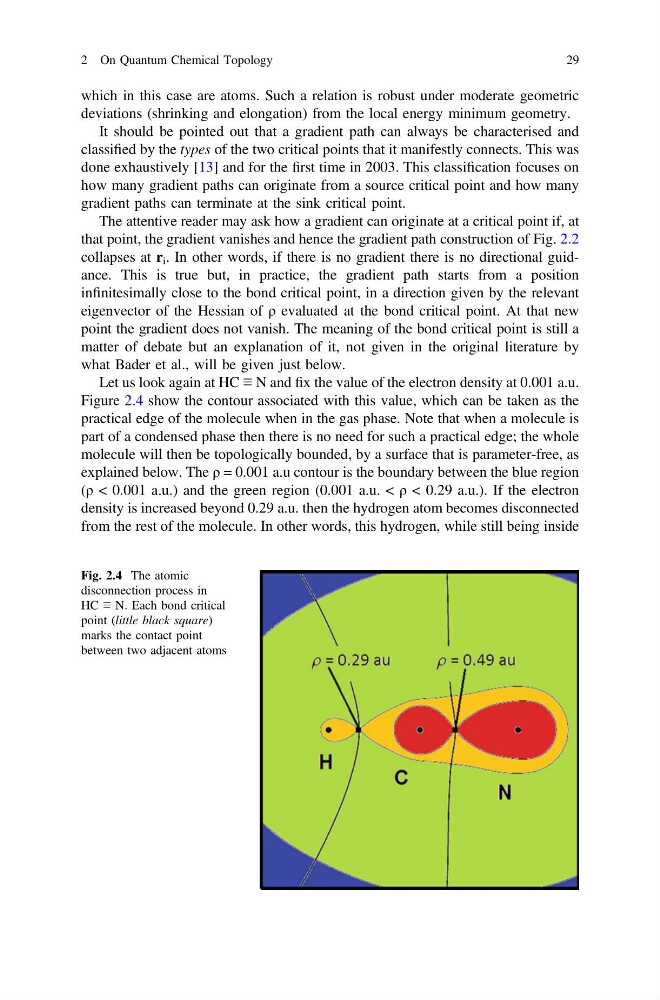
Let us look again at HC ≡ N and fix the value of the electron density at 0.001 a.u.
Figure 2.4 show the contour associated with this value, which can be taken as the
practical edge of the molecule when in the gas phase. Note that when a molecule is
part of a condensed phase then there is no need for such a practical edge; the whole
molecule will then be topologically bounded, by a surface that is parameter-free, as
explained below. The ρ = 0.001 a.u contour is the boundary between the blue region
(ρ < 0.001 a.u.) and the green region (0.001 a.u. < ρ < 0.29 a.u.). If the electron
density is increased beyond 0.29 a.u. then the hydrogen atom becomes disconnected
from the rest of the molecule. In other words, this hydrogen, while still being inside
Fig. 2.4 The atomic
disconnection process in
HC ≡ N. Each bond critical
point (little black square)
marks the contact point
between two adjacent atoms
2 On Quantum Chemical Topology
29
deviations (shrinking and elongation) from the local energy minimum geometry.
It should be pointed out that a gradient path can always be characterised and
classified by the types of the two critical points that it manifestly connects. This was
done exhaustively [13] and for the first time in 2003. This classification focuses on
how many gradient paths can originate from a source critical point and how many
gradient paths can terminate at the sink critical point.
The attentive reader may ask how a gradient can originate at a critical point if, at
that point, the gradient vanishes and hence the gradient path construction of Fig. 2.2
collapses at r i . In other words, if there is no gradient there is no directional guidance. This is true but, in practice, the gradient path starts from a position
infinitesimally close to the bond critical point, in a direction given by the relevant
eigenvector of the Hessian of ρ evaluated at the bond critical point. At that new
point the gradient does not vanish. The meaning of the bond critical point is still a
matter of debate but an explanation of it, not given in the original literature by
what Bader et al., will be given just below.
Let us look again at HC ≡ N and fix the value of the electron density at 0.001 a.u.
Figure 2.4 show the contour associated with this value, which can be taken as the
practical edge of the molecule when in the gas phase. Note that when a molecule is
part of a condensed phase then there is no need for such a practical edge; the whole
molecule will then be topologically bounded, by a surface that is parameter-free, as
explained below. The ρ = 0.001 a.u contour is the boundary between the blue region
(ρ < 0.001 a.u.) and the green region (0.001 a.u. < ρ < 0.29 a.u.). If the electron
density is increased beyond 0.29 a.u. then the hydrogen atom becomes disconnected
from the rest of the molecule. In other words, this hydrogen, while still being inside
Fig. 2.4 The atomic
disconnection process in
HC ≡ N. Each bond critical
point (little black square)
marks the contact point
between two adjacent atoms
2 On Quantum Chemical Topology
29