

axis. All these scalars show extrema (which may rise to infinity) at the nuclear
positions, so we may topologically consider these as attractors of their gradient
fields. We should notice that, as well known, the position of the attractors in the
density, and in this case also in the xc potential, do not exactly coincide with the
nuclear positions in the case of H atoms whenever finite gaussian basis sets are
used. This are artifacts of the modeling.
Several interesting facts stand out. First, it is rather interesting that q and V xc are
not only alike, but strikingly similar. Although the relation between the exchangecorrelation density and the density has already been pointed out, the role of the r
À1
12
weight seems small. This is a non-trivial result that we have found pretty general.
V xc r
ð Þ, a covalent energy density, is close to quantitatively equal to the density. As
we will show below, its critical points are also extremely close to those of the
density. Although the validity of these assertions demands further work, we think
that these results reinforce the energetic link between the BCPs of the QTAIM and
the exchange-correlation channels that was found in our previous work on the
interatomic exchange-correlation energies [5, 26].
We must also comment on the (di)similarities between the MEP and the PAEM
potentials. As expected the impact of considering the potential felt by an electron of
the molecule, or that felt by a test charge is considerable in a two electron system. In
both cases, the electron-nucleus interaction dominates, being counteracted by
electron-electron contributions of two and one electrons, respectively, as shown in
Eqs. 6.1 and 6.17. This leads to similar portraits but larger PAEM values in this
system.
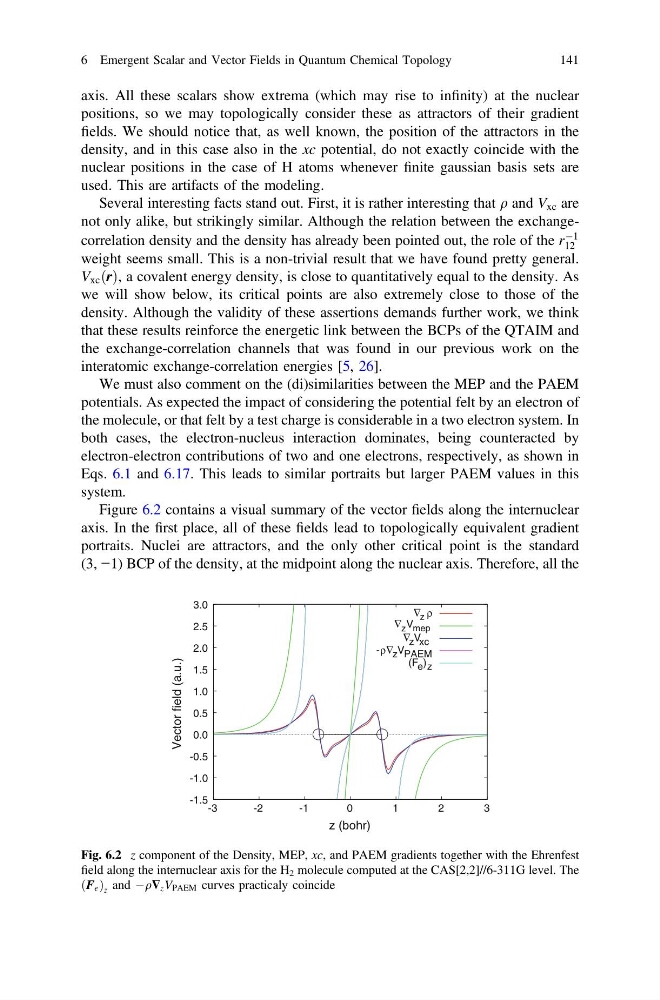
Figure 6.2 contains a visual summary of the vector fields along the internuclear
axis. In the first place, all of these fields lead to topologically equivalent gradient
portraits. Nuclei are attractors, and the only other critical point is the standard
(3, −1) BCP of the density, at the midpoint along the nuclear axis. Therefore, all the
-1.5
-1.0
-0.5
0.0
0.5
1.0
1.5
2.0
2.5
3.0
-3
-2
-1
0
1
2
3
Vector field (a.u.)
z (bohr)
∇ z ρ
∇ z V mep
∇ z V xc
-ρ∇ z V PAEM
(F e ) z
Fig. 6.2 z component of the Density, MEP, xc, and PAEM gradients together with the Ehrenfest
field along the internuclear axis for the H 2 molecule computed at the CAS[2,2]//6-311G level. The
ðF e Þ z and Àq$ z V PAEM curves practicaly coincide
6 Emergent Scalar and Vector Fields in Quantum Chemical Topology
141
positions, so we may topologically consider these as attractors of their gradient
fields. We should notice that, as well known, the position of the attractors in the
density, and in this case also in the xc potential, do not exactly coincide with the
nuclear positions in the case of H atoms whenever finite gaussian basis sets are
used. This are artifacts of the modeling.
Several interesting facts stand out. First, it is rather interesting that q and V xc are
not only alike, but strikingly similar. Although the relation between the exchangecorrelation density and the density has already been pointed out, the role of the r
À1
12
weight seems small. This is a non-trivial result that we have found pretty general.
V xc r
ð Þ, a covalent energy density, is close to quantitatively equal to the density. As
we will show below, its critical points are also extremely close to those of the
density. Although the validity of these assertions demands further work, we think
that these results reinforce the energetic link between the BCPs of the QTAIM and
the exchange-correlation channels that was found in our previous work on the
interatomic exchange-correlation energies [5, 26].
We must also comment on the (di)similarities between the MEP and the PAEM
potentials. As expected the impact of considering the potential felt by an electron of
the molecule, or that felt by a test charge is considerable in a two electron system. In
both cases, the electron-nucleus interaction dominates, being counteracted by
electron-electron contributions of two and one electrons, respectively, as shown in
Eqs. 6.1 and 6.17. This leads to similar portraits but larger PAEM values in this
system.
Figure 6.2 contains a visual summary of the vector fields along the internuclear
axis. In the first place, all of these fields lead to topologically equivalent gradient
portraits. Nuclei are attractors, and the only other critical point is the standard
(3, −1) BCP of the density, at the midpoint along the nuclear axis. Therefore, all the
-1.5
-1.0
-0.5
0.0
0.5
1.0
1.5
2.0
2.5
3.0
-3
-2
-1
0
1
2
3
Vector field (a.u.)
z (bohr)
∇ z ρ
∇ z V mep
∇ z V xc
-ρ∇ z V PAEM
(F e ) z
Fig. 6.2 z component of the Density, MEP, xc, and PAEM gradients together with the Ehrenfest
field along the internuclear axis for the H 2 molecule computed at the CAS[2,2]//6-311G level. The
ðF e Þ z and Àq$ z V PAEM curves practicaly coincide
6 Emergent Scalar and Vector Fields in Quantum Chemical Topology
141