

The quantity
R
dr q r
ð ÞV PAEM r
ð Þ represents the total potential energy of the
electrons in the volume element dr.
6.3 Computational Details and Studied Systems
We will now turn to show the general properties of the scalar and vector fields
presented in the last Section. Our purpose here is not that of systematizing, but just
picking some very simple systems where we will compare the fields with each other
when relevant, or show their shape and basic topology.
All the scalar and vector fields defined in Sect. 6.2, as well as their gradients and
Hessians, were computed with our PROMOLDEN code [24]. All the electronic
structure calculations were performed with a domestic version of the GAMESS
code [35].
We will start considering a simple correlated description of the H 2 molecule,
where the basic features of the fields will be presented. Then we will show to what
extent these features are general by examining the ethylene molecule at the HartreeFock level.
6.4 Results and Discussion
6.4.1 The Dihydrogen Molecule
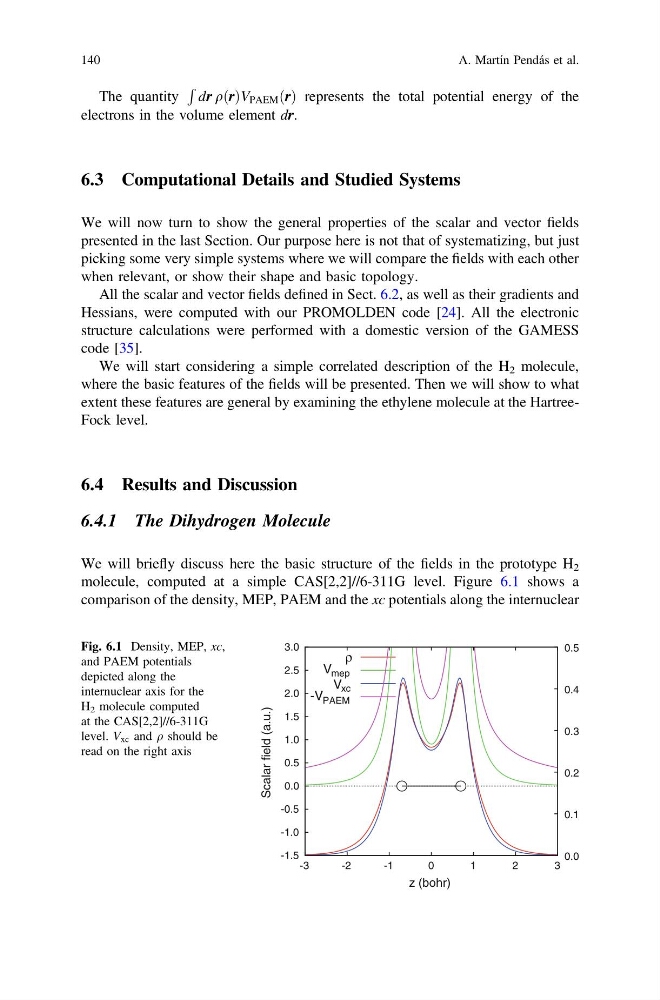
We will briefly discuss here the basic structure of the fields in the prototype H 2
molecule, computed at a simple CAS[2,2]//6-311G level. Figure 6.1 shows a
comparison of the density, MEP, PAEM and the xc potentials along the internuclear
-1.5
-1.0
-0.5
0.0
0.5
1.0
1.5
2.0
2.5
3.0
-3
-2
-1
0
1
2
3
0.0
0.1
0.2
0.3
0.4
0.5
Scalar field (a.u.)
z (bohr)
ρ
V mep
V xc
-V PAEM
Fig. 6.1 Density, MEP, xc,
and PAEM potentials
depicted along the
internuclear axis for the
H 2 molecule computed
at the CAS[2,2]//6-311G
level. V xc and q should be
read on the right axis
140
A. Martín Pendás et al.
R
dr q r
ð ÞV PAEM r
ð Þ represents the total potential energy of the
electrons in the volume element dr.
6.3 Computational Details and Studied Systems
We will now turn to show the general properties of the scalar and vector fields
presented in the last Section. Our purpose here is not that of systematizing, but just
picking some very simple systems where we will compare the fields with each other
when relevant, or show their shape and basic topology.
All the scalar and vector fields defined in Sect. 6.2, as well as their gradients and
Hessians, were computed with our PROMOLDEN code [24]. All the electronic
structure calculations were performed with a domestic version of the GAMESS
code [35].
We will start considering a simple correlated description of the H 2 molecule,
where the basic features of the fields will be presented. Then we will show to what
extent these features are general by examining the ethylene molecule at the HartreeFock level.
6.4 Results and Discussion
6.4.1 The Dihydrogen Molecule
We will briefly discuss here the basic structure of the fields in the prototype H 2
molecule, computed at a simple CAS[2,2]//6-311G level. Figure 6.1 shows a
comparison of the density, MEP, PAEM and the xc potentials along the internuclear
-1.5
-1.0
-0.5
0.0
0.5
1.0
1.5
2.0
2.5
3.0
-3
-2
-1
0
1
2
3
0.0
0.1
0.2
0.3
0.4
0.5
Scalar field (a.u.)
z (bohr)
ρ
V mep
V xc
-V PAEM
Fig. 6.1 Density, MEP, xc,
and PAEM potentials
depicted along the
internuclear axis for the
H 2 molecule computed
at the CAS[2,2]//6-311G
level. V xc and q should be
read on the right axis
140
A. Martín Pendás et al.