

fields provide the same partition of the space. Secondly, the density scaled gradient
of the PAEM and the Ehrenfest force are almost coincident. Their difference is due
to the Hellmann-Feynman imbalance commented before, very small in this system.
This means that although strictly speaking F e is not a gradient field, the PAEM
potential may be used as an approximate potential for it. Thirdly, both the gradients
of the density and the xc potential are again extremely similar.
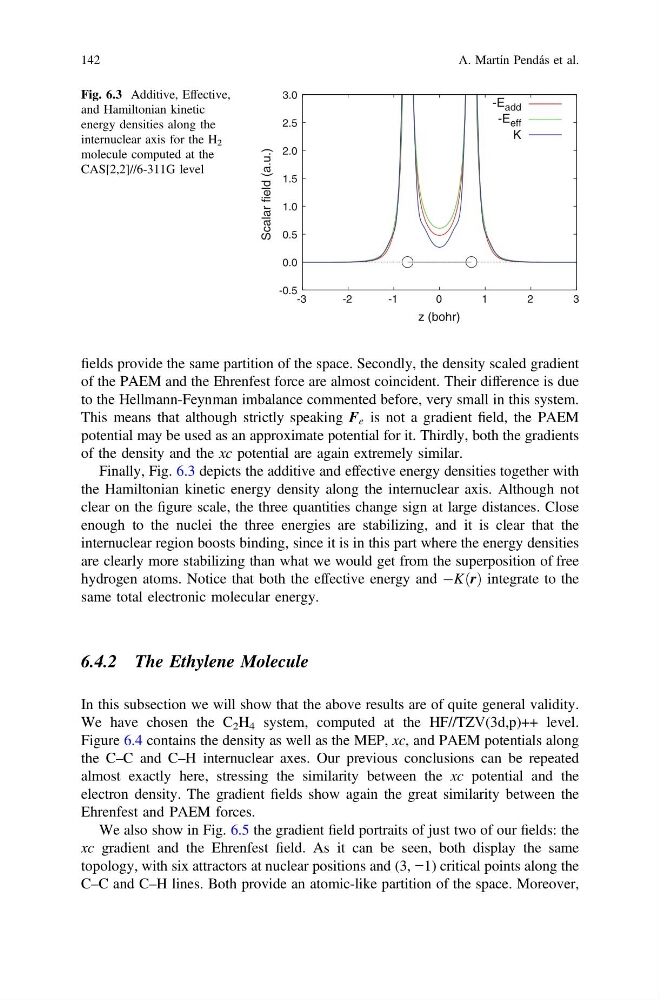
Finally, Fig. 6.3 depicts the additive and effective energy densities together with
the Hamiltonian kinetic energy density along the internuclear axis. Although not
clear on the figure scale, the three quantities change sign at large distances. Close
enough to the nuclei the three energies are stabilizing, and it is clear that the
internuclear region boosts binding, since it is in this part where the energy densities
are clearly more stabilizing than what we would get from the superposition of free
hydrogen atoms. Notice that both the effective energy and ÀK r
ð Þ integrate to the
same total electronic molecular energy.
6.4.2 The Ethylene Molecule
In this subsection we will show that the above results are of quite general validity.
We have chosen the C 2 H 4 system, computed at the HF//TZV(3d,p)++ level.
Figure 6.4 contains the density as well as the MEP, xc, and PAEM potentials along
the C–C and C–H internuclear axes. Our previous conclusions can be repeated
almost exactly here, stressing the similarity between the xc potential and the
electron density. The gradient fields show again the great similarity between the
Ehrenfest and PAEM forces.
We also show in Fig. 6.5 the gradient field portraits of just two of our fields: the
xc gradient and the Ehrenfest field. As it can be seen, both display the same
topology, with six attractors at nuclear positions and (3, −1) critical points along the
C–C and C–H lines. Both provide an atomic-like partition of the space. Moreover,
-0.5
0.0
0.5
1.0
1.5
2.0
2.5
3.0
-3
-2
-1
0
1
2
3
Scalar field (a.u.)
z (bohr)
-E add
-E eff
K
Fig. 6.3 Additive, Effective,
and Hamiltonian kinetic
energy densities along the
internuclear axis for the H 2
molecule computed at the
CAS[2,2]//6-311G level
142
A. Martín Pendás et al.
of the PAEM and the Ehrenfest force are almost coincident. Their difference is due
to the Hellmann-Feynman imbalance commented before, very small in this system.
This means that although strictly speaking F e is not a gradient field, the PAEM
potential may be used as an approximate potential for it. Thirdly, both the gradients
of the density and the xc potential are again extremely similar.
Finally, Fig. 6.3 depicts the additive and effective energy densities together with
the Hamiltonian kinetic energy density along the internuclear axis. Although not
clear on the figure scale, the three quantities change sign at large distances. Close
enough to the nuclei the three energies are stabilizing, and it is clear that the
internuclear region boosts binding, since it is in this part where the energy densities
are clearly more stabilizing than what we would get from the superposition of free
hydrogen atoms. Notice that both the effective energy and ÀK r
ð Þ integrate to the
same total electronic molecular energy.
6.4.2 The Ethylene Molecule
In this subsection we will show that the above results are of quite general validity.
We have chosen the C 2 H 4 system, computed at the HF//TZV(3d,p)++ level.
Figure 6.4 contains the density as well as the MEP, xc, and PAEM potentials along
the C–C and C–H internuclear axes. Our previous conclusions can be repeated
almost exactly here, stressing the similarity between the xc potential and the
electron density. The gradient fields show again the great similarity between the
Ehrenfest and PAEM forces.
We also show in Fig. 6.5 the gradient field portraits of just two of our fields: the
xc gradient and the Ehrenfest field. As it can be seen, both display the same
topology, with six attractors at nuclear positions and (3, −1) critical points along the
C–C and C–H lines. Both provide an atomic-like partition of the space. Moreover,
-0.5
0.0
0.5
1.0
1.5
2.0
2.5
3.0
-3
-2
-1
0
1
2
3
Scalar field (a.u.)
z (bohr)
-E add
-E eff
K
Fig. 6.3 Additive, Effective,
and Hamiltonian kinetic
energy densities along the
internuclear axis for the H 2
molecule computed at the
CAS[2,2]//6-311G level
142
A. Martín Pendás et al.