

the role of experimentally-derived SDD, which might so become soon a key
instrument to understand and design specific magnetic interactions in complex
solid-state networks [93].
The SDD alone is, however, neither able to provide direct information on the
reasons underlying possible spin polarization effects, nor to disentangle different
exchange/pairing mechanisms. Of late, we have proposed a novel SDD-based
real-space descriptor [94], the spin density Source Function (SF S ), that is able to
gain quantitative insight on the relative importance of different atoms or groups of
atoms in determining the electron spin density at a given reference point. Due to its
own nature, this new tool equally applies to theoretically or experimentally derived
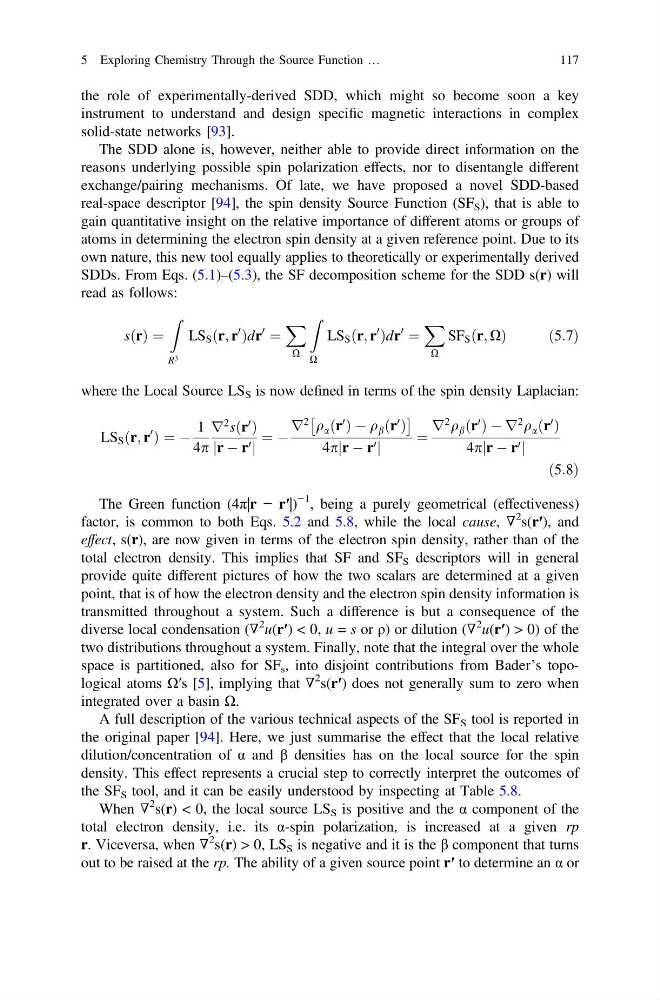
SDDs. From Eqs. (5.1)–(5.3), the SF decomposition scheme for the SDD s(r) will
read as follows:
s r
ð Þ ¼
Z
R 3
LS S ðr; r
0
Þdr
0
¼
X
X
Z
X
LS S ðr; r
0
Þdr
0
¼
X
X
SF S ðr; XÞ
ð5:7Þ
where the Local Source LS S is now defined in terms of the spin density Laplacian:
LS S ðr; r
0
Þ ¼ À
1
4p
r
2 sðr
0
Þ
r À r 0
j
j
¼ À
r
2
q a ðr
0
Þ À q b ðr
0
Þ
Â
Ã
4p r À r 0
j
j
¼
r
2
q b ðr
0
Þ À r
2
q a ðr
0
Þ
4p r À r 0
j
j
ð5:8Þ
The Green function (4π|r − r′|)
−1 , being a purely geometrical (effectiveness)
factor, is common to both Eqs. 5.2 and 5.8, while the local cause, ∇
2 s(r′), and
effect, s(r), are now given in terms of the electron spin density, rather than of the
total electron density. This implies that SF and SF S descriptors will in general
provide quite different pictures of how the two scalars are determined at a given
point, that is of how the electron density and the electron spin density information is
transmitted throughout a system. Such a difference is but a consequence of the
diverse local condensation (∇
2 u(r′) < 0, u = s or ρ) or dilution (∇
2 u(r′) > 0) of the
two distributions throughout a system. Finally, note that the integral over the whole
space is partitioned, also for SF s , into disjoint contributions from Bader’s topological atoms Ω′s [5], implying that ∇
2 s(r′) does not generally sum to zero when
integrated over a basin Ω.
A full description of the various technical aspects of the SF S tool is reported in
the original paper [94]. Here, we just summarise the effect that the local relative
dilution/concentration of α and β densities has on the local source for the spin
density. This effect represents a crucial step to correctly interpret the outcomes of
the SF S tool, and it can be easily understood by inspecting at Table 5.8.
When ∇
2 s(r) < 0, the local source LS S is positive and the α component of the
total electron density, i.e. its α-spin polarization, is increased at a given rp
r. Viceversa, when ∇
2 s(r) > 0, LS S is negative and it is the β component that turns
out to be raised at the rp. The ability of a given source point r′ to determine an α or
5 Exploring Chemistry Through the Source Function …
117
instrument to understand and design specific magnetic interactions in complex
solid-state networks [93].
The SDD alone is, however, neither able to provide direct information on the
reasons underlying possible spin polarization effects, nor to disentangle different
exchange/pairing mechanisms. Of late, we have proposed a novel SDD-based
real-space descriptor [94], the spin density Source Function (SF S ), that is able to
gain quantitative insight on the relative importance of different atoms or groups of
atoms in determining the electron spin density at a given reference point. Due to its
own nature, this new tool equally applies to theoretically or experimentally derived
SDDs. From Eqs. (5.1)–(5.3), the SF decomposition scheme for the SDD s(r) will
read as follows:
s r
ð Þ ¼
Z
R 3
LS S ðr; r
0
Þdr
0
¼
X
X
Z
X
LS S ðr; r
0
Þdr
0
¼
X
X
SF S ðr; XÞ
ð5:7Þ
where the Local Source LS S is now defined in terms of the spin density Laplacian:
LS S ðr; r
0
Þ ¼ À
1
4p
r
2 sðr
0
Þ
r À r 0
j
j
¼ À
r
2
q a ðr
0
Þ À q b ðr
0
Þ
Â
Ã
4p r À r 0
j
j
¼
r
2
q b ðr
0
Þ À r
2
q a ðr
0
Þ
4p r À r 0
j
j
ð5:8Þ
The Green function (4π|r − r′|)
−1 , being a purely geometrical (effectiveness)
factor, is common to both Eqs. 5.2 and 5.8, while the local cause, ∇
2 s(r′), and
effect, s(r), are now given in terms of the electron spin density, rather than of the
total electron density. This implies that SF and SF S descriptors will in general
provide quite different pictures of how the two scalars are determined at a given
point, that is of how the electron density and the electron spin density information is
transmitted throughout a system. Such a difference is but a consequence of the
diverse local condensation (∇
2 u(r′) < 0, u = s or ρ) or dilution (∇
2 u(r′) > 0) of the
two distributions throughout a system. Finally, note that the integral over the whole
space is partitioned, also for SF s , into disjoint contributions from Bader’s topological atoms Ω′s [5], implying that ∇
2 s(r′) does not generally sum to zero when
integrated over a basin Ω.
A full description of the various technical aspects of the SF S tool is reported in
the original paper [94]. Here, we just summarise the effect that the local relative
dilution/concentration of α and β densities has on the local source for the spin
density. This effect represents a crucial step to correctly interpret the outcomes of
the SF S tool, and it can be easily understood by inspecting at Table 5.8.
When ∇
2 s(r) < 0, the local source LS S is positive and the α component of the
total electron density, i.e. its α-spin polarization, is increased at a given rp
r. Viceversa, when ∇
2 s(r) > 0, LS S is negative and it is the β component that turns
out to be raised at the rp. The ability of a given source point r′ to determine an α or
5 Exploring Chemistry Through the Source Function …
117