

β contribution to the electron density at the rp is named as ‘α’ or ‘β effect’,
respectively. Clearly, for a given r′, the magnitude of such effect depends on the
distance from the rp, but its α or β nature is only a function of the source point r′.
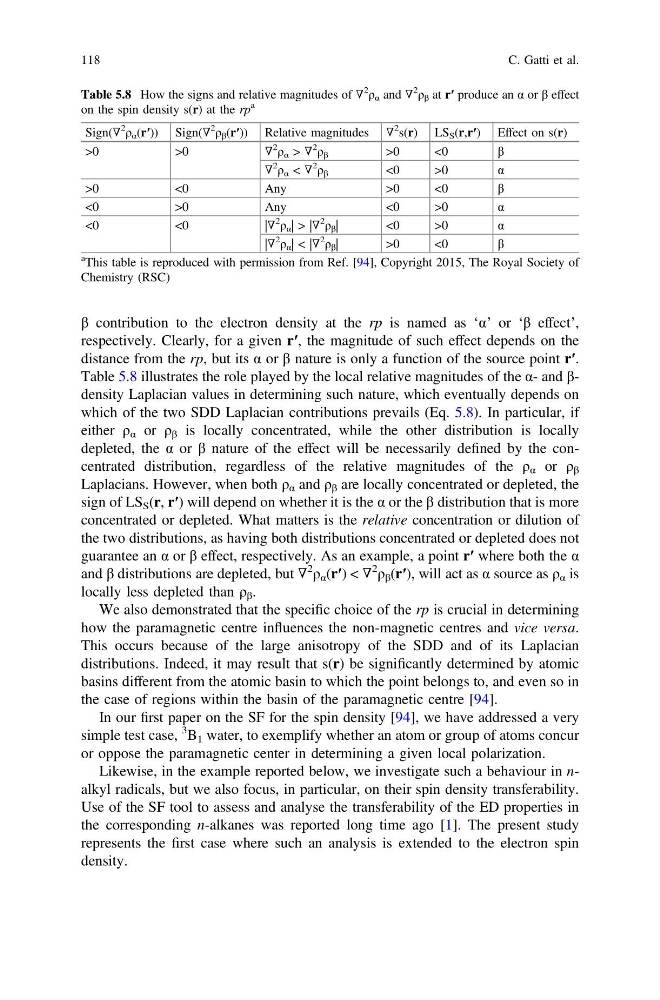
Table 5.8 illustrates the role played by the local relative magnitudes of the α- and βdensity Laplacian values in determining such nature, which eventually depends on
which of the two SDD Laplacian contributions prevails (Eq. 5.8). In particular, if
either ρ α or ρ β is locally concentrated, while the other distribution is locally
depleted, the α or β nature of the effect will be necessarily defined by the concentrated distribution, regardless of the relative magnitudes of the ρ α or ρ β
Laplacians. However, when both ρ α and ρ β are locally concentrated or depleted, the
sign of LS S (r, r′) will depend on whether it is the α or the β distribution that is more
concentrated or depleted. What matters is the relative concentration or dilution of
the two distributions, as having both distributions concentrated or depleted does not
guarantee an α or β effect, respectively. As an example, a point r′ where both the α
and β distributions are depleted, but ∇
2
ρ α (r′) < ∇
2
ρ β (r′), will act as α source as ρ α is
locally less depleted than ρ β .
We also demonstrated that the specific choice of the rp is crucial in determining
how the paramagnetic centre influences the non-magnetic centres and vice versa.
This occurs because of the large anisotropy of the SDD and of its Laplacian
distributions. Indeed, it may result that s(r) be significantly determined by atomic
basins different from the atomic basin to which the point belongs to, and even so in
the case of regions within the basin of the paramagnetic centre [94].
In our first paper on the SF for the spin density [94], we have addressed a very
simple test case,
3 B 1 water, to exemplify whether an atom or group of atoms concur
or oppose the paramagnetic center in determining a given local polarization.
Likewise, in the example reported below, we investigate such a behaviour in nalkyl radicals, but we also focus, in particular, on their spin density transferability.
Use of the SF tool to assess and analyse the transferability of the ED properties in
the corresponding n-alkanes was reported long time ago [1]. The present study
represents the first case where such an analysis is extended to the electron spin
density.
Table 5.8 How the signs and relative magnitudes of ∇
2
ρ α and ∇
2
ρ β at r′ produce an α or β effect
on the spin density s(r) at the rp
a
Sign(∇
2
ρ α (r′)) Sign(∇
2
ρ β (r′)) Relative magnitudes ∇
2
s(r) LS S (r,r′) Effect on s(r)
>0
>0
∇
2
ρ α > ∇
2
ρ β
>0
<0
β
∇
2
ρ α < ∇
2
ρ β
<0
>0
α
>0
<0
Any
>0
<0
β
<0
>0
Any
<0
>0
α
<0
<0
|∇
2
ρ α | > |∇
2
ρ β |
< 0
> 0
α
|∇
2
ρ α | < |∇
2
ρ β |
> 0
< 0
β
a This table is reproduced with permission from Ref. [94], Copyright 2015, The Royal Society of
Chemistry (RSC)
118
C. Gatti et al.
respectively. Clearly, for a given r′, the magnitude of such effect depends on the
distance from the rp, but its α or β nature is only a function of the source point r′.
Table 5.8 illustrates the role played by the local relative magnitudes of the α- and βdensity Laplacian values in determining such nature, which eventually depends on
which of the two SDD Laplacian contributions prevails (Eq. 5.8). In particular, if
either ρ α or ρ β is locally concentrated, while the other distribution is locally
depleted, the α or β nature of the effect will be necessarily defined by the concentrated distribution, regardless of the relative magnitudes of the ρ α or ρ β
Laplacians. However, when both ρ α and ρ β are locally concentrated or depleted, the
sign of LS S (r, r′) will depend on whether it is the α or the β distribution that is more
concentrated or depleted. What matters is the relative concentration or dilution of
the two distributions, as having both distributions concentrated or depleted does not
guarantee an α or β effect, respectively. As an example, a point r′ where both the α
and β distributions are depleted, but ∇
2
ρ α (r′) < ∇
2
ρ β (r′), will act as α source as ρ α is
locally less depleted than ρ β .
We also demonstrated that the specific choice of the rp is crucial in determining
how the paramagnetic centre influences the non-magnetic centres and vice versa.
This occurs because of the large anisotropy of the SDD and of its Laplacian
distributions. Indeed, it may result that s(r) be significantly determined by atomic
basins different from the atomic basin to which the point belongs to, and even so in
the case of regions within the basin of the paramagnetic centre [94].
In our first paper on the SF for the spin density [94], we have addressed a very
simple test case,
3 B 1 water, to exemplify whether an atom or group of atoms concur
or oppose the paramagnetic center in determining a given local polarization.
Likewise, in the example reported below, we investigate such a behaviour in nalkyl radicals, but we also focus, in particular, on their spin density transferability.
Use of the SF tool to assess and analyse the transferability of the ED properties in
the corresponding n-alkanes was reported long time ago [1]. The present study
represents the first case where such an analysis is extended to the electron spin
density.
Table 5.8 How the signs and relative magnitudes of ∇
2
ρ α and ∇
2
ρ β at r′ produce an α or β effect
on the spin density s(r) at the rp
a
Sign(∇
2
ρ α (r′)) Sign(∇
2
ρ β (r′)) Relative magnitudes ∇
2
s(r) LS S (r,r′) Effect on s(r)
>0
>0
∇
2
ρ α > ∇
2
ρ β
>0
<0
β
∇
2
ρ α < ∇
2
ρ β
<0
>0
α
>0
<0
Any
>0
<0
β
<0
>0
Any
<0
>0
α
<0
<0
|∇
2
ρ α | > |∇
2
ρ β |
< 0
> 0
α
|∇
2
ρ α | < |∇
2
ρ β |
> 0
< 0
β
a This table is reproduced with permission from Ref. [94], Copyright 2015, The Royal Society of
Chemistry (RSC)
118
C. Gatti et al.