

pseudo-6MR’s contribute to the density at the midpoint, instead of just one 7MR as
in homotropylium. Indeed, the annulenic 10MR can in principle delocalize electrons without passing through C1···C6. Therefore, the “through bond”, but not
necessarily the “through space” homoconjugative mechanism is expected to be less
important than in homotropylium. In this respect, the weakening of C1···C6 is a
straightforward consequence. As a further proof, each pseudo-6MR in the annulenic
system does not show the typical para effect of aromatic 6MR [15], as δ(C1,
C3) = 0.07 is larger and not smaller than δ(C1, C4) = 0.05 and δ(C1, C5) = 0.02 is
much smaller than both δ(C1, C3) and δ(C1, C4).
5.4 Source Function Applied to Spin-Polarized Systems:
A Novel Tool for Gaining Insight
into the Transmission of Magnetic Information
at the Molecular and Sub-molecular Level
Various cutting-edge research areas, including spintronics [86], advanced sensing
[87] and production of porous molecular sieves [88, 89] continuously require the
development of novel magnetic networks, often designed at the molecular scale.
Different mechanisms, such as direct exchange, ligand-mediated exchange and
superexchange are involved in transmitting the magnetic information from a given
paramagnetic centre to its neighbouring atoms [90]. Such mechanisms often
compete with each other, so it is far from trivial even to accurately understand—
saying nothing about predicting—the macroscopic magnetic properties of complex
bulk materials. Similarly to the ED scalar field, magnetism is also due to non-local
effects, which may likewise develop through space or through chemical bonds. In
particular, non-locality is crucial in determining magnetic properties, as it inherently
concerns far range correlations among unpaired electrons, more or less localized
onto different centres.
To achieve a first-principle understanding of magnetism in complex systems, the
electron spin density distribution, SDD (s(r)), is often analysed. It is defined as:
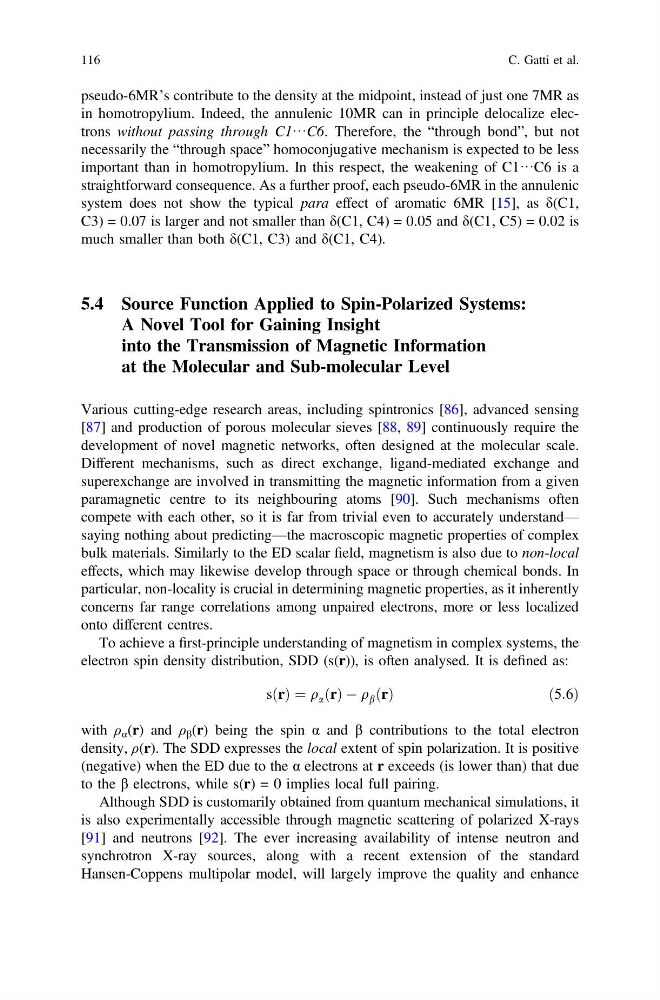
sðrÞ ¼ q a r
ð Þ À q b r
ð Þ
ð5:6Þ
with ρ α (r) and ρ β (r) being the spin α and β contributions to the total electron
density, ρ(r). The SDD expresses the local extent of spin polarization. It is positive
(negative) when the ED due to the α electrons at r exceeds (is lower than) that due
to the β electrons, while s(r) = 0 implies local full pairing.
Although SDD is customarily obtained from quantum mechanical simulations, it
is also experimentally accessible through magnetic scattering of polarized X-rays
[91] and neutrons [92]. The ever increasing availability of intense neutron and
synchrotron X-ray sources, along with a recent extension of the standard
Hansen-Coppens multipolar model, will largely improve the quality and enhance
116
C. Gatti et al.
in homotropylium. Indeed, the annulenic 10MR can in principle delocalize electrons without passing through C1···C6. Therefore, the “through bond”, but not
necessarily the “through space” homoconjugative mechanism is expected to be less
important than in homotropylium. In this respect, the weakening of C1···C6 is a
straightforward consequence. As a further proof, each pseudo-6MR in the annulenic
system does not show the typical para effect of aromatic 6MR [15], as δ(C1,
C3) = 0.07 is larger and not smaller than δ(C1, C4) = 0.05 and δ(C1, C5) = 0.02 is
much smaller than both δ(C1, C3) and δ(C1, C4).
5.4 Source Function Applied to Spin-Polarized Systems:
A Novel Tool for Gaining Insight
into the Transmission of Magnetic Information
at the Molecular and Sub-molecular Level
Various cutting-edge research areas, including spintronics [86], advanced sensing
[87] and production of porous molecular sieves [88, 89] continuously require the
development of novel magnetic networks, often designed at the molecular scale.
Different mechanisms, such as direct exchange, ligand-mediated exchange and
superexchange are involved in transmitting the magnetic information from a given
paramagnetic centre to its neighbouring atoms [90]. Such mechanisms often
compete with each other, so it is far from trivial even to accurately understand—
saying nothing about predicting—the macroscopic magnetic properties of complex
bulk materials. Similarly to the ED scalar field, magnetism is also due to non-local
effects, which may likewise develop through space or through chemical bonds. In
particular, non-locality is crucial in determining magnetic properties, as it inherently
concerns far range correlations among unpaired electrons, more or less localized
onto different centres.
To achieve a first-principle understanding of magnetism in complex systems, the
electron spin density distribution, SDD (s(r)), is often analysed. It is defined as:
sðrÞ ¼ q a r
ð Þ À q b r
ð Þ
ð5:6Þ
with ρ α (r) and ρ β (r) being the spin α and β contributions to the total electron
density, ρ(r). The SDD expresses the local extent of spin polarization. It is positive
(negative) when the ED due to the α electrons at r exceeds (is lower than) that due
to the β electrons, while s(r) = 0 implies local full pairing.
Although SDD is customarily obtained from quantum mechanical simulations, it
is also experimentally accessible through magnetic scattering of polarized X-rays
[91] and neutrons [92]. The ever increasing availability of intense neutron and
synchrotron X-ray sources, along with a recent extension of the standard
Hansen-Coppens multipolar model, will largely improve the quality and enhance
116
C. Gatti et al.