

and similar to the value in benzene, while the reconstruction of the density at the
C1–C3 midpoint reveals a scenario of highly delocalised sources. Only 33 % of this
density is determined by the closest atoms C1 and C3 and the apical sp
3 carbon C2
is found to contribute even more (18.8 %) than each of the bridgehead atoms.
Relatively high SF nn % and SF others % contributions are observed for the bonds in the
pseudo-7MR, though lower than the analogues in benzene [15]. This is likely the
consequence of the peculiar (homoconjugative) aromatic character of the π system
in this compound. In fact, C2 is an allylic sp
3 atom; therefore, it provides an almost
halved SF% contribution to its adjacent bonds with respect to a sp
2 carbon atom
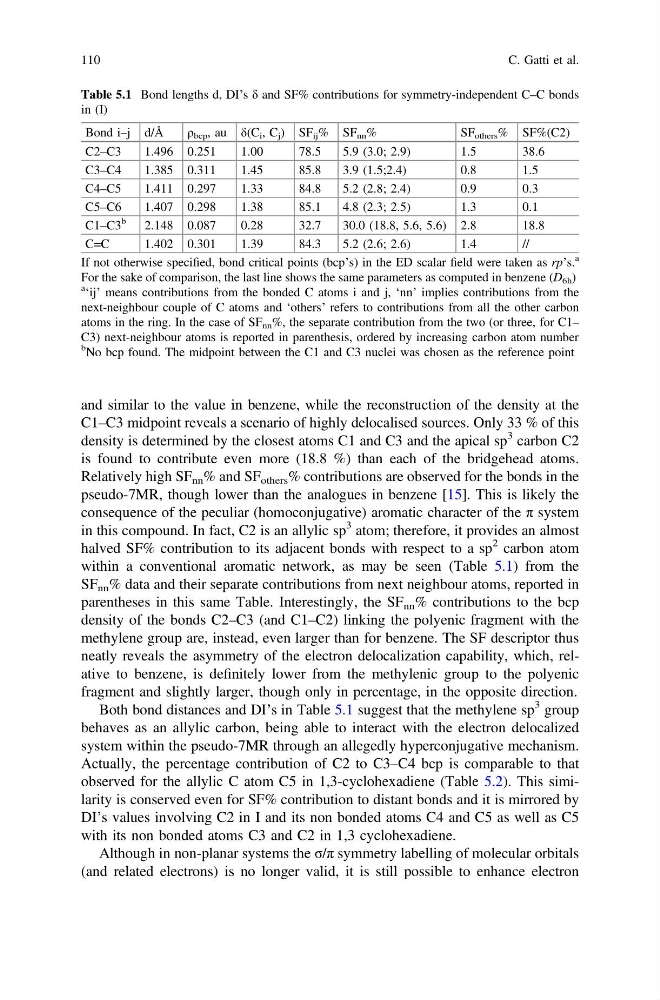
within a conventional aromatic network, as may be seen (Table 5.1) from the
SF nn % data and their separate contributions from next neighbour atoms, reported in
parentheses in this same Table. Interestingly, the SF nn % contributions to the bcp
density of the bonds C2–C3 (and C1–C2) linking the polyenic fragment with the
methylene group are, instead, even larger than for benzene. The SF descriptor thus
neatly reveals the asymmetry of the electron delocalization capability, which, relative to benzene, is definitely lower from the methylenic group to the polyenic
fragment and slightly larger, though only in percentage, in the opposite direction.
Both bond distances and DI’s in Table 5.1 suggest that the methylene sp
3 group
behaves as an allylic carbon, being able to interact with the electron delocalized
system within the pseudo-7MR through an allegedly hyperconjugative mechanism.
Actually, the percentage contribution of C2 to C3–C4 bcp is comparable to that
observed for the allylic C atom C5 in 1,3-cyclohexadiene (Table 5.2). This similarity is conserved even for SF% contribution to distant bonds and it is mirrored by
DI’s values involving C2 in I and its non bonded atoms C4 and C5 as well as C5
with its non bonded atoms C3 and C2 in 1,3 cyclohexadiene.
Although in non-planar systems the σ/π symmetry labelling of molecular orbitals
(and related electrons) is no longer valid, it is still possible to enhance electron
Table 5.1 Bond lengths d, DI’s δ and SF% contributions for symmetry-independent C–C bonds
in (I)
Bond i–j d/Å
ρ bcp , au δ(C i , C j ) SF ij % SF nn %
S F others % SF%(C2)
C2–C3
1.496 0.251
1.00
78.5
5.9 (3.0; 2.9)
1.5
38.6
C3–C4
1.385 0.311
1.45
85.8
3.9 (1.5;2.4)
0.8
1.5
C4–C5
1.411 0.297
1.33
84.8
5.2 (2.8; 2.4)
0.9
0.3
C5–C6
1.407 0.298
1.38
85.1
4.8 (2.3; 2.5)
1.3
0.1
C1–C3
b
2.148 0.087
0.28
32.7
30.0 (18.8, 5.6, 5.6) 2.8
18.8
C=C
1.402 0.301
1.39
84.3
5.2 (2.6; 2.6)
1.4
//
If not otherwise specified, bond critical points (bcp’s) in the ED scalar field were taken as rp’s.
a
For the sake of comparison, the last line shows the same parameters as computed in benzene (D 6h )
a ‘ij’ means contributions from the bonded C atoms i and j, ‘nn’ implies contributions from the
next-neighbour couple of C atoms and ‘others’ refers to contributions from all the other carbon
atoms in the ring. In the case of SF nn %, the separate contribution from the two (or three, for C1–
C3) next-neighbour atoms is reported in parenthesis, ordered by increasing carbon atom number
b
No bcp found. The midpoint between the C1 and C3 nuclei was chosen as the reference point
110
C. Gatti et al.
C1–C3 midpoint reveals a scenario of highly delocalised sources. Only 33 % of this
density is determined by the closest atoms C1 and C3 and the apical sp
3 carbon C2
is found to contribute even more (18.8 %) than each of the bridgehead atoms.
Relatively high SF nn % and SF others % contributions are observed for the bonds in the
pseudo-7MR, though lower than the analogues in benzene [15]. This is likely the
consequence of the peculiar (homoconjugative) aromatic character of the π system
in this compound. In fact, C2 is an allylic sp
3 atom; therefore, it provides an almost
halved SF% contribution to its adjacent bonds with respect to a sp
2 carbon atom
within a conventional aromatic network, as may be seen (Table 5.1) from the
SF nn % data and their separate contributions from next neighbour atoms, reported in
parentheses in this same Table. Interestingly, the SF nn % contributions to the bcp
density of the bonds C2–C3 (and C1–C2) linking the polyenic fragment with the
methylene group are, instead, even larger than for benzene. The SF descriptor thus
neatly reveals the asymmetry of the electron delocalization capability, which, relative to benzene, is definitely lower from the methylenic group to the polyenic
fragment and slightly larger, though only in percentage, in the opposite direction.
Both bond distances and DI’s in Table 5.1 suggest that the methylene sp
3 group
behaves as an allylic carbon, being able to interact with the electron delocalized
system within the pseudo-7MR through an allegedly hyperconjugative mechanism.
Actually, the percentage contribution of C2 to C3–C4 bcp is comparable to that
observed for the allylic C atom C5 in 1,3-cyclohexadiene (Table 5.2). This similarity is conserved even for SF% contribution to distant bonds and it is mirrored by
DI’s values involving C2 in I and its non bonded atoms C4 and C5 as well as C5
with its non bonded atoms C3 and C2 in 1,3 cyclohexadiene.
Although in non-planar systems the σ/π symmetry labelling of molecular orbitals
(and related electrons) is no longer valid, it is still possible to enhance electron
Table 5.1 Bond lengths d, DI’s δ and SF% contributions for symmetry-independent C–C bonds
in (I)
Bond i–j d/Å
ρ bcp , au δ(C i , C j ) SF ij % SF nn %
S F others % SF%(C2)
C2–C3
1.496 0.251
1.00
78.5
5.9 (3.0; 2.9)
1.5
38.6
C3–C4
1.385 0.311
1.45
85.8
3.9 (1.5;2.4)
0.8
1.5
C4–C5
1.411 0.297
1.33
84.8
5.2 (2.8; 2.4)
0.9
0.3
C5–C6
1.407 0.298
1.38
85.1
4.8 (2.3; 2.5)
1.3
0.1
C1–C3
b
2.148 0.087
0.28
32.7
30.0 (18.8, 5.6, 5.6) 2.8
18.8
C=C
1.402 0.301
1.39
84.3
5.2 (2.6; 2.6)
1.4
//
If not otherwise specified, bond critical points (bcp’s) in the ED scalar field were taken as rp’s.
a
For the sake of comparison, the last line shows the same parameters as computed in benzene (D 6h )
a ‘ij’ means contributions from the bonded C atoms i and j, ‘nn’ implies contributions from the
next-neighbour couple of C atoms and ‘others’ refers to contributions from all the other carbon
atoms in the ring. In the case of SF nn %, the separate contribution from the two (or three, for C1–
C3) next-neighbour atoms is reported in parenthesis, ordered by increasing carbon atom number
b
No bcp found. The midpoint between the C1 and C3 nuclei was chosen as the reference point
110
C. Gatti et al.