

involved in carbocation rearrangements [67, 68] and of understanding the role of
substituents on the ring chemistry [65, 69].
In this section, we report on the ability of the SF descriptor to investigate
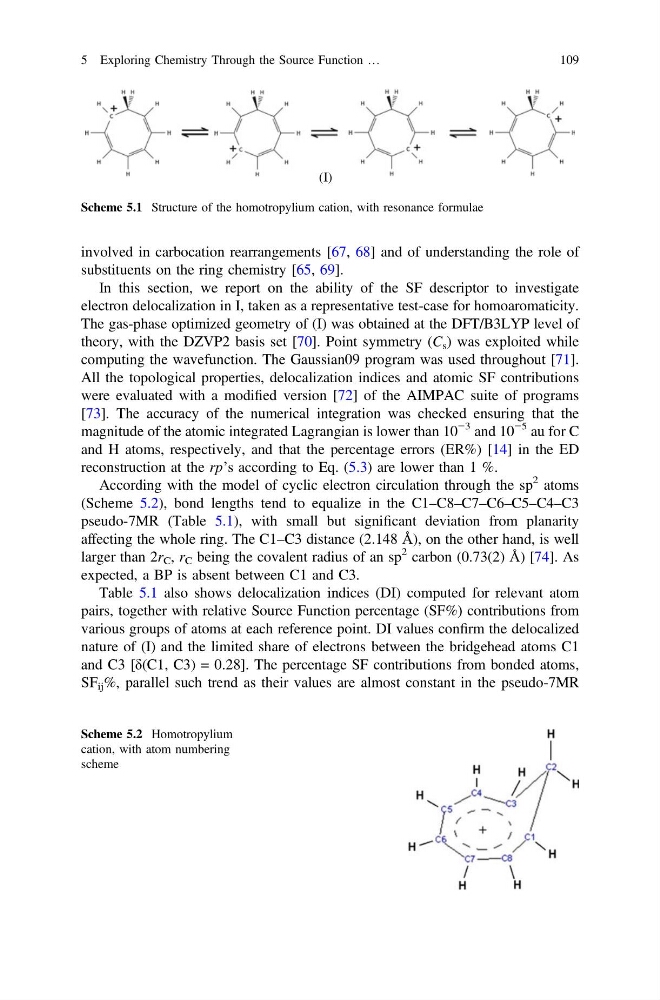
electron delocalization in I, taken as a representative test-case for homoaromaticity.
The gas-phase optimized geometry of (I) was obtained at the DFT/B3LYP level of
theory, with the DZVP2 basis set [70]. Point symmetry (C s ) was exploited while
computing the wavefunction. The Gaussian09 program was used throughout [71].
All the topological properties, delocalization indices and atomic SF contributions
were evaluated with a modified version [72] of the AIMPAC suite of programs
[73]. The accuracy of the numerical integration was checked ensuring that the
magnitude of the atomic integrated Lagrangian is lower than 10
−3 and 10
−5 au for C
and H atoms, respectively, and that the percentage errors (ER%) [14] in the ED
reconstruction at the rp’s according to Eq. (5.3) are lower than 1 %.
According with the model of cyclic electron circulation through the sp
2 atoms
(Scheme 5.2), bond lengths tend to equalize in the C1–C8–C7–C6–C5–C4–C3
pseudo-7MR (Table 5.1), with small but significant deviation from planarity
affecting the whole ring. The C1–C3 distance (2.148 Å), on the other hand, is well
larger than 2r C , r C being the covalent radius of an sp
2 carbon (0.73(2) Å) [74]. As
expected, a BP is absent between C1 and C3.
Table 5.1 also shows delocalization indices (DI) computed for relevant atom
pairs, together with relative Source Function percentage (SF%) contributions from
various groups of atoms at each reference point. DI values confirm the delocalized
nature of (I) and the limited share of electrons between the bridgehead atoms C1
and C3 [δ(C1, C3) = 0.28]. The percentage SF contributions from bonded atoms,
SF ij %, parallel such trend as their values are almost constant in the pseudo-7MR
(I)
Scheme 5.1 Structure of the homotropylium cation, with resonance formulae
Scheme 5.2 Homotropylium
cation, with atom numbering
scheme
5 Exploring Chemistry Through the Source Function …
109
substituents on the ring chemistry [65, 69].
In this section, we report on the ability of the SF descriptor to investigate
electron delocalization in I, taken as a representative test-case for homoaromaticity.
The gas-phase optimized geometry of (I) was obtained at the DFT/B3LYP level of
theory, with the DZVP2 basis set [70]. Point symmetry (C s ) was exploited while
computing the wavefunction. The Gaussian09 program was used throughout [71].
All the topological properties, delocalization indices and atomic SF contributions
were evaluated with a modified version [72] of the AIMPAC suite of programs
[73]. The accuracy of the numerical integration was checked ensuring that the
magnitude of the atomic integrated Lagrangian is lower than 10
−3 and 10
−5 au for C
and H atoms, respectively, and that the percentage errors (ER%) [14] in the ED
reconstruction at the rp’s according to Eq. (5.3) are lower than 1 %.
According with the model of cyclic electron circulation through the sp
2 atoms
(Scheme 5.2), bond lengths tend to equalize in the C1–C8–C7–C6–C5–C4–C3
pseudo-7MR (Table 5.1), with small but significant deviation from planarity
affecting the whole ring. The C1–C3 distance (2.148 Å), on the other hand, is well
larger than 2r C , r C being the covalent radius of an sp
2 carbon (0.73(2) Å) [74]. As
expected, a BP is absent between C1 and C3.
Table 5.1 also shows delocalization indices (DI) computed for relevant atom
pairs, together with relative Source Function percentage (SF%) contributions from
various groups of atoms at each reference point. DI values confirm the delocalized
nature of (I) and the limited share of electrons between the bridgehead atoms C1
and C3 [δ(C1, C3) = 0.28]. The percentage SF contributions from bonded atoms,
SF ij %, parallel such trend as their values are almost constant in the pseudo-7MR
(I)
Scheme 5.1 Structure of the homotropylium cation, with resonance formulae
Scheme 5.2 Homotropylium
cation, with atom numbering
scheme
5 Exploring Chemistry Through the Source Function …
109