

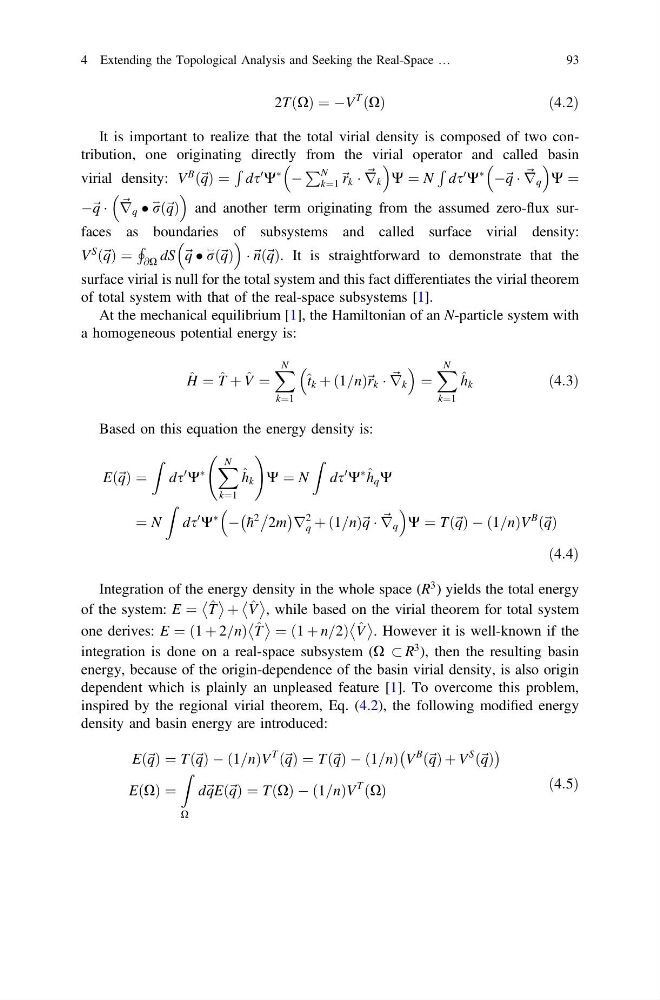
2TðXÞ ¼ ÀV
T
ðXÞ
ð 4:2Þ
It is important to realize that the total virial density is composed of two contribution, one originating directly from the virial operator and called basin
virial density: V
B
~ q
ð Þ ¼
R
ds
0
W
Ã
À
P N
k¼1 ~ r k Á ~
r k
W ¼ N
R
ds
0
W
Ã
À~ q Á ~
r q
W ¼
À~ q Á ~
r q r
$ ~ q
ð Þ
and another term originating from the assumed zero-flux surfaces as boundaries of subsystems and called surface virial density:
V
S
~ q
ð Þ ¼
H
@X dS ~ q r
$ ~ q
ð Þ
Á ~ n ~ q
ð Þ. It is straightforward to demonstrate that the
surface virial is null for the total system and this fact differentiates the virial theorem
of total system with that of the real-space subsystems [1].
At the mechanical equilibrium [1], the Hamiltonian of an N-particle system with
a homogeneous potential energy is:
^
H ¼ ^
T þ ^
V ¼
X N
k¼1
^ t k þ 1=n
ð
Þ~ r k Á ~
r k
¼
X N
k¼1
^ h k
ð4:3Þ
Based on this equation the energy density is:
E ~ q
ð Þ ¼
Z
ds
0
W
Ã
X N
k¼1
^ h k
!
W ¼ N
Z
ds
0
W
à ^ h q W
¼ N
Z
ds
0
W
Ã
À h
2
2m
À
Á r
2
q þ 1=n
ð
Þ~ q Á ~
r q
W ¼ T ~ q
ð Þ À 1=n
ð
ÞV
B
~ q
ð Þ
ð4:4Þ
Integration of the energy density in the whole space (R
3 ) yields the total energy
of the system: E ¼ ^
T
þ ^
V
, while based on the virial theorem for total system
one derives: E ¼ 1 þ 2=n
ð
Þ ^
T
¼ 1 þ n=2
ð
Þ ^
V
. However it is well-known if the
integration is done on a real-space subsystem (X & R
3 ), then the resulting basin
energy, because of the origin-dependence of the basin virial density, is also origin
dependent which is plainly an unpleased feature [1]. To overcome this problem,
inspired by the regional virial theorem, Eq. (4.2), the following modified energy
density and basin energy are introduced:
E ~ q
ð Þ ¼ T ~ q
ð Þ À 1=n
ð
ÞV
T
~ q
ð Þ ¼ T ~ q
ð Þ À 1=n
ð
Þ V
B
~ q
ð Þ þ V
S
~ q
ð Þ
À
Á
EðXÞ ¼
Z
X
d~ qE ~ q
ð Þ ¼ TðXÞ À 1=n
ð
ÞV
T
ðXÞ
ð4:5Þ
4 Extending the Topological Analysis and Seeking the Real-Space …
93
T
ðXÞ
ð 4:2Þ
It is important to realize that the total virial density is composed of two contribution, one originating directly from the virial operator and called basin
virial density: V
B
~ q
ð Þ ¼
R
ds
0
W
Ã
À
P N
k¼1 ~ r k Á ~
r k
W ¼ N
R
ds
0
W
Ã
À~ q Á ~
r q
W ¼
À~ q Á ~
r q r
$ ~ q
ð Þ
and another term originating from the assumed zero-flux surfaces as boundaries of subsystems and called surface virial density:
V
S
~ q
ð Þ ¼
H
@X dS ~ q r
$ ~ q
ð Þ
Á ~ n ~ q
ð Þ. It is straightforward to demonstrate that the
surface virial is null for the total system and this fact differentiates the virial theorem
of total system with that of the real-space subsystems [1].
At the mechanical equilibrium [1], the Hamiltonian of an N-particle system with
a homogeneous potential energy is:
^
H ¼ ^
T þ ^
V ¼
X N
k¼1
^ t k þ 1=n
ð
Þ~ r k Á ~
r k
¼
X N
k¼1
^ h k
ð4:3Þ
Based on this equation the energy density is:
E ~ q
ð Þ ¼
Z
ds
0
W
Ã
X N
k¼1
^ h k
!
W ¼ N
Z
ds
0
W
à ^ h q W
¼ N
Z
ds
0
W
Ã
À h
2
2m
À
Á r
2
q þ 1=n
ð
Þ~ q Á ~
r q
W ¼ T ~ q
ð Þ À 1=n
ð
ÞV
B
~ q
ð Þ
ð4:4Þ
Integration of the energy density in the whole space (R
3 ) yields the total energy
of the system: E ¼ ^
T
þ ^
V
, while based on the virial theorem for total system
one derives: E ¼ 1 þ 2=n
ð
Þ ^
T
¼ 1 þ n=2
ð
Þ ^
V
. However it is well-known if the
integration is done on a real-space subsystem (X & R
3 ), then the resulting basin
energy, because of the origin-dependence of the basin virial density, is also origin
dependent which is plainly an unpleased feature [1]. To overcome this problem,
inspired by the regional virial theorem, Eq. (4.2), the following modified energy
density and basin energy are introduced:
E ~ q
ð Þ ¼ T ~ q
ð Þ À 1=n
ð
ÞV
T
~ q
ð Þ ¼ T ~ q
ð Þ À 1=n
ð
Þ V
B
~ q
ð Þ þ V
S
~ q
ð Þ
À
Á
EðXÞ ¼
Z
X
d~ qE ~ q
ð Þ ¼ TðXÞ À 1=n
ð
ÞV
T
ðXÞ
ð4:5Þ
4 Extending the Topological Analysis and Seeking the Real-Space …
93