

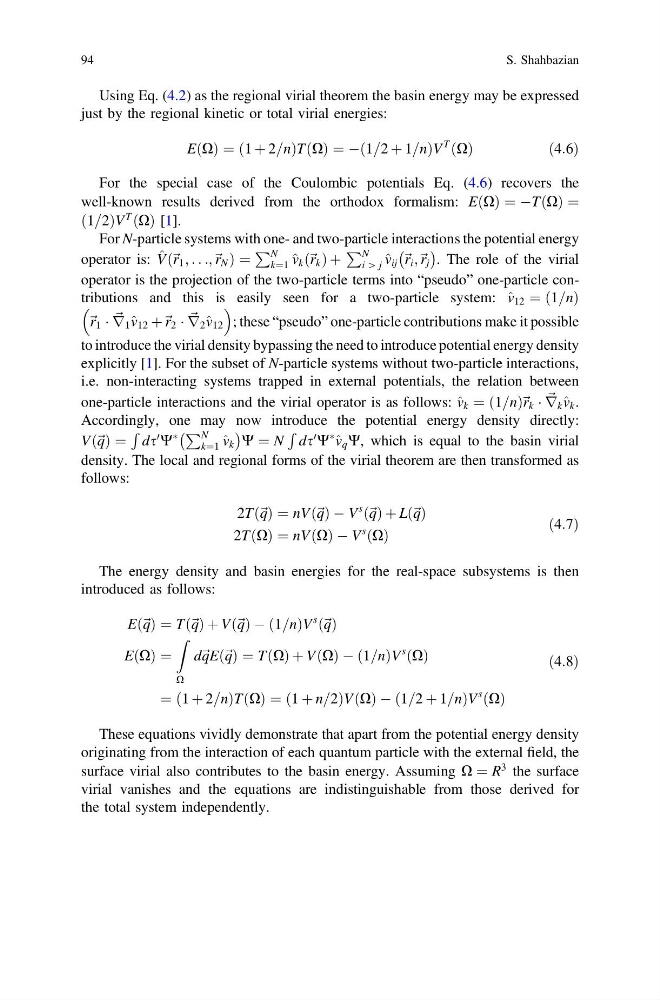
Using Eq. (4.2) as the regional virial theorem the basin energy may be expressed
just by the regional kinetic or total virial energies:
EðXÞ ¼ 1 þ 2=n
ð
Þ TðXÞ ¼ À 1=2 þ 1=n
ð
Þ V
T
ðXÞ
ð 4:6Þ
For the special case of the Coulombic potentials Eq. (4.6) recovers the
well-known results derived from the orthodox formalism: EðXÞ ¼ ÀTðXÞ ¼
1=2
ð
ÞV
T
ðXÞ [1].
For N-particle systems with one- and two-particle interactions the potential energy
operator is: ^
V ~ r 1 ; . . .;~ r N
ð
Þ¼
P N
k¼1 ^ v k ~ r k
ð Þþ
P N
i [ j ^ v ij ~ r i ;~ r j
À
Á
. The role of the virial
operator is the projection of the two-particle terms into “pseudo” one-particle contributions and this is easily seen for a two-particle system: ^ v 12 ¼ 1=n
ð
Þ
~ r 1 Á ~
r 1 ^ v 12 þ~ r 2 Á ~
r 2 ^ v 12
; these “pseudo” one-particle contributions make it possible
to introduce the virial density bypassing the need to introduce potential energy density
explicitly [1]. For the subset of N-particle systems without two-particle interactions,
i.e. non-interacting systems trapped in external potentials, the relation between
one-particle interactions and the virial operator is as follows: ^ v k ¼ 1=n
ð
Þ~ r k Á ~
r k ^ v k .
Accordingly, one may now introduce the potential energy density directly:
V ~ q
ð Þ ¼
R
ds
0
W
à P N
k¼1 ^ v k
À
Á W ¼ N
R
ds
0
W
Ã
^ v q W, which is equal to the basin virial
density. The local and regional forms of the virial theorem are then transformed as
follows:
2T ~ q
ð Þ ¼ nV ~ q
ð Þ À V
s
~ q
ð Þ þ L ~ q
ð Þ
2TðXÞ ¼ nVðXÞ À V
s
ðXÞ
ð4:7Þ
The energy density and basin energies for the real-space subsystems is then
introduced as follows:
E ~ q
ð Þ ¼ T ~ q
ð Þ þ V ~ q
ð Þ À 1=n
ð
ÞV
s
~ q
ð Þ
EðXÞ ¼
Z
X
d~ qE ~ q
ð Þ ¼ TðXÞ þ VðXÞ À 1=n
ð
ÞV
s
ðXÞ
¼ 1 þ 2=n
ð
Þ TðXÞ ¼ 1 þ n=2
ð
Þ VðXÞ À 1=2 þ 1=n
ð
Þ V
s
ðXÞ
ð4:8Þ
These equations vividly demonstrate that apart from the potential energy density
originating from the interaction of each quantum particle with the external field, the
surface virial also contributes to the basin energy. Assuming X ¼ R
3 the surface
virial vanishes and the equations are indistinguishable from those derived for
the total system independently.
94
S. Shahbazian
just by the regional kinetic or total virial energies:
EðXÞ ¼ 1 þ 2=n
ð
Þ TðXÞ ¼ À 1=2 þ 1=n
ð
Þ V
T
ðXÞ
ð 4:6Þ
For the special case of the Coulombic potentials Eq. (4.6) recovers the
well-known results derived from the orthodox formalism: EðXÞ ¼ ÀTðXÞ ¼
1=2
ð
ÞV
T
ðXÞ [1].
For N-particle systems with one- and two-particle interactions the potential energy
operator is: ^
V ~ r 1 ; . . .;~ r N
ð
Þ¼
P N
k¼1 ^ v k ~ r k
ð Þþ
P N
i [ j ^ v ij ~ r i ;~ r j
À
Á
. The role of the virial
operator is the projection of the two-particle terms into “pseudo” one-particle contributions and this is easily seen for a two-particle system: ^ v 12 ¼ 1=n
ð
Þ
~ r 1 Á ~
r 1 ^ v 12 þ~ r 2 Á ~
r 2 ^ v 12
; these “pseudo” one-particle contributions make it possible
to introduce the virial density bypassing the need to introduce potential energy density
explicitly [1]. For the subset of N-particle systems without two-particle interactions,
i.e. non-interacting systems trapped in external potentials, the relation between
one-particle interactions and the virial operator is as follows: ^ v k ¼ 1=n
ð
Þ~ r k Á ~
r k ^ v k .
Accordingly, one may now introduce the potential energy density directly:
V ~ q
ð Þ ¼
R
ds
0
W
à P N
k¼1 ^ v k
À
Á W ¼ N
R
ds
0
W
Ã
^ v q W, which is equal to the basin virial
density. The local and regional forms of the virial theorem are then transformed as
follows:
2T ~ q
ð Þ ¼ nV ~ q
ð Þ À V
s
~ q
ð Þ þ L ~ q
ð Þ
2TðXÞ ¼ nVðXÞ À V
s
ðXÞ
ð4:7Þ
The energy density and basin energies for the real-space subsystems is then
introduced as follows:
E ~ q
ð Þ ¼ T ~ q
ð Þ þ V ~ q
ð Þ À 1=n
ð
ÞV
s
~ q
ð Þ
EðXÞ ¼
Z
X
d~ qE ~ q
ð Þ ¼ TðXÞ þ VðXÞ À 1=n
ð
ÞV
s
ðXÞ
¼ 1 þ 2=n
ð
Þ TðXÞ ¼ 1 þ n=2
ð
Þ VðXÞ À 1=2 þ 1=n
ð
Þ V
s
ðXÞ
ð4:8Þ
These equations vividly demonstrate that apart from the potential energy density
originating from the interaction of each quantum particle with the external field, the
surface virial also contributes to the basin energy. Assuming X ¼ R
3 the surface
virial vanishes and the equations are indistinguishable from those derived for
the total system independently.
94
S. Shahbazian