

H
HN
NH
N
+ Cu
II (ClO 4 ) 2
1.0 eq
MeCN
– 0.5 HClO 4
Cu III
HN
NH
N
(ClO4
–
)2
+
Cu I
HN
NH
N
ClO 4
–
0.5 eq
0.5 eq
(46)
Cu III
HN
NH
N
(ClO4
–
)2
MeOH
HN
NH
N
OMe
Cu
I (ClO 4 )
quant
+
HClO 4
RNH
RNH =
NH
O
HN
NH
N
NR
quant
Cu I ( ClO 4)
HClO 4
+
(47)
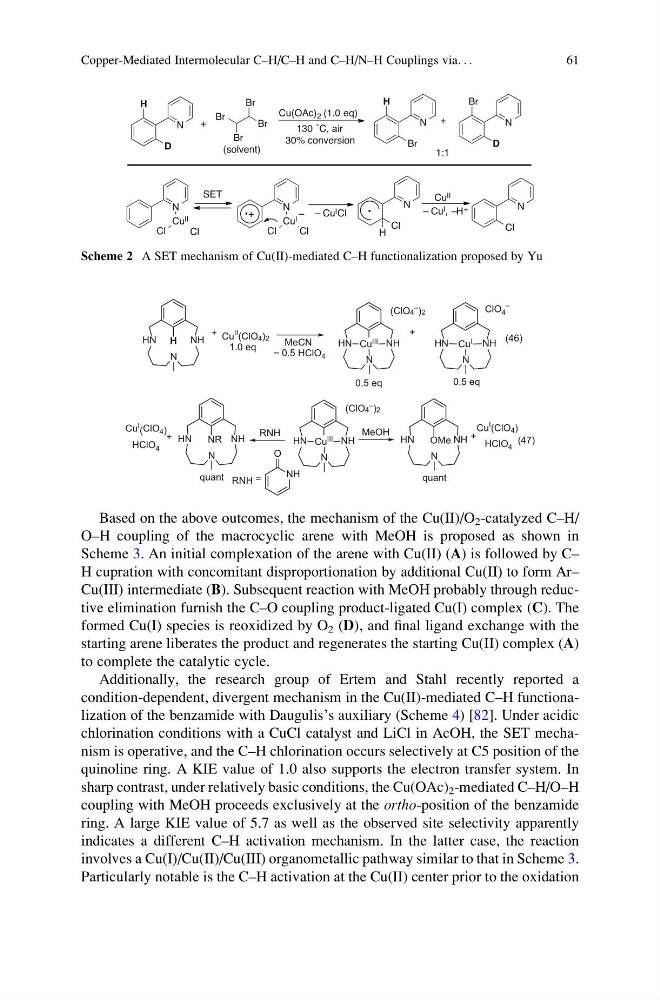
Based on the above outcomes, the mechanism of the Cu(II)/O 2 -catalyzed C–H/
O–H coupling of the macrocyclic arene with MeOH is proposed as shown in
Scheme 3. An initial complexation of the arene with Cu(II) (A) is followed by C–
H cupration with concomitant disproportionation by additional Cu(II) to form Ar–
Cu(III) intermediate (B). Subsequent reaction with MeOH probably through reductive elimination furnish the C–O coupling product-ligated Cu(I) complex (C). The
formed Cu(I) species is reoxidized by O 2 (D), and final ligand exchange with the
starting arene liberates the product and regenerates the starting Cu(II) complex (A)
to complete the catalytic cycle.
Additionally, the research group of Ertem and Stahl recently reported a
condition-dependent, divergent mechanism in the Cu(II)-mediated C–H functionalization of the benzamide with Daugulis’s auxiliary (Scheme 4) [82]. Under acidic
chlorination conditions with a CuCl catalyst and LiCl in AcOH, the SET mechanism is operative, and the C–H chlorination occurs selectively at C5 position of the
quinoline ring. A KIE value of 1.0 also supports the electron transfer system. In
sharp contrast, under relatively basic conditions, the Cu(OAc) 2 -mediated C–H/O–H
coupling with MeOH proceeds exclusively at the ortho-position of the benzamide
ring. A large KIE value of 5.7 as well as the observed site selectivity apparently
indicates a different C–H activation mechanism. In the latter case, the reaction
involves a Cu(I)/Cu(II)/Cu(III) organometallic pathway similar to that in Scheme 3.
Particularly notable is the C–H activation at the Cu(II) center prior to the oxidation
Scheme 2 A SET mechanism of Cu(II)-mediated C–H functionalization proposed by Yu
Copper-Mediated Intermolecular C–H/C–H and C–H/N–H Couplings via. . .
61
HN
NH
N
+ Cu
II (ClO 4 ) 2
1.0 eq
MeCN
– 0.5 HClO 4
Cu III
HN
NH
N
(ClO4
–
)2
+
Cu I
HN
NH
N
ClO 4
–
0.5 eq
0.5 eq
(46)
Cu III
HN
NH
N
(ClO4
–
)2
MeOH
HN
NH
N
OMe
Cu
I (ClO 4 )
quant
+
HClO 4
RNH
RNH =
NH
O
HN
NH
N
NR
quant
Cu I ( ClO 4)
HClO 4
+
(47)
Based on the above outcomes, the mechanism of the Cu(II)/O 2 -catalyzed C–H/
O–H coupling of the macrocyclic arene with MeOH is proposed as shown in
Scheme 3. An initial complexation of the arene with Cu(II) (A) is followed by C–
H cupration with concomitant disproportionation by additional Cu(II) to form Ar–
Cu(III) intermediate (B). Subsequent reaction with MeOH probably through reductive elimination furnish the C–O coupling product-ligated Cu(I) complex (C). The
formed Cu(I) species is reoxidized by O 2 (D), and final ligand exchange with the
starting arene liberates the product and regenerates the starting Cu(II) complex (A)
to complete the catalytic cycle.
Additionally, the research group of Ertem and Stahl recently reported a
condition-dependent, divergent mechanism in the Cu(II)-mediated C–H functionalization of the benzamide with Daugulis’s auxiliary (Scheme 4) [82]. Under acidic
chlorination conditions with a CuCl catalyst and LiCl in AcOH, the SET mechanism is operative, and the C–H chlorination occurs selectively at C5 position of the
quinoline ring. A KIE value of 1.0 also supports the electron transfer system. In
sharp contrast, under relatively basic conditions, the Cu(OAc) 2 -mediated C–H/O–H
coupling with MeOH proceeds exclusively at the ortho-position of the benzamide
ring. A large KIE value of 5.7 as well as the observed site selectivity apparently
indicates a different C–H activation mechanism. In the latter case, the reaction
involves a Cu(I)/Cu(II)/Cu(III) organometallic pathway similar to that in Scheme 3.
Particularly notable is the C–H activation at the Cu(II) center prior to the oxidation
Scheme 2 A SET mechanism of Cu(II)-mediated C–H functionalization proposed by Yu
Copper-Mediated Intermolecular C–H/C–H and C–H/N–H Couplings via. . .
61