

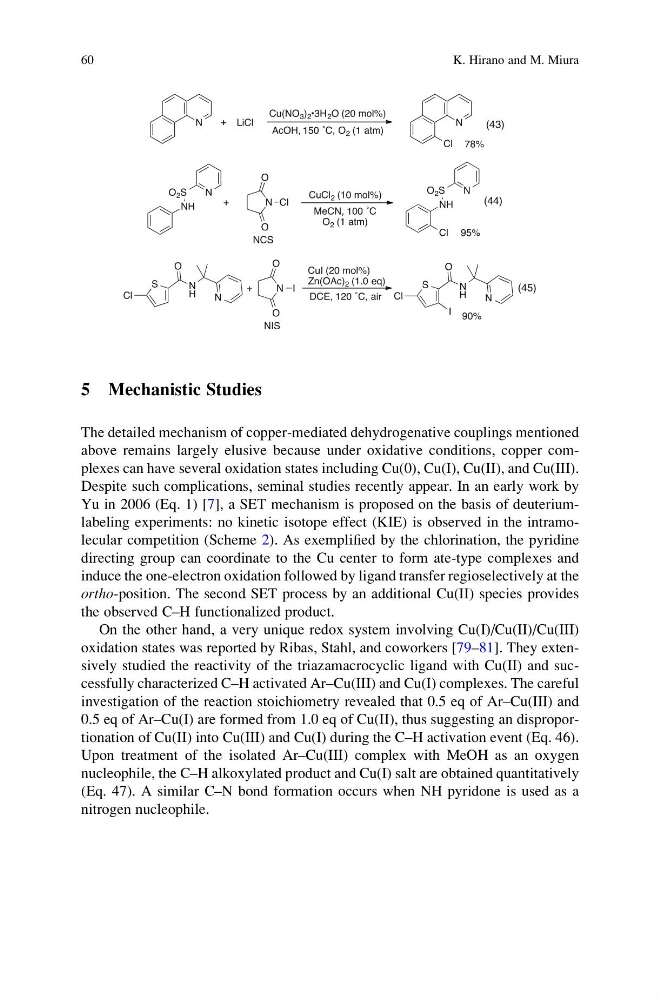
(43)
(44)
(45)
5 Mechanistic Studies
The detailed mechanism of copper-mediated dehydrogenative couplings mentioned
above remains largely elusive because under oxidative conditions, copper complexes can have several oxidation states including Cu(0), Cu(I), Cu(II), and Cu(III).
Despite such complications, seminal studies recently appear. In an early work by
Yu in 2006 (Eq. 1) [7], a SET mechanism is proposed on the basis of deuteriumlabeling experiments: no kinetic isotope effect (KIE) is observed in the intramolecular competition (Scheme 2). As exemplified by the chlorination, the pyridine
directing group can coordinate to the Cu center to form ate-type complexes and
induce the one-electron oxidation followed by ligand transfer regioselectively at the
ortho-position. The second SET process by an additional Cu(II) species provides
the observed C–H functionalized product.
On the other hand, a very unique redox system involving Cu(I)/Cu(II)/Cu(III)
oxidation states was reported by Ribas, Stahl, and coworkers [79–81]. They extensively studied the reactivity of the triazamacrocyclic ligand with Cu(II) and successfully characterized C–H activated Ar–Cu(III) and Cu(I) complexes. The careful
investigation of the reaction stoichiometry revealed that 0.5 eq of Ar–Cu(III) and
0.5 eq of Ar–Cu(I) are formed from 1.0 eq of Cu(II), thus suggesting an disproportionation of Cu(II) into Cu(III) and Cu(I) during the C–H activation event (Eq. 46).
Upon treatment of the isolated Ar–Cu(III) complex with MeOH as an oxygen
nucleophile, the C–H alkoxylated product and Cu(I) salt are obtained quantitatively
(Eq. 47). A similar C–N bond formation occurs when NH pyridone is used as a
nitrogen nucleophile.
60
K. Hirano and M. Miura
(44)
(45)
5 Mechanistic Studies
The detailed mechanism of copper-mediated dehydrogenative couplings mentioned
above remains largely elusive because under oxidative conditions, copper complexes can have several oxidation states including Cu(0), Cu(I), Cu(II), and Cu(III).
Despite such complications, seminal studies recently appear. In an early work by
Yu in 2006 (Eq. 1) [7], a SET mechanism is proposed on the basis of deuteriumlabeling experiments: no kinetic isotope effect (KIE) is observed in the intramolecular competition (Scheme 2). As exemplified by the chlorination, the pyridine
directing group can coordinate to the Cu center to form ate-type complexes and
induce the one-electron oxidation followed by ligand transfer regioselectively at the
ortho-position. The second SET process by an additional Cu(II) species provides
the observed C–H functionalized product.
On the other hand, a very unique redox system involving Cu(I)/Cu(II)/Cu(III)
oxidation states was reported by Ribas, Stahl, and coworkers [79–81]. They extensively studied the reactivity of the triazamacrocyclic ligand with Cu(II) and successfully characterized C–H activated Ar–Cu(III) and Cu(I) complexes. The careful
investigation of the reaction stoichiometry revealed that 0.5 eq of Ar–Cu(III) and
0.5 eq of Ar–Cu(I) are formed from 1.0 eq of Cu(II), thus suggesting an disproportionation of Cu(II) into Cu(III) and Cu(I) during the C–H activation event (Eq. 46).
Upon treatment of the isolated Ar–Cu(III) complex with MeOH as an oxygen
nucleophile, the C–H alkoxylated product and Cu(I) salt are obtained quantitatively
(Eq. 47). A similar C–N bond formation occurs when NH pyridone is used as a
nitrogen nucleophile.
60
K. Hirano and M. Miura