

dehydrogenative coupling with readily available (hetero)arenes and amines is ideal
but difficult, particularly in an intermolecular manner, even with the noble transition metals such as palladium. The challenging aromatic C–H/N–H coupling has
been recently achieved in copper-based systems.
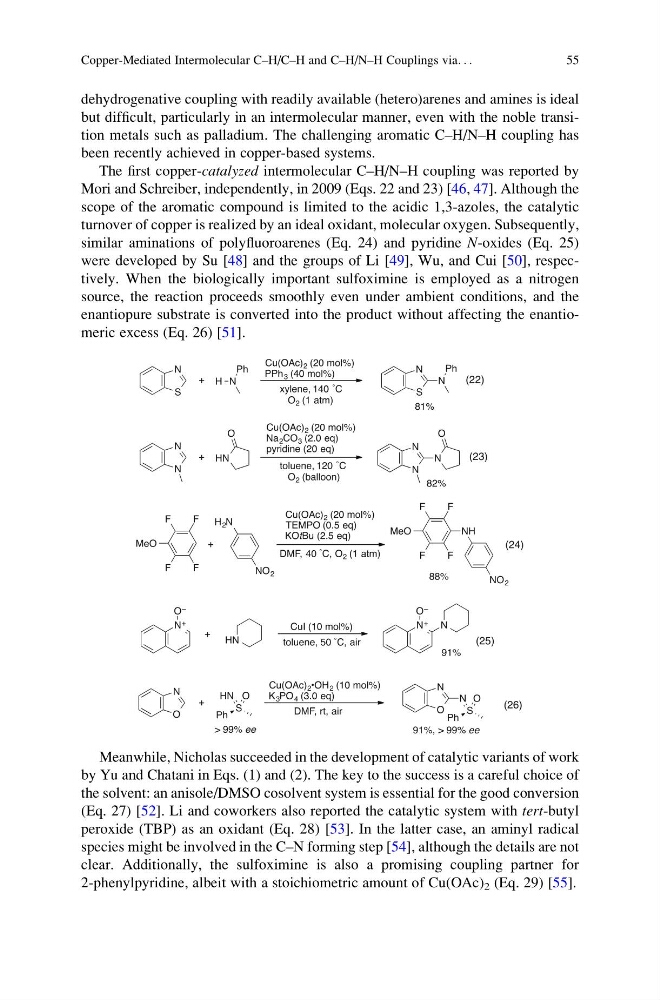
The first copper-catalyzed intermolecular C–H/N–H coupling was reported by
Mori and Schreiber, independently, in 2009 (Eqs. 22 and 23) [46, 47]. Although the
scope of the aromatic compound is limited to the acidic 1,3-azoles, the catalytic
turnover of copper is realized by an ideal oxidant, molecular oxygen. Subsequently,
similar aminations of polyfluoroarenes (Eq. 24) and pyridine N-oxides (Eq. 25)
were developed by Su [48] and the groups of Li [49], Wu, and Cui [50], respectively. When the biologically important sulfoximine is employed as a nitrogen
source, the reaction proceeds smoothly even under ambient conditions, and the
enantiopure substrate is converted into the product without affecting the enantiomeric excess (Eq. 26) [51].
(22)
(23)
(24)
(25)
(26)
Meanwhile, Nicholas succeeded in the development of catalytic variants of work
by Yu and Chatani in Eqs. (1) and (2). The key to the success is a careful choice of
the solvent: an anisole/DMSO cosolvent system is essential for the good conversion
(Eq. 27) [52]. Li and coworkers also reported the catalytic system with tert-butyl
peroxide (TBP) as an oxidant (Eq. 28) [53]. In the latter case, an aminyl radical
species might be involved in the C–N forming step [54], although the details are not
clear. Additionally, the sulfoximine is also a promising coupling partner for
2-phenylpyridine, albeit with a stoichiometric amount of Cu(OAc) 2 (Eq. 29) [55].
Copper-Mediated Intermolecular C–H/C–H and C–H/N–H Couplings via. . .
55
but difficult, particularly in an intermolecular manner, even with the noble transition metals such as palladium. The challenging aromatic C–H/N–H coupling has
been recently achieved in copper-based systems.
The first copper-catalyzed intermolecular C–H/N–H coupling was reported by
Mori and Schreiber, independently, in 2009 (Eqs. 22 and 23) [46, 47]. Although the
scope of the aromatic compound is limited to the acidic 1,3-azoles, the catalytic
turnover of copper is realized by an ideal oxidant, molecular oxygen. Subsequently,
similar aminations of polyfluoroarenes (Eq. 24) and pyridine N-oxides (Eq. 25)
were developed by Su [48] and the groups of Li [49], Wu, and Cui [50], respectively. When the biologically important sulfoximine is employed as a nitrogen
source, the reaction proceeds smoothly even under ambient conditions, and the
enantiopure substrate is converted into the product without affecting the enantiomeric excess (Eq. 26) [51].
(22)
(23)
(24)
(25)
(26)
Meanwhile, Nicholas succeeded in the development of catalytic variants of work
by Yu and Chatani in Eqs. (1) and (2). The key to the success is a careful choice of
the solvent: an anisole/DMSO cosolvent system is essential for the good conversion
(Eq. 27) [52]. Li and coworkers also reported the catalytic system with tert-butyl
peroxide (TBP) as an oxidant (Eq. 28) [53]. In the latter case, an aminyl radical
species might be involved in the C–N forming step [54], although the details are not
clear. Additionally, the sulfoximine is also a promising coupling partner for
2-phenylpyridine, albeit with a stoichiometric amount of Cu(OAc) 2 (Eq. 29) [55].
Copper-Mediated Intermolecular C–H/C–H and C–H/N–H Couplings via. . .
55