

(27)
(28)
(29)
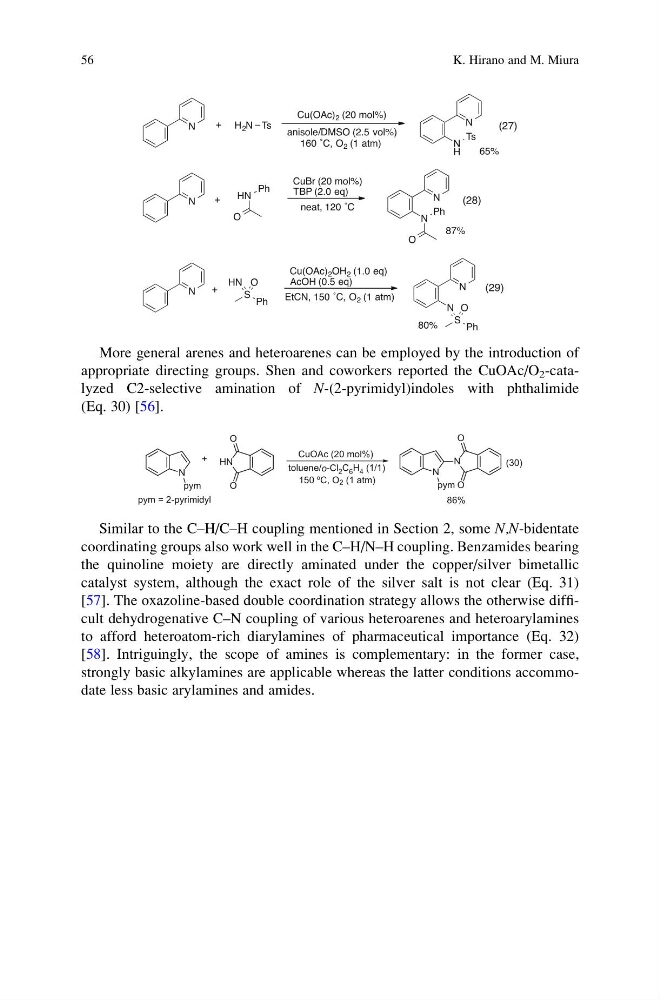
More general arenes and heteroarenes can be employed by the introduction of
appropriate directing groups. Shen and coworkers reported the CuOAc/O 2 -catalyzed C2-selective amination of N-(2-pyrimidyl)indoles with phthalimide
(Eq. 30) [56].
N
pym
pym = 2-pyrimidyl
+ HN
O
O
CuOAc (20 mol%)
toluene/o-Cl 2 C 6 H 4 (1/1)
150 ºC, O2 (1 atm)
N
pym
N
O
O
(30)
86%
Similar to the C–H/C–H coupling mentioned in Section 2, some N,N-bidentate
coordinating groups also work well in the C–H/N–H coupling. Benzamides bearing
the quinoline moiety are directly aminated under the copper/silver bimetallic
catalyst system, although the exact role of the silver salt is not clear (Eq. 31)
[57]. The oxazoline-based double coordination strategy allows the otherwise difficult dehydrogenative C–N coupling of various heteroarenes and heteroarylamines
to afford heteroatom-rich diarylamines of pharmaceutical importance (Eq. 32)
[58]. Intriguingly, the scope of amines is complementary: in the former case,
strongly basic alkylamines are applicable whereas the latter conditions accommodate less basic arylamines and amides.
56
K. Hirano and M. Miura
(28)
(29)
More general arenes and heteroarenes can be employed by the introduction of
appropriate directing groups. Shen and coworkers reported the CuOAc/O 2 -catalyzed C2-selective amination of N-(2-pyrimidyl)indoles with phthalimide
(Eq. 30) [56].
N
pym
pym = 2-pyrimidyl
+ HN
O
O
CuOAc (20 mol%)
toluene/o-Cl 2 C 6 H 4 (1/1)
150 ºC, O2 (1 atm)
N
pym
N
O
O
(30)
86%
Similar to the C–H/C–H coupling mentioned in Section 2, some N,N-bidentate
coordinating groups also work well in the C–H/N–H coupling. Benzamides bearing
the quinoline moiety are directly aminated under the copper/silver bimetallic
catalyst system, although the exact role of the silver salt is not clear (Eq. 31)
[57]. The oxazoline-based double coordination strategy allows the otherwise difficult dehydrogenative C–N coupling of various heteroarenes and heteroarylamines
to afford heteroatom-rich diarylamines of pharmaceutical importance (Eq. 32)
[58]. Intriguingly, the scope of amines is complementary: in the former case,
strongly basic alkylamines are applicable whereas the latter conditions accommodate less basic arylamines and amides.
56
K. Hirano and M. Miura