

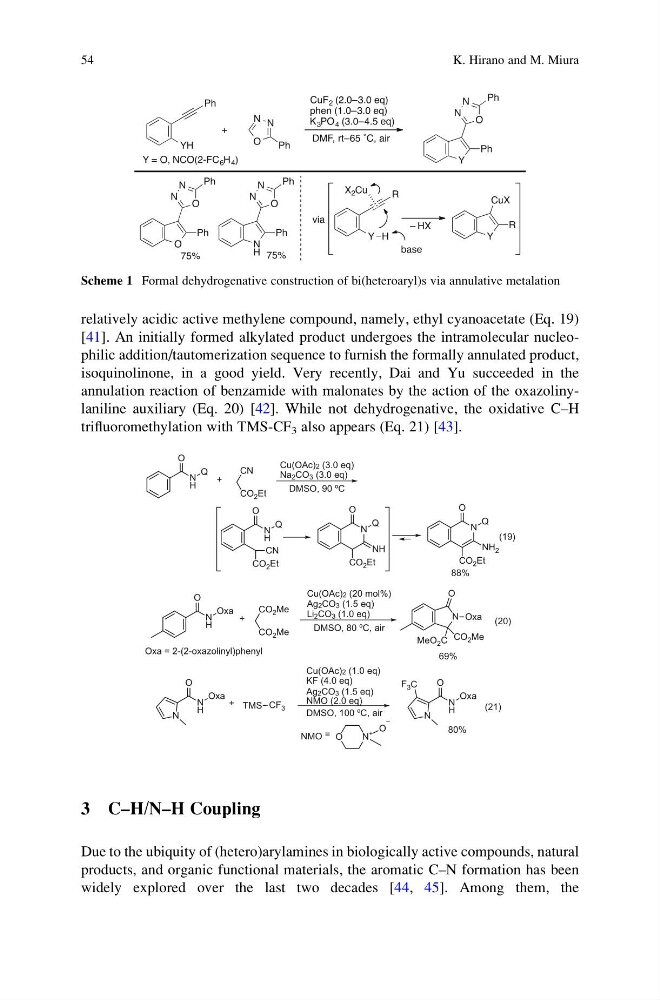
relatively acidic active methylene compound, namely, ethyl cyanoacetate (Eq. 19)
[41]. An initially formed alkylated product undergoes the intramolecular nucleophilic addition/tautomerization sequence to furnish the formally annulated product,
isoquinolinone, in a good yield. Very recently, Dai and Yu succeeded in the
annulation reaction of benzamide with malonates by the action of the oxazolinylaniline auxiliary (Eq. 20) [42]. While not dehydrogenative, the oxidative C–H
trifluoromethylation with TMS-CF 3 also appears (Eq. 21) [43].
O
N
H
Q
+
CN
CO 2 Et
Cu(OAc)2 (3.0 eq)
Na 2 CO 3 (3.0 eq)
DMSO, 90 ºC
O
N
H
Q
CN
CO 2 Et
N
Q
CO 2 Et
NH
O
N
Q
CO 2 Et
NH 2
O
88%
(19)
N
H
O
Oxa
Oxa = 2-(2-oxazolinyl)phenyl
+
CO 2 Me
CO 2 Me
Cu(OAc)2 (20 mol%)
Ag2CO3 (1.5 eq)
Li 2 CO 3 (1.0 eq)
DMSO, 80 ºC, air
N
O
Oxa
MeO 2 C CO 2 Me
69%
(20)
N
H
O
Oxa
N
+ TMS CF 3
Cu(OAc)2 (1.0 eq)
KF (4.0 eq)
Ag2CO3 (1.5 eq)
NMO (2.0 eq)
DMSO, 100 ºC, air
N
H
O
Oxa
N
F 3 C
80%
(21)
NMO = O
N
+
O
–
3 C–H/N–H Coupling
Due to the ubiquity of (hetero)arylamines in biologically active compounds, natural
products, and organic functional materials, the aromatic C–N formation has been
widely explored over the last two decades [44, 45]. Among them, the
Scheme 1 Formal dehydrogenative construction of bi(heteroaryl)s via annulative metalation
54
K. Hirano and M. Miura
[41]. An initially formed alkylated product undergoes the intramolecular nucleophilic addition/tautomerization sequence to furnish the formally annulated product,
isoquinolinone, in a good yield. Very recently, Dai and Yu succeeded in the
annulation reaction of benzamide with malonates by the action of the oxazolinylaniline auxiliary (Eq. 20) [42]. While not dehydrogenative, the oxidative C–H
trifluoromethylation with TMS-CF 3 also appears (Eq. 21) [43].
O
N
H
Q
+
CN
CO 2 Et
Cu(OAc)2 (3.0 eq)
Na 2 CO 3 (3.0 eq)
DMSO, 90 ºC
O
N
H
Q
CN
CO 2 Et
N
Q
CO 2 Et
NH
O
N
Q
CO 2 Et
NH 2
O
88%
(19)
N
H
O
Oxa
Oxa = 2-(2-oxazolinyl)phenyl
+
CO 2 Me
CO 2 Me
Cu(OAc)2 (20 mol%)
Ag2CO3 (1.5 eq)
Li 2 CO 3 (1.0 eq)
DMSO, 80 ºC, air
N
O
Oxa
MeO 2 C CO 2 Me
69%
(20)
N
H
O
Oxa
N
+ TMS CF 3
Cu(OAc)2 (1.0 eq)
KF (4.0 eq)
Ag2CO3 (1.5 eq)
NMO (2.0 eq)
DMSO, 100 ºC, air
N
H
O
Oxa
N
F 3 C
80%
(21)
NMO = O
N
+
O
–
3 C–H/N–H Coupling
Due to the ubiquity of (hetero)arylamines in biologically active compounds, natural
products, and organic functional materials, the aromatic C–N formation has been
widely explored over the last two decades [44, 45]. Among them, the
Scheme 1 Formal dehydrogenative construction of bi(heteroaryl)s via annulative metalation
54
K. Hirano and M. Miura