

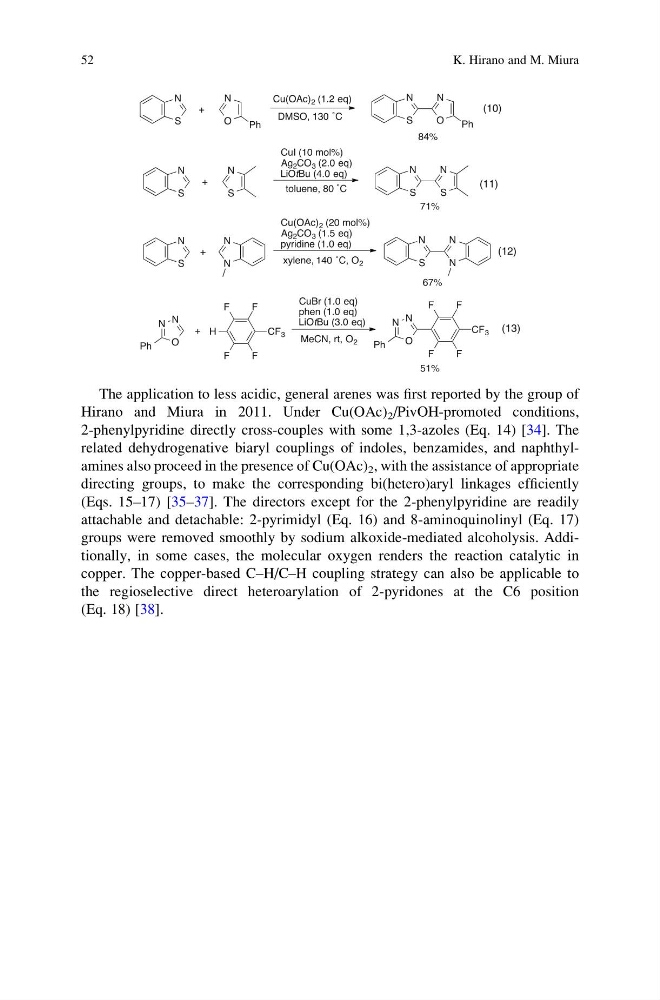
(10)
(11)
(12)
(13)
The application to less acidic, general arenes was first reported by the group of
Hirano and Miura in 2011. Under Cu(OAc) 2 /PivOH-promoted conditions,
2-phenylpyridine directly cross-couples with some 1,3-azoles (Eq. 14) [34]. The
related dehydrogenative biaryl couplings of indoles, benzamides, and naphthylamines also proceed in the presence of Cu(OAc) 2 , with the assistance of appropriate
directing groups, to make the corresponding bi(hetero)aryl linkages efficiently
(Eqs. 15–17) [35–37]. The directors except for the 2-phenylpyridine are readily
attachable and detachable: 2-pyrimidyl (Eq. 16) and 8-aminoquinolinyl (Eq. 17)
groups were removed smoothly by sodium alkoxide-mediated alcoholysis. Additionally, in some cases, the molecular oxygen renders the reaction catalytic in
copper. The copper-based C–H/C–H coupling strategy can also be applicable to
the regioselective direct heteroarylation of 2-pyridones at the C6 position
(Eq. 18) [38].
52
K. Hirano and M. Miura
(11)
(12)
(13)
The application to less acidic, general arenes was first reported by the group of
Hirano and Miura in 2011. Under Cu(OAc) 2 /PivOH-promoted conditions,
2-phenylpyridine directly cross-couples with some 1,3-azoles (Eq. 14) [34]. The
related dehydrogenative biaryl couplings of indoles, benzamides, and naphthylamines also proceed in the presence of Cu(OAc) 2 , with the assistance of appropriate
directing groups, to make the corresponding bi(hetero)aryl linkages efficiently
(Eqs. 15–17) [35–37]. The directors except for the 2-phenylpyridine are readily
attachable and detachable: 2-pyrimidyl (Eq. 16) and 8-aminoquinolinyl (Eq. 17)
groups were removed smoothly by sodium alkoxide-mediated alcoholysis. Additionally, in some cases, the molecular oxygen renders the reaction catalytic in
copper. The copper-based C–H/C–H coupling strategy can also be applicable to
the regioselective direct heteroarylation of 2-pyridones at the C6 position
(Eq. 18) [38].
52
K. Hirano and M. Miura