

three types of alkynylation, arylation, and alkylation, and their scope and limitations are described.
2.1 Alkynylation
Arylacetylenes are among the most fundamental and important π-conjugated systems in various areas of organic chemistry. A powerful and reliable approach to
these molecules is the palladium/copper-catalyzed cross-coupling of aryl halides
with terminal alkynes, also known as the Sonogashira coupling [13–16]. However,
the stoichiometric halogenation of arenes is inevitable for the preparation of the
starting halogenated arenes. Ultimately, the direct coupling between arenes and
terminal alkynes via twofold C–H bond cleavage of both substrates is an ideal goal
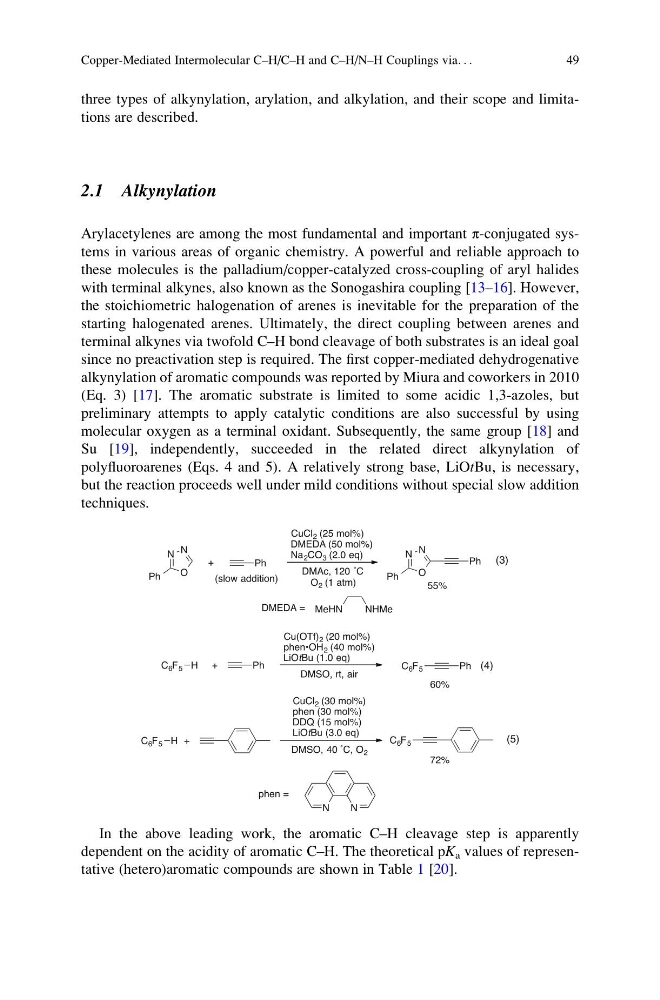
since no preactivation step is required. The first copper-mediated dehydrogenative
alkynylation of aromatic compounds was reported by Miura and coworkers in 2010
(Eq. 3) [17]. The aromatic substrate is limited to some acidic 1,3-azoles, but
preliminary attempts to apply catalytic conditions are also successful by using
molecular oxygen as a terminal oxidant. Subsequently, the same group [18] and
Su [19], independently, succeeded in the related direct alkynylation of
polyfluoroarenes (Eqs. 4 and 5). A relatively strong base, LiOtBu, is necessary,
but the reaction proceeds well under mild conditions without special slow addition
techniques.
In the above leading work, the aromatic C–H cleavage step is apparently
dependent on the acidity of aromatic C–H. The theoretical pK a values of representative (hetero)aromatic compounds are shown in Table 1 [20].
Copper-Mediated Intermolecular C–H/C–H and C–H/N–H Couplings via. . .
49
2.1 Alkynylation
Arylacetylenes are among the most fundamental and important π-conjugated systems in various areas of organic chemistry. A powerful and reliable approach to
these molecules is the palladium/copper-catalyzed cross-coupling of aryl halides
with terminal alkynes, also known as the Sonogashira coupling [13–16]. However,
the stoichiometric halogenation of arenes is inevitable for the preparation of the
starting halogenated arenes. Ultimately, the direct coupling between arenes and
terminal alkynes via twofold C–H bond cleavage of both substrates is an ideal goal
since no preactivation step is required. The first copper-mediated dehydrogenative
alkynylation of aromatic compounds was reported by Miura and coworkers in 2010
(Eq. 3) [17]. The aromatic substrate is limited to some acidic 1,3-azoles, but
preliminary attempts to apply catalytic conditions are also successful by using
molecular oxygen as a terminal oxidant. Subsequently, the same group [18] and
Su [19], independently, succeeded in the related direct alkynylation of
polyfluoroarenes (Eqs. 4 and 5). A relatively strong base, LiOtBu, is necessary,
but the reaction proceeds well under mild conditions without special slow addition
techniques.
In the above leading work, the aromatic C–H cleavage step is apparently
dependent on the acidity of aromatic C–H. The theoretical pK a values of representative (hetero)aromatic compounds are shown in Table 1 [20].
Copper-Mediated Intermolecular C–H/C–H and C–H/N–H Couplings via. . .
49