

1 Introduction
Since the pioneering work on the ruthenium-catalyzed directed C–H alkylation by
Murai and coworkers [1], the transition metal-mediated C–H functionalization has
grown rapidly because of its possibility for transformation of ubiquitous C–H bonds
to versatile functional groups in atom- and step-economical manners. While the
second- and third-row transition metal catalysts such as palladium, rhodium, and
ruthenium have initially been developed, for the realistic catalyst loading, many
researchers then turned attention into less expensive and easy-to-handle first-row
transition metals. Particularly, less toxic and abundant copper salts are attractive
alternatives for the above noble metal catalysts and have great potential for ideal
but greatly challenging intermolecular C–H/C–H and C–H/N–H couplings [2–6]. In
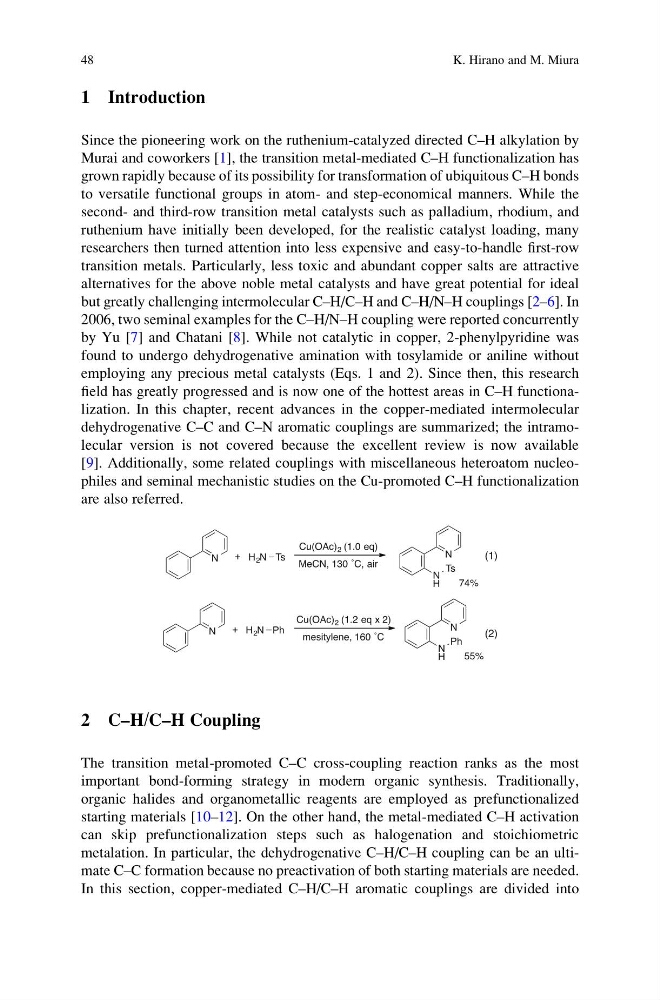
2006, two seminal examples for the C–H/N–H coupling were reported concurrently
by Yu [7] and Chatani [8]. While not catalytic in copper, 2-phenylpyridine was
found to undergo dehydrogenative amination with tosylamide or aniline without
employing any precious metal catalysts (Eqs. 1 and 2). Since then, this research
field has greatly progressed and is now one of the hottest areas in C–H functionalization. In this chapter, recent advances in the copper-mediated intermolecular
dehydrogenative C–C and C–N aromatic couplings are summarized; the intramolecular version is not covered because the excellent review is now available
[9]. Additionally, some related couplings with miscellaneous heteroatom nucleophiles and seminal mechanistic studies on the Cu-promoted C–H functionalization
are also referred.
2 C–H/C–H Coupling
The transition metal-promoted C–C cross-coupling reaction ranks as the most
important bond-forming strategy in modern organic synthesis. Traditionally,
organic halides and organometallic reagents are employed as prefunctionalized
starting materials [10–12]. On the other hand, the metal-mediated C–H activation
can skip prefunctionalization steps such as halogenation and stoichiometric
metalation. In particular, the dehydrogenative C–H/C–H coupling can be an ultimate C–C formation because no preactivation of both starting materials are needed.
In this section, copper-mediated C–H/C–H aromatic couplings are divided into
48
K. Hirano and M. Miura
Since the pioneering work on the ruthenium-catalyzed directed C–H alkylation by
Murai and coworkers [1], the transition metal-mediated C–H functionalization has
grown rapidly because of its possibility for transformation of ubiquitous C–H bonds
to versatile functional groups in atom- and step-economical manners. While the
second- and third-row transition metal catalysts such as palladium, rhodium, and
ruthenium have initially been developed, for the realistic catalyst loading, many
researchers then turned attention into less expensive and easy-to-handle first-row
transition metals. Particularly, less toxic and abundant copper salts are attractive
alternatives for the above noble metal catalysts and have great potential for ideal
but greatly challenging intermolecular C–H/C–H and C–H/N–H couplings [2–6]. In
2006, two seminal examples for the C–H/N–H coupling were reported concurrently
by Yu [7] and Chatani [8]. While not catalytic in copper, 2-phenylpyridine was
found to undergo dehydrogenative amination with tosylamide or aniline without
employing any precious metal catalysts (Eqs. 1 and 2). Since then, this research
field has greatly progressed and is now one of the hottest areas in C–H functionalization. In this chapter, recent advances in the copper-mediated intermolecular
dehydrogenative C–C and C–N aromatic couplings are summarized; the intramolecular version is not covered because the excellent review is now available
[9]. Additionally, some related couplings with miscellaneous heteroatom nucleophiles and seminal mechanistic studies on the Cu-promoted C–H functionalization
are also referred.
2 C–H/C–H Coupling
The transition metal-promoted C–C cross-coupling reaction ranks as the most
important bond-forming strategy in modern organic synthesis. Traditionally,
organic halides and organometallic reagents are employed as prefunctionalized
starting materials [10–12]. On the other hand, the metal-mediated C–H activation
can skip prefunctionalization steps such as halogenation and stoichiometric
metalation. In particular, the dehydrogenative C–H/C–H coupling can be an ultimate C–C formation because no preactivation of both starting materials are needed.
In this section, copper-mediated C–H/C–H aromatic couplings are divided into
48
K. Hirano and M. Miura