

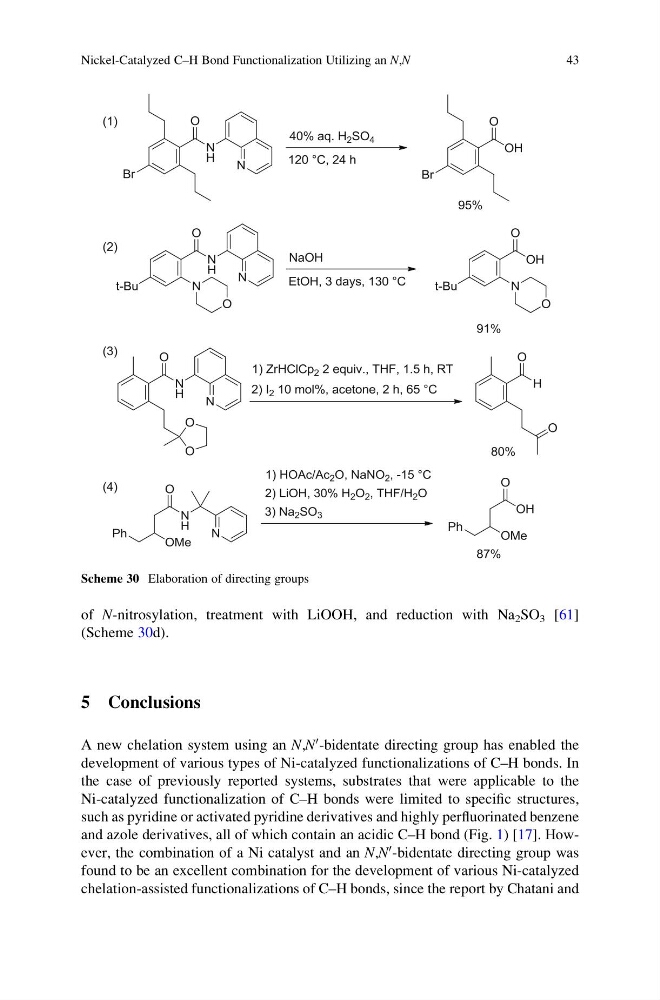
of N-nitrosylation, treatment with LiOOH, and reduction with Na 2 SO 3 [61]
(Scheme 30d).
5 Conclusions
A new chelation system using an N,N
0 -bidentate directing group has enabled the
development of various types of Ni-catalyzed functionalizations of C–H bonds. In
the case of previously reported systems, substrates that were applicable to the
Ni-catalyzed functionalization of C–H bonds were limited to specific structures,
such as pyridine or activated pyridine derivatives and highly perfluorinated benzene
and azole derivatives, all of which contain an acidic C–H bond (Fig. 1) [17]. However, the combination of a Ni catalyst and an N,N
0 -bidentate directing group was
found to be an excellent combination for the development of various Ni-catalyzed
chelation-assisted functionalizations of C–H bonds, since the report by Chatani and
Scheme 30 Elaboration of directing groups
Nickel-Catalyzed C–H Bond Functionalization Utilizing an N,N
43
(Scheme 30d).
5 Conclusions
A new chelation system using an N,N
0 -bidentate directing group has enabled the
development of various types of Ni-catalyzed functionalizations of C–H bonds. In
the case of previously reported systems, substrates that were applicable to the
Ni-catalyzed functionalization of C–H bonds were limited to specific structures,
such as pyridine or activated pyridine derivatives and highly perfluorinated benzene
and azole derivatives, all of which contain an acidic C–H bond (Fig. 1) [17]. However, the combination of a Ni catalyst and an N,N
0 -bidentate directing group was
found to be an excellent combination for the development of various Ni-catalyzed
chelation-assisted functionalizations of C–H bonds, since the report by Chatani and
Scheme 30 Elaboration of directing groups
Nickel-Catalyzed C–H Bond Functionalization Utilizing an N,N
43