

coworkers in 2011, on the use of an N,N
0 -bidentate directing group in the first
example of the Ni-catalyzed chelation-assisted functionalization of C–H
bonds [20].
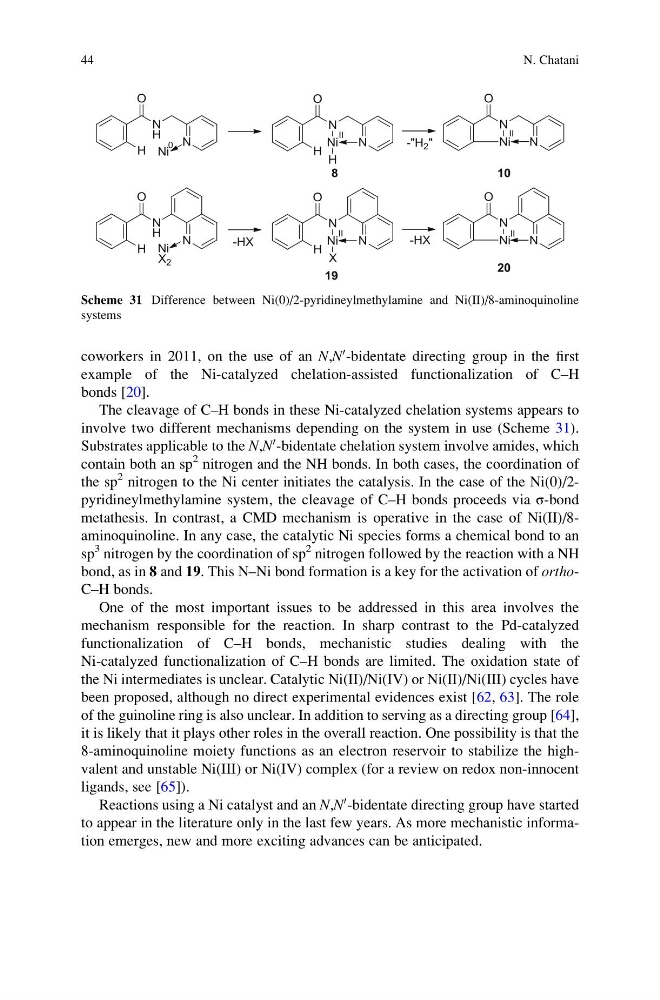
The cleavage of C–H bonds in these Ni-catalyzed chelation systems appears to
involve two different mechanisms depending on the system in use (Scheme 31).
Substrates applicable to the N,N
0 -bidentate chelation system involve amides, which
contain both an sp
2 nitrogen and the NH bonds. In both cases, the coordination of
the sp
2 nitrogen to the Ni center initiates the catalysis. In the case of the Ni(0)/2pyridineylmethylamine system, the cleavage of C–H bonds proceeds via σ-bond
metathesis. In contrast, a CMD mechanism is operative in the case of Ni(II)/8aminoquinoline. In any case, the catalytic Ni species forms a chemical bond to an
sp
3 nitrogen by the coordination of sp
2 nitrogen followed by the reaction with a NH
bond, as in 8 and 19. This N–Ni bond formation is a key for the activation of orthoC–H bonds.
One of the most important issues to be addressed in this area involves the
mechanism responsible for the reaction. In sharp contrast to the Pd-catalyzed
functionalization of C–H bonds, mechanistic studies dealing with the
Ni-catalyzed functionalization of C–H bonds are limited. The oxidation state of
the Ni intermediates is unclear. Catalytic Ni(II)/Ni(IV) or Ni(II)/Ni(III) cycles have
been proposed, although no direct experimental evidences exist [62, 63]. The role
of the guinoline ring is also unclear. In addition to serving as a directing group [64],
it is likely that it plays other roles in the overall reaction. One possibility is that the
8-aminoquinoline moiety functions as an electron reservoir to stabilize the highvalent and unstable Ni(III) or Ni(IV) complex (for a review on redox non-innocent
ligands, see [65]).
Reactions using a Ni catalyst and an N,N
0 -bidentate directing group have started
to appear in the literature only in the last few years. As more mechanistic information emerges, new and more exciting advances can be anticipated.
Scheme 31 Difference between Ni(0)/2-pyridineylmethylamine and Ni(II)/8-aminoquinoline
systems
44
N. Chatani
0 -bidentate directing group in the first
example of the Ni-catalyzed chelation-assisted functionalization of C–H
bonds [20].
The cleavage of C–H bonds in these Ni-catalyzed chelation systems appears to
involve two different mechanisms depending on the system in use (Scheme 31).
Substrates applicable to the N,N
0 -bidentate chelation system involve amides, which
contain both an sp
2 nitrogen and the NH bonds. In both cases, the coordination of
the sp
2 nitrogen to the Ni center initiates the catalysis. In the case of the Ni(0)/2pyridineylmethylamine system, the cleavage of C–H bonds proceeds via σ-bond
metathesis. In contrast, a CMD mechanism is operative in the case of Ni(II)/8aminoquinoline. In any case, the catalytic Ni species forms a chemical bond to an
sp
3 nitrogen by the coordination of sp
2 nitrogen followed by the reaction with a NH
bond, as in 8 and 19. This N–Ni bond formation is a key for the activation of orthoC–H bonds.
One of the most important issues to be addressed in this area involves the
mechanism responsible for the reaction. In sharp contrast to the Pd-catalyzed
functionalization of C–H bonds, mechanistic studies dealing with the
Ni-catalyzed functionalization of C–H bonds are limited. The oxidation state of
the Ni intermediates is unclear. Catalytic Ni(II)/Ni(IV) or Ni(II)/Ni(III) cycles have
been proposed, although no direct experimental evidences exist [62, 63]. The role
of the guinoline ring is also unclear. In addition to serving as a directing group [64],
it is likely that it plays other roles in the overall reaction. One possibility is that the
8-aminoquinoline moiety functions as an electron reservoir to stabilize the highvalent and unstable Ni(III) or Ni(IV) complex (for a review on redox non-innocent
ligands, see [65]).
Reactions using a Ni catalyst and an N,N
0 -bidentate directing group have started
to appear in the literature only in the last few years. As more mechanistic information emerges, new and more exciting advances can be anticipated.
Scheme 31 Difference between Ni(0)/2-pyridineylmethylamine and Ni(II)/8-aminoquinoline
systems
44
N. Chatani