

3.5 C–N Bond Formation
Ge reported on the TEMPO-assisted Ni(II)-catalyzed intramolecular cyclization of
C–H bonds in aliphatic amides leading to the formation of β-lactam derivatives with
the assistance of an 8-aminoquinoline directing group (Scheme 28) [55]. Amidation
took place at the methyl C–H bond preferentially over phenyl C–H bonds, as in 61.
If the substrate did not contain a methyl group at the β-position, the reaction took
place at the benzylic C–H bonds, as in 62 and 63. A 5-methoxy-8-aminoquinoline
can be used as the directing group, as in 64, and the directing group can be easily
removed under oxidation conditions using cerium (IV) ammonium nitrate (CAN).
A Ni(II)/Ni(III) catalytic cycle is proposed (Scheme 29). Catalysis is initiated by
the coordination of 46 to Ni(II) followed by a ligand exchange and the cleavage of
C–H bonds gives the cyclometalated Ni(II) complex 50, which is oxidized to the Ni
(III) species 65 by TEMPO. Reductive elimination gives the desired product 60
with the generation of a Ni(I) species that is oxidized to Ni(II) species by TEMPO.
4 Elaboration of Directing Groups
Three different directing groups, such as 2-pyridinylmethylamine,
8-aminoquinoline or derivatives thereof, and (pyridine-2-yl)isopropylamine moieties, have been used as the directing group in Ni-catalyzed chelation-assisted C–H
functionalization reactions. These directing groups are easily converted to other
synthetically useful functional groups. Deprotection of an 8-aminoquinline moiety
to carboxylic acids was easily achieved by hydrolysis under acidic conditions
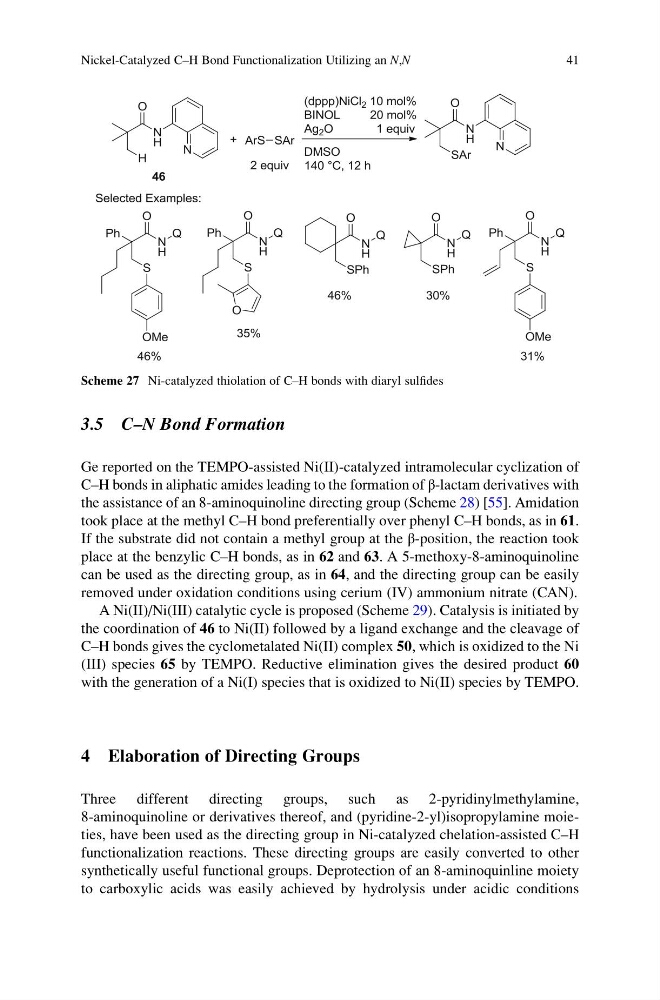
Scheme 27 Ni-catalyzed thiolation of C–H bonds with diaryl sulfides
Nickel-Catalyzed C–H Bond Functionalization Utilizing an N,N
41
Ge reported on the TEMPO-assisted Ni(II)-catalyzed intramolecular cyclization of
C–H bonds in aliphatic amides leading to the formation of β-lactam derivatives with
the assistance of an 8-aminoquinoline directing group (Scheme 28) [55]. Amidation
took place at the methyl C–H bond preferentially over phenyl C–H bonds, as in 61.
If the substrate did not contain a methyl group at the β-position, the reaction took
place at the benzylic C–H bonds, as in 62 and 63. A 5-methoxy-8-aminoquinoline
can be used as the directing group, as in 64, and the directing group can be easily
removed under oxidation conditions using cerium (IV) ammonium nitrate (CAN).
A Ni(II)/Ni(III) catalytic cycle is proposed (Scheme 29). Catalysis is initiated by
the coordination of 46 to Ni(II) followed by a ligand exchange and the cleavage of
C–H bonds gives the cyclometalated Ni(II) complex 50, which is oxidized to the Ni
(III) species 65 by TEMPO. Reductive elimination gives the desired product 60
with the generation of a Ni(I) species that is oxidized to Ni(II) species by TEMPO.
4 Elaboration of Directing Groups
Three different directing groups, such as 2-pyridinylmethylamine,
8-aminoquinoline or derivatives thereof, and (pyridine-2-yl)isopropylamine moieties, have been used as the directing group in Ni-catalyzed chelation-assisted C–H
functionalization reactions. These directing groups are easily converted to other
synthetically useful functional groups. Deprotection of an 8-aminoquinline moiety
to carboxylic acids was easily achieved by hydrolysis under acidic conditions
Scheme 27 Ni-catalyzed thiolation of C–H bonds with diaryl sulfides
Nickel-Catalyzed C–H Bond Functionalization Utilizing an N,N
41