

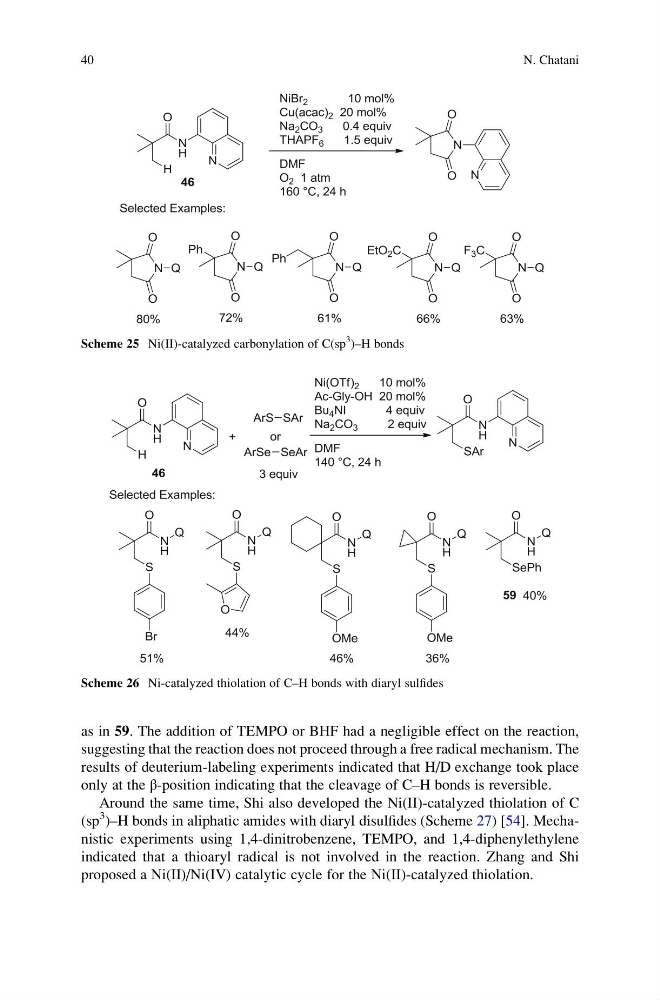
as in 59. The addition of TEMPO or BHF had a negligible effect on the reaction,
suggesting that the reaction does not proceed through a free radical mechanism. The
results of deuterium-labeling experiments indicated that H/D exchange took place
only at the β-position indicating that the cleavage of C–H bonds is reversible.
Around the same time, Shi also developed the Ni(II)-catalyzed thiolation of C
(sp
3 )–H bonds in aliphatic amides with diaryl disulfides (Scheme 27) [54]. Mechanistic experiments using 1,4-dinitrobenzene, TEMPO, and 1,4-diphenylethylene
indicated that a thioaryl radical is not involved in the reaction. Zhang and Shi
proposed a Ni(II)/Ni(IV) catalytic cycle for the Ni(II)-catalyzed thiolation.
Scheme 25 Ni(II)-catalyzed carbonylation of C(sp
3
)–H bonds
Scheme 26 Ni-catalyzed thiolation of C–H bonds with diaryl sulfides
40
N. Chatani
suggesting that the reaction does not proceed through a free radical mechanism. The
results of deuterium-labeling experiments indicated that H/D exchange took place
only at the β-position indicating that the cleavage of C–H bonds is reversible.
Around the same time, Shi also developed the Ni(II)-catalyzed thiolation of C
(sp
3 )–H bonds in aliphatic amides with diaryl disulfides (Scheme 27) [54]. Mechanistic experiments using 1,4-dinitrobenzene, TEMPO, and 1,4-diphenylethylene
indicated that a thioaryl radical is not involved in the reaction. Zhang and Shi
proposed a Ni(II)/Ni(IV) catalytic cycle for the Ni(II)-catalyzed thiolation.
Scheme 25 Ni(II)-catalyzed carbonylation of C(sp
3
)–H bonds
Scheme 26 Ni-catalyzed thiolation of C–H bonds with diaryl sulfides
40
N. Chatani