

3.2 Alkylation of C(sp
3
)–H Bonds
Ge reported on the Ni(II)-catalyzed alkylation of C(sp
3 )–H bonds with alkyl halides
by taking advantage of an 8-aminoquinoline directing group (Scheme 24) [52]. In
sharp contrast to the arylation of C(sp
3 )–H bonds [47], Ni(cod) 2 was not active as a
catalyst. It was found that various phosphine ligands improved the product yield.
Among the phosphine ligands screened, 1,2-bis(diphenylphosphino)benzene
(dppbz) gave the best result. The reaction tolerated various functional groups,
such as terminal alkenes (55), esters (56), cyano groups (57), and trifluoromethyl
groups (58). It was found that alkyl iodides could be replaced with alkyl bromides
with the addition of CsI, as in 55–57.
In contrast to the mechanism proposed by Chatani (Schemes 7, 11, and 20),
which involves a Ni(II)/Ni(IV) catalytic cycle, a Ni(II)/Ni(III) cycle was proposed.
When TEMPO was added, the yield of the product 54 was decreased: 0 equiv. 86%,
3 equiv. 46%, and 8 equiv. trace. In addition, the corresponding pentyl TEMP ether
was isolated. On the basis of these observations, a Ni(II)/Ni(III) catalytic cycle was
proposed. The cyclometalated complex 50 reacts with an alkyl radical, which is
generated through SET from a Ni(I) species to an alkyl halide with the concomitant
generation of a Ni(II) species. In this catalytic system, H/D exchange did not take
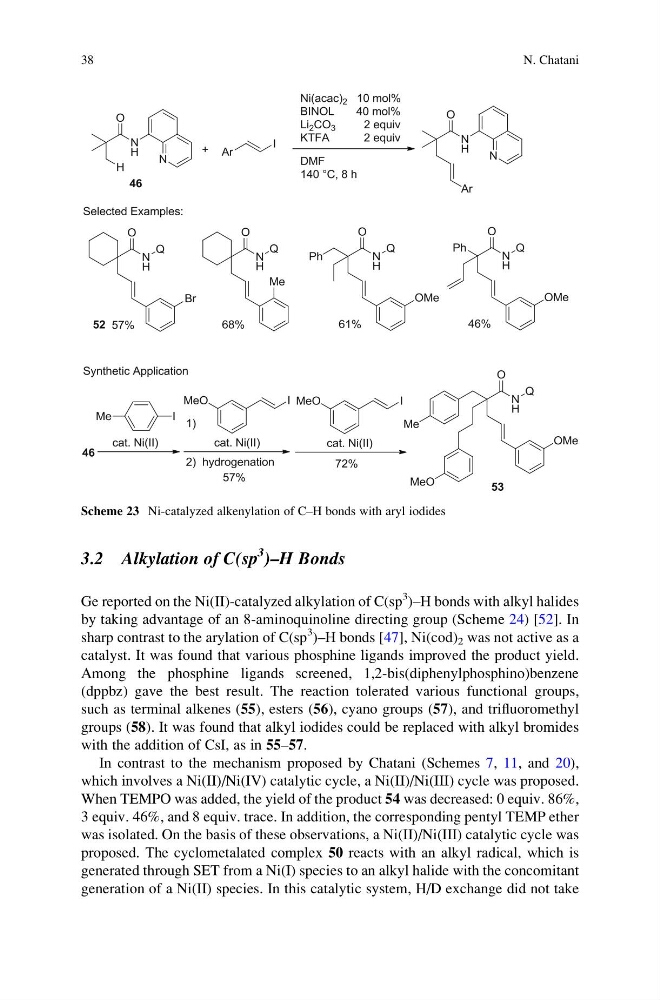
Scheme 23 Ni-catalyzed alkenylation of C–H bonds with aryl iodides
38
N. Chatani
3
)–H Bonds
Ge reported on the Ni(II)-catalyzed alkylation of C(sp
3 )–H bonds with alkyl halides
by taking advantage of an 8-aminoquinoline directing group (Scheme 24) [52]. In
sharp contrast to the arylation of C(sp
3 )–H bonds [47], Ni(cod) 2 was not active as a
catalyst. It was found that various phosphine ligands improved the product yield.
Among the phosphine ligands screened, 1,2-bis(diphenylphosphino)benzene
(dppbz) gave the best result. The reaction tolerated various functional groups,
such as terminal alkenes (55), esters (56), cyano groups (57), and trifluoromethyl
groups (58). It was found that alkyl iodides could be replaced with alkyl bromides
with the addition of CsI, as in 55–57.
In contrast to the mechanism proposed by Chatani (Schemes 7, 11, and 20),
which involves a Ni(II)/Ni(IV) catalytic cycle, a Ni(II)/Ni(III) cycle was proposed.
When TEMPO was added, the yield of the product 54 was decreased: 0 equiv. 86%,
3 equiv. 46%, and 8 equiv. trace. In addition, the corresponding pentyl TEMP ether
was isolated. On the basis of these observations, a Ni(II)/Ni(III) catalytic cycle was
proposed. The cyclometalated complex 50 reacts with an alkyl radical, which is
generated through SET from a Ni(I) species to an alkyl halide with the concomitant
generation of a Ni(II) species. In this catalytic system, H/D exchange did not take
Scheme 23 Ni-catalyzed alkenylation of C–H bonds with aryl iodides
38
N. Chatani