

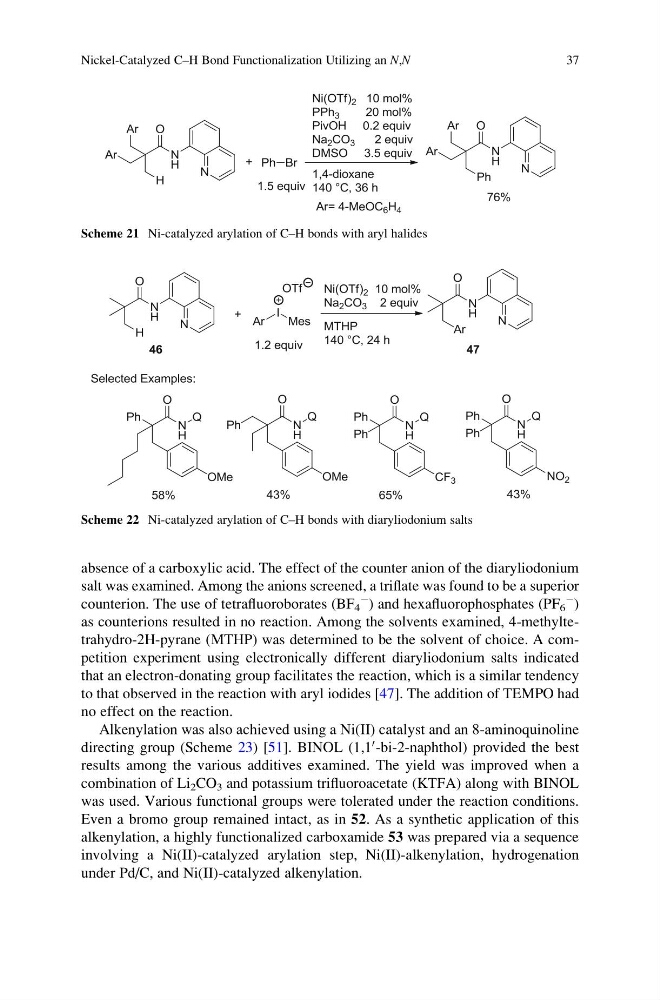
absence of a carboxylic acid. The effect of the counter anion of the diaryliodonium
salt was examined. Among the anions screened, a triflate was found to be a superior
counterion. The use of tetrafluoroborates (BF 4
À
) and hexafluorophosphates (PF 6
À
)
as counterions resulted in no reaction. Among the solvents examined, 4-methyltetrahydro-2H-pyrane (MTHP) was determined to be the solvent of choice. A competition experiment using electronically different diaryliodonium salts indicated
that an electron-donating group facilitates the reaction, which is a similar tendency
to that observed in the reaction with aryl iodides [47]. The addition of TEMPO had
no effect on the reaction.
Alkenylation was also achieved using a Ni(II) catalyst and an 8-aminoquinoline
directing group (Scheme 23) [51]. BINOL (1,1
0 -bi-2-naphthol) provided the best
results among the various additives examined. The yield was improved when a
combination of Li 2 CO 3 and potassium trifluoroacetate (KTFA) along with BINOL
was used. Various functional groups were tolerated under the reaction conditions.
Even a bromo group remained intact, as in 52. As a synthetic application of this
alkenylation, a highly functionalized carboxamide 53 was prepared via a sequence
involving a Ni(II)-catalyzed arylation step, Ni(II)-alkenylation, hydrogenation
under Pd/C, and Ni(II)-catalyzed alkenylation.
Scheme 21 Ni-catalyzed arylation of C–H bonds with aryl halides
Scheme 22 Ni-catalyzed arylation of C–H bonds with diaryliodonium salts
Nickel-Catalyzed C–H Bond Functionalization Utilizing an N,N
37
salt was examined. Among the anions screened, a triflate was found to be a superior
counterion. The use of tetrafluoroborates (BF 4
À
) and hexafluorophosphates (PF 6
À
)
as counterions resulted in no reaction. Among the solvents examined, 4-methyltetrahydro-2H-pyrane (MTHP) was determined to be the solvent of choice. A competition experiment using electronically different diaryliodonium salts indicated
that an electron-donating group facilitates the reaction, which is a similar tendency
to that observed in the reaction with aryl iodides [47]. The addition of TEMPO had
no effect on the reaction.
Alkenylation was also achieved using a Ni(II) catalyst and an 8-aminoquinoline
directing group (Scheme 23) [51]. BINOL (1,1
0 -bi-2-naphthol) provided the best
results among the various additives examined. The yield was improved when a
combination of Li 2 CO 3 and potassium trifluoroacetate (KTFA) along with BINOL
was used. Various functional groups were tolerated under the reaction conditions.
Even a bromo group remained intact, as in 52. As a synthetic application of this
alkenylation, a highly functionalized carboxamide 53 was prepared via a sequence
involving a Ni(II)-catalyzed arylation step, Ni(II)-alkenylation, hydrogenation
under Pd/C, and Ni(II)-catalyzed alkenylation.
Scheme 21 Ni-catalyzed arylation of C–H bonds with aryl halides
Scheme 22 Ni-catalyzed arylation of C–H bonds with diaryliodonium salts
Nickel-Catalyzed C–H Bond Functionalization Utilizing an N,N
37