

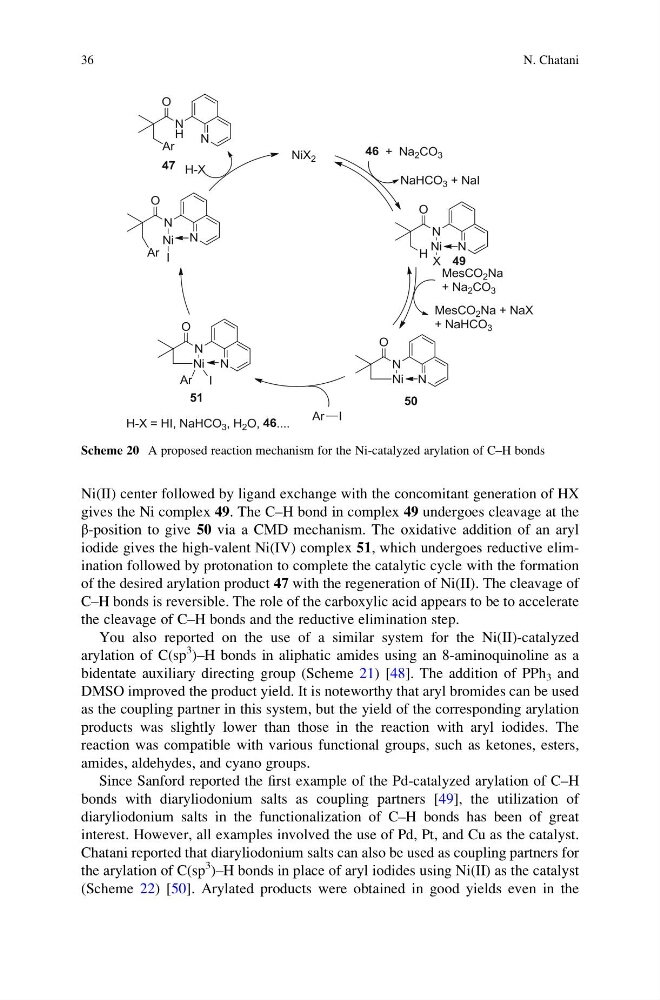
Ni(II) center followed by ligand exchange with the concomitant generation of HX
gives the Ni complex 49. The C–H bond in complex 49 undergoes cleavage at the
β-position to give 50 via a CMD mechanism. The oxidative addition of an aryl
iodide gives the high-valent Ni(IV) complex 51, which undergoes reductive elimination followed by protonation to complete the catalytic cycle with the formation
of the desired arylation product 47 with the regeneration of Ni(II). The cleavage of
C–H bonds is reversible. The role of the carboxylic acid appears to be to accelerate
the cleavage of C–H bonds and the reductive elimination step.
You also reported on the use of a similar system for the Ni(II)-catalyzed
arylation of C(sp
3 )–H bonds in aliphatic amides using an 8-aminoquinoline as a
bidentate auxiliary directing group (Scheme 21) [48]. The addition of PPh 3 and
DMSO improved the product yield. It is noteworthy that aryl bromides can be used
as the coupling partner in this system, but the yield of the corresponding arylation
products was slightly lower than those in the reaction with aryl iodides. The
reaction was compatible with various functional groups, such as ketones, esters,
amides, aldehydes, and cyano groups.
Since Sanford reported the first example of the Pd-catalyzed arylation of C–H
bonds with diaryliodonium salts as coupling partners [49], the utilization of
diaryliodonium salts in the functionalization of C–H bonds has been of great
interest. However, all examples involved the use of Pd, Pt, and Cu as the catalyst.
Chatani reported that diaryliodonium salts can also be used as coupling partners for
the arylation of C(sp
3 )–H bonds in place of aryl iodides using Ni(II) as the catalyst
(Scheme 22) [50]. Arylated products were obtained in good yields even in the
Scheme 20 A proposed reaction mechanism for the Ni-catalyzed arylation of C–H bonds
36
N. Chatani
gives the Ni complex 49. The C–H bond in complex 49 undergoes cleavage at the
β-position to give 50 via a CMD mechanism. The oxidative addition of an aryl
iodide gives the high-valent Ni(IV) complex 51, which undergoes reductive elimination followed by protonation to complete the catalytic cycle with the formation
of the desired arylation product 47 with the regeneration of Ni(II). The cleavage of
C–H bonds is reversible. The role of the carboxylic acid appears to be to accelerate
the cleavage of C–H bonds and the reductive elimination step.
You also reported on the use of a similar system for the Ni(II)-catalyzed
arylation of C(sp
3 )–H bonds in aliphatic amides using an 8-aminoquinoline as a
bidentate auxiliary directing group (Scheme 21) [48]. The addition of PPh 3 and
DMSO improved the product yield. It is noteworthy that aryl bromides can be used
as the coupling partner in this system, but the yield of the corresponding arylation
products was slightly lower than those in the reaction with aryl iodides. The
reaction was compatible with various functional groups, such as ketones, esters,
amides, aldehydes, and cyano groups.
Since Sanford reported the first example of the Pd-catalyzed arylation of C–H
bonds with diaryliodonium salts as coupling partners [49], the utilization of
diaryliodonium salts in the functionalization of C–H bonds has been of great
interest. However, all examples involved the use of Pd, Pt, and Cu as the catalyst.
Chatani reported that diaryliodonium salts can also be used as coupling partners for
the arylation of C(sp
3 )–H bonds in place of aryl iodides using Ni(II) as the catalyst
(Scheme 22) [50]. Arylated products were obtained in good yields even in the
Scheme 20 A proposed reaction mechanism for the Ni-catalyzed arylation of C–H bonds
36
N. Chatani