

and pharmaceuticals. Much attention has been currently focused on the functionalization of C(sp
3 )–H bonds, which continues to be a challenging issue. In 2014,
Chatani reported the first example of the Ni(II)-catalyzed β-arylation of C(sp
3 )–H
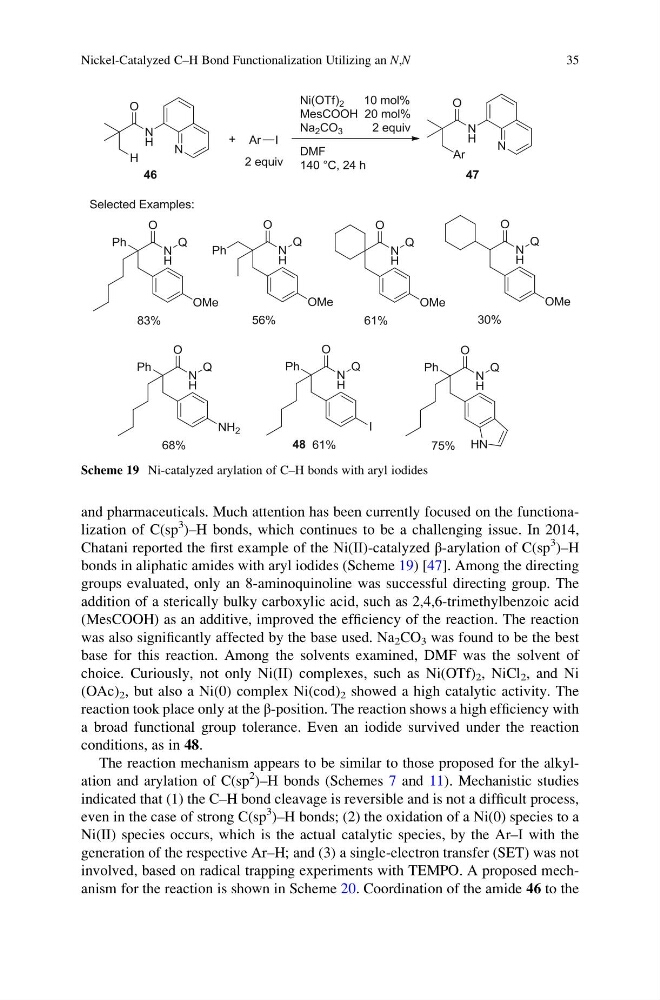
bonds in aliphatic amides with aryl iodides (Scheme 19) [47]. Among the directing
groups evaluated, only an 8-aminoquinoline was successful directing group. The
addition of a sterically bulky carboxylic acid, such as 2,4,6-trimethylbenzoic acid
(MesCOOH) as an additive, improved the efficiency of the reaction. The reaction
was also significantly affected by the base used. Na 2 CO 3 was found to be the best
base for this reaction. Among the solvents examined, DMF was the solvent of
choice. Curiously, not only Ni(II) complexes, such as Ni(OTf) 2 , NiCl 2 , and Ni
(OAc) 2 , but also a Ni(0) complex Ni(cod) 2 showed a high catalytic activity. The
reaction took place only at the β-position. The reaction shows a high efficiency with
a broad functional group tolerance. Even an iodide survived under the reaction
conditions, as in 48.
The reaction mechanism appears to be similar to those proposed for the alkylation and arylation of C(sp
2 )–H bonds (Schemes 7 and 11). Mechanistic studies
indicated that (1) the C–H bond cleavage is reversible and is not a difficult process,
even in the case of strong C(sp
3 )–H bonds; (2) the oxidation of a Ni(0) species to a
Ni(II) species occurs, which is the actual catalytic species, by the Ar–I with the
generation of the respective Ar–H; and (3) a single-electron transfer (SET) was not
involved, based on radical trapping experiments with TEMPO. A proposed mechanism for the reaction is shown in Scheme 20. Coordination of the amide 46 to the
Scheme 19 Ni-catalyzed arylation of C–H bonds with aryl iodides
Nickel-Catalyzed C–H Bond Functionalization Utilizing an N,N
35
3 )–H bonds, which continues to be a challenging issue. In 2014,
Chatani reported the first example of the Ni(II)-catalyzed β-arylation of C(sp
3 )–H
bonds in aliphatic amides with aryl iodides (Scheme 19) [47]. Among the directing
groups evaluated, only an 8-aminoquinoline was successful directing group. The
addition of a sterically bulky carboxylic acid, such as 2,4,6-trimethylbenzoic acid
(MesCOOH) as an additive, improved the efficiency of the reaction. The reaction
was also significantly affected by the base used. Na 2 CO 3 was found to be the best
base for this reaction. Among the solvents examined, DMF was the solvent of
choice. Curiously, not only Ni(II) complexes, such as Ni(OTf) 2 , NiCl 2 , and Ni
(OAc) 2 , but also a Ni(0) complex Ni(cod) 2 showed a high catalytic activity. The
reaction took place only at the β-position. The reaction shows a high efficiency with
a broad functional group tolerance. Even an iodide survived under the reaction
conditions, as in 48.
The reaction mechanism appears to be similar to those proposed for the alkylation and arylation of C(sp
2 )–H bonds (Schemes 7 and 11). Mechanistic studies
indicated that (1) the C–H bond cleavage is reversible and is not a difficult process,
even in the case of strong C(sp
3 )–H bonds; (2) the oxidation of a Ni(0) species to a
Ni(II) species occurs, which is the actual catalytic species, by the Ar–I with the
generation of the respective Ar–H; and (3) a single-electron transfer (SET) was not
involved, based on radical trapping experiments with TEMPO. A proposed mechanism for the reaction is shown in Scheme 20. Coordination of the amide 46 to the
Scheme 19 Ni-catalyzed arylation of C–H bonds with aryl iodides
Nickel-Catalyzed C–H Bond Functionalization Utilizing an N,N
35