

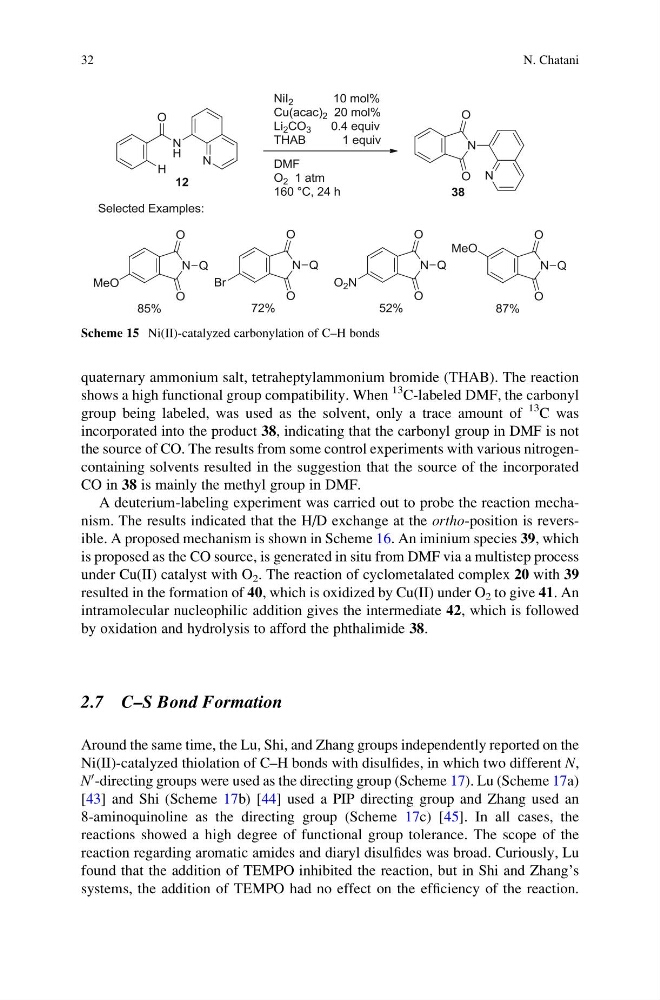
quaternary ammonium salt, tetraheptylammonium bromide (THAB). The reaction
shows a high functional group compatibility. When
13 C-labeled DMF, the carbonyl
group being labeled, was used as the solvent, only a trace amount of
13 C was
incorporated into the product 38, indicating that the carbonyl group in DMF is not
the source of CO. The results from some control experiments with various nitrogencontaining solvents resulted in the suggestion that the source of the incorporated
CO in 38 is mainly the methyl group in DMF.
A deuterium-labeling experiment was carried out to probe the reaction mechanism. The results indicated that the H/D exchange at the ortho-position is reversible. A proposed mechanism is shown in Scheme 16. An iminium species 39, which
is proposed as the CO source, is generated in situ from DMF via a multistep process
under Cu(II) catalyst with O 2 . The reaction of cyclometalated complex 20 with 39
resulted in the formation of 40, which is oxidized by Cu(II) under O 2 to give 41. An
intramolecular nucleophilic addition gives the intermediate 42, which is followed
by oxidation and hydrolysis to afford the phthalimide 38.
2.7 C–S Bond Formation
Around the same time, the Lu, Shi, and Zhang groups independently reported on the
Ni(II)-catalyzed thiolation of C–H bonds with disulfides, in which two different N,
N
0 -directing groups were used as the directing group (Scheme 17). Lu (Scheme 17a)
[43] and Shi (Scheme 17b) [44] used a PIP directing group and Zhang used an
8-aminoquinoline as the directing group (Scheme 17c) [45]. In all cases, the
reactions showed a high degree of functional group tolerance. The scope of the
reaction regarding aromatic amides and diaryl disulfides was broad. Curiously, Lu
found that the addition of TEMPO inhibited the reaction, but in Shi and Zhang’s
systems, the addition of TEMPO had no effect on the efficiency of the reaction.
Scheme 15 Ni(II)-catalyzed carbonylation of C–H bonds
32
N. Chatani
shows a high functional group compatibility. When
13 C-labeled DMF, the carbonyl
group being labeled, was used as the solvent, only a trace amount of
13 C was
incorporated into the product 38, indicating that the carbonyl group in DMF is not
the source of CO. The results from some control experiments with various nitrogencontaining solvents resulted in the suggestion that the source of the incorporated
CO in 38 is mainly the methyl group in DMF.
A deuterium-labeling experiment was carried out to probe the reaction mechanism. The results indicated that the H/D exchange at the ortho-position is reversible. A proposed mechanism is shown in Scheme 16. An iminium species 39, which
is proposed as the CO source, is generated in situ from DMF via a multistep process
under Cu(II) catalyst with O 2 . The reaction of cyclometalated complex 20 with 39
resulted in the formation of 40, which is oxidized by Cu(II) under O 2 to give 41. An
intramolecular nucleophilic addition gives the intermediate 42, which is followed
by oxidation and hydrolysis to afford the phthalimide 38.
2.7 C–S Bond Formation
Around the same time, the Lu, Shi, and Zhang groups independently reported on the
Ni(II)-catalyzed thiolation of C–H bonds with disulfides, in which two different N,
N
0 -directing groups were used as the directing group (Scheme 17). Lu (Scheme 17a)
[43] and Shi (Scheme 17b) [44] used a PIP directing group and Zhang used an
8-aminoquinoline as the directing group (Scheme 17c) [45]. In all cases, the
reactions showed a high degree of functional group tolerance. The scope of the
reaction regarding aromatic amides and diaryl disulfides was broad. Curiously, Lu
found that the addition of TEMPO inhibited the reaction, but in Shi and Zhang’s
systems, the addition of TEMPO had no effect on the efficiency of the reaction.
Scheme 15 Ni(II)-catalyzed carbonylation of C–H bonds
32
N. Chatani