

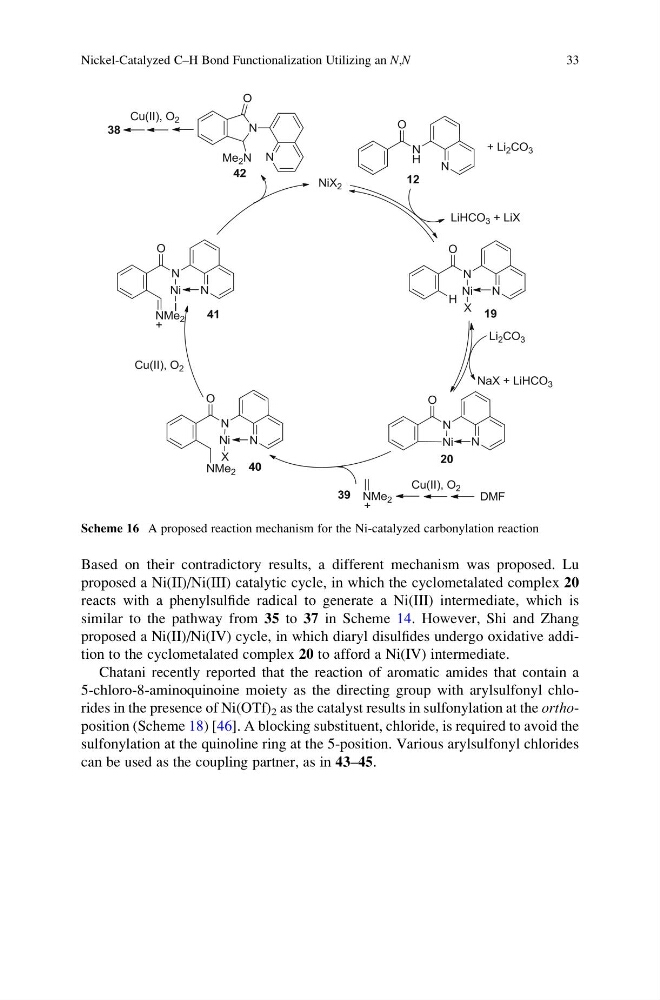
Based on their contradictory results, a different mechanism was proposed. Lu
proposed a Ni(II)/Ni(III) catalytic cycle, in which the cyclometalated complex 20
reacts with a phenylsulfide radical to generate a Ni(III) intermediate, which is
similar to the pathway from 35 to 37 in Scheme 14. However, Shi and Zhang
proposed a Ni(II)/Ni(IV) cycle, in which diaryl disulfides undergo oxidative addition to the cyclometalated complex 20 to afford a Ni(IV) intermediate.
Chatani recently reported that the reaction of aromatic amides that contain a
5-chloro-8-aminoquinoine moiety as the directing group with arylsulfonyl chlorides in the presence of Ni(OTf) 2 as the catalyst results in sulfonylation at the orthoposition (Scheme 18) [46]. A blocking substituent, chloride, is required to avoid the
sulfonylation at the quinoline ring at the 5-position. Various arylsulfonyl chlorides
can be used as the coupling partner, as in 43–45.
Scheme 16 A proposed reaction mechanism for the Ni-catalyzed carbonylation reaction
Nickel-Catalyzed C–H Bond Functionalization Utilizing an N,N
33
proposed a Ni(II)/Ni(III) catalytic cycle, in which the cyclometalated complex 20
reacts with a phenylsulfide radical to generate a Ni(III) intermediate, which is
similar to the pathway from 35 to 37 in Scheme 14. However, Shi and Zhang
proposed a Ni(II)/Ni(IV) cycle, in which diaryl disulfides undergo oxidative addition to the cyclometalated complex 20 to afford a Ni(IV) intermediate.
Chatani recently reported that the reaction of aromatic amides that contain a
5-chloro-8-aminoquinoine moiety as the directing group with arylsulfonyl chlorides in the presence of Ni(OTf) 2 as the catalyst results in sulfonylation at the orthoposition (Scheme 18) [46]. A blocking substituent, chloride, is required to avoid the
sulfonylation at the quinoline ring at the 5-position. Various arylsulfonyl chlorides
can be used as the coupling partner, as in 43–45.
Scheme 16 A proposed reaction mechanism for the Ni-catalyzed carbonylation reaction
Nickel-Catalyzed C–H Bond Functionalization Utilizing an N,N
33