

(or pseudohalide) are very rare, the methylation of C–H bonds continues to be a
significant challenge. The use of a combination of methyl tosylate/NaI afforded the
methylation product 18 in 91% yield.
To gain insights into the reaction mechanism, various mechanistic experiments,
including deuterium-labeling experiments, competition experiments, radical clock
experiments, and radical trap experiments, have been carried out. These mechanistic studies indicated that (1) the cleavage of C–H bonds is reversible, (2) a free
radical is not involved, and (3) Ni(II) is a key catalytic species. A proposed
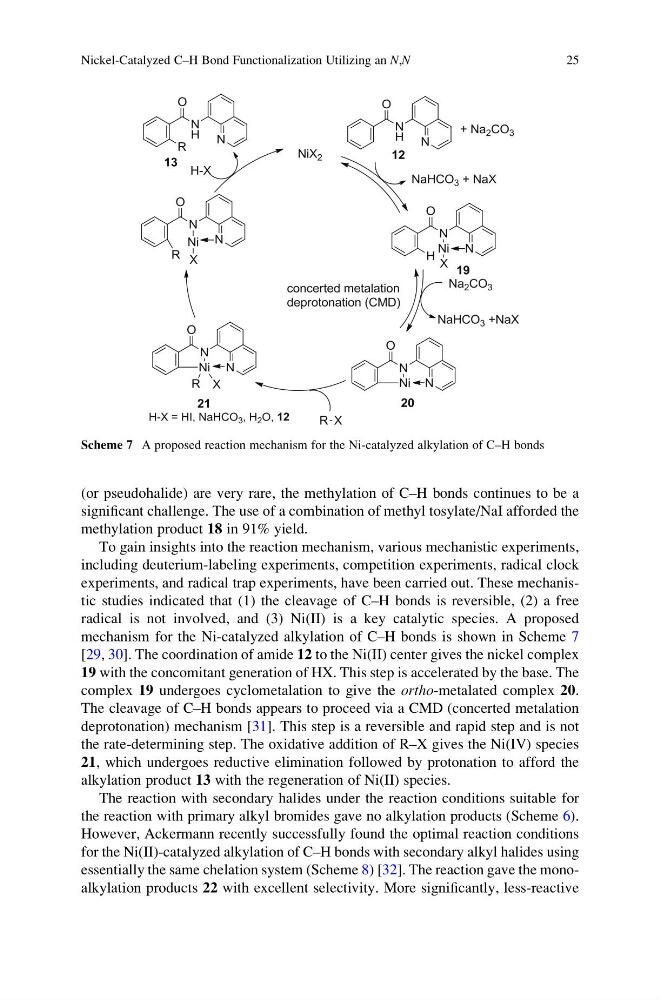
mechanism for the Ni-catalyzed alkylation of C–H bonds is shown in Scheme 7
[29, 30]. The coordination of amide 12 to the Ni(II) center gives the nickel complex
19 with the concomitant generation of HX. This step is accelerated by the base. The
complex 19 undergoes cyclometalation to give the ortho-metalated complex 20.
The cleavage of C–H bonds appears to proceed via a CMD (concerted metalation
deprotonation) mechanism [31]. This step is a reversible and rapid step and is not
the rate-determining step. The oxidative addition of R–X gives the Ni(IV) species
21, which undergoes reductive elimination followed by protonation to afford the
alkylation product 13 with the regeneration of Ni(II) species.
The reaction with secondary halides under the reaction conditions suitable for
the reaction with primary alkyl bromides gave no alkylation products (Scheme 6).
However, Ackermann recently successfully found the optimal reaction conditions
for the Ni(II)-catalyzed alkylation of C–H bonds with secondary alkyl halides using
essentially the same chelation system (Scheme 8) [32]. The reaction gave the monoalkylation products 22 with excellent selectivity. More significantly, less-reactive
Scheme 7 A proposed reaction mechanism for the Ni-catalyzed alkylation of C–H bonds
Nickel-Catalyzed C–H Bond Functionalization Utilizing an N,N
25
significant challenge. The use of a combination of methyl tosylate/NaI afforded the
methylation product 18 in 91% yield.
To gain insights into the reaction mechanism, various mechanistic experiments,
including deuterium-labeling experiments, competition experiments, radical clock
experiments, and radical trap experiments, have been carried out. These mechanistic studies indicated that (1) the cleavage of C–H bonds is reversible, (2) a free
radical is not involved, and (3) Ni(II) is a key catalytic species. A proposed
mechanism for the Ni-catalyzed alkylation of C–H bonds is shown in Scheme 7
[29, 30]. The coordination of amide 12 to the Ni(II) center gives the nickel complex
19 with the concomitant generation of HX. This step is accelerated by the base. The
complex 19 undergoes cyclometalation to give the ortho-metalated complex 20.
The cleavage of C–H bonds appears to proceed via a CMD (concerted metalation
deprotonation) mechanism [31]. This step is a reversible and rapid step and is not
the rate-determining step. The oxidative addition of R–X gives the Ni(IV) species
21, which undergoes reductive elimination followed by protonation to afford the
alkylation product 13 with the regeneration of Ni(II) species.
The reaction with secondary halides under the reaction conditions suitable for
the reaction with primary alkyl bromides gave no alkylation products (Scheme 6).
However, Ackermann recently successfully found the optimal reaction conditions
for the Ni(II)-catalyzed alkylation of C–H bonds with secondary alkyl halides using
essentially the same chelation system (Scheme 8) [32]. The reaction gave the monoalkylation products 22 with excellent selectivity. More significantly, less-reactive
Scheme 7 A proposed reaction mechanism for the Ni-catalyzed alkylation of C–H bonds
Nickel-Catalyzed C–H Bond Functionalization Utilizing an N,N
25