

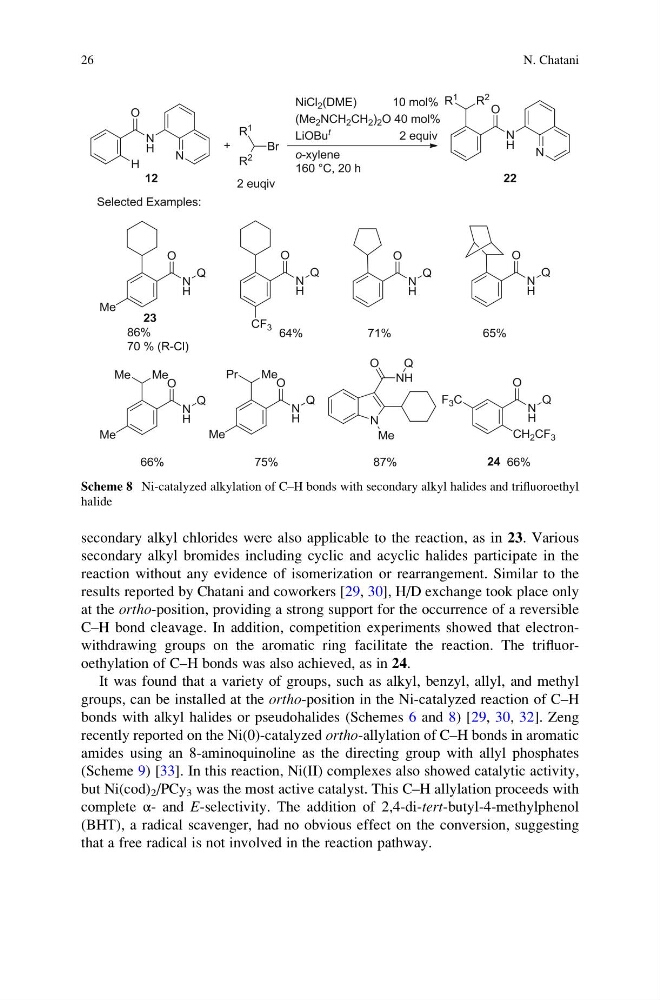
secondary alkyl chlorides were also applicable to the reaction, as in 23. Various
secondary alkyl bromides including cyclic and acyclic halides participate in the
reaction without any evidence of isomerization or rearrangement. Similar to the
results reported by Chatani and coworkers [29, 30], H/D exchange took place only
at the ortho-position, providing a strong support for the occurrence of a reversible
C–H bond cleavage. In addition, competition experiments showed that electronwithdrawing groups on the aromatic ring facilitate the reaction. The trifluoroethylation of C–H bonds was also achieved, as in 24.
It was found that a variety of groups, such as alkyl, benzyl, allyl, and methyl
groups, can be installed at the ortho-position in the Ni-catalyzed reaction of C–H
bonds with alkyl halides or pseudohalides (Schemes 6 and 8) [29, 30, 32]. Zeng
recently reported on the Ni(0)-catalyzed ortho-allylation of C–H bonds in aromatic
amides using an 8-aminoquinoline as the directing group with allyl phosphates
(Scheme 9) [33]. In this reaction, Ni(II) complexes also showed catalytic activity,
but Ni(cod) 2 /PCy 3 was the most active catalyst. This C–H allylation proceeds with
complete α- and E-selectivity. The addition of 2,4-di-tert-butyl-4-methylphenol
(BHT), a radical scavenger, had no obvious effect on the conversion, suggesting
that a free radical is not involved in the reaction pathway.
Scheme 8 Ni-catalyzed alkylation of C–H bonds with secondary alkyl halides and trifluoroethyl
halide
26
N. Chatani
secondary alkyl bromides including cyclic and acyclic halides participate in the
reaction without any evidence of isomerization or rearrangement. Similar to the
results reported by Chatani and coworkers [29, 30], H/D exchange took place only
at the ortho-position, providing a strong support for the occurrence of a reversible
C–H bond cleavage. In addition, competition experiments showed that electronwithdrawing groups on the aromatic ring facilitate the reaction. The trifluoroethylation of C–H bonds was also achieved, as in 24.
It was found that a variety of groups, such as alkyl, benzyl, allyl, and methyl
groups, can be installed at the ortho-position in the Ni-catalyzed reaction of C–H
bonds with alkyl halides or pseudohalides (Schemes 6 and 8) [29, 30, 32]. Zeng
recently reported on the Ni(0)-catalyzed ortho-allylation of C–H bonds in aromatic
amides using an 8-aminoquinoline as the directing group with allyl phosphates
(Scheme 9) [33]. In this reaction, Ni(II) complexes also showed catalytic activity,
but Ni(cod) 2 /PCy 3 was the most active catalyst. This C–H allylation proceeds with
complete α- and E-selectivity. The addition of 2,4-di-tert-butyl-4-methylphenol
(BHT), a radical scavenger, had no obvious effect on the conversion, suggesting
that a free radical is not involved in the reaction pathway.
Scheme 8 Ni-catalyzed alkylation of C–H bonds with secondary alkyl halides and trifluoroethyl
halide
26
N. Chatani