

2.2 Alkylation of C(sp
2
)–H Bonds
The direct arylation of C–H bonds with aryl halides or pseudo halides has been
extensively studied to construct biaryls as one of the alternative cross-coupling
reactions because biaryls find widespread applications as building blocks for
organic materials, fine chemicals, and pharmaceuticals. In sharp contrast, examples
of the direct alkylation of C–H bonds with alkyl halides are limited because the
oxidative addition of alkyl halides to transition metal complexes is an unfavorable
process and the resulting alkylmetal complexes tend to undergo β-hydride elimination (for a review on C–H alkylation, see [28]). In 2013, Chatani reported on the
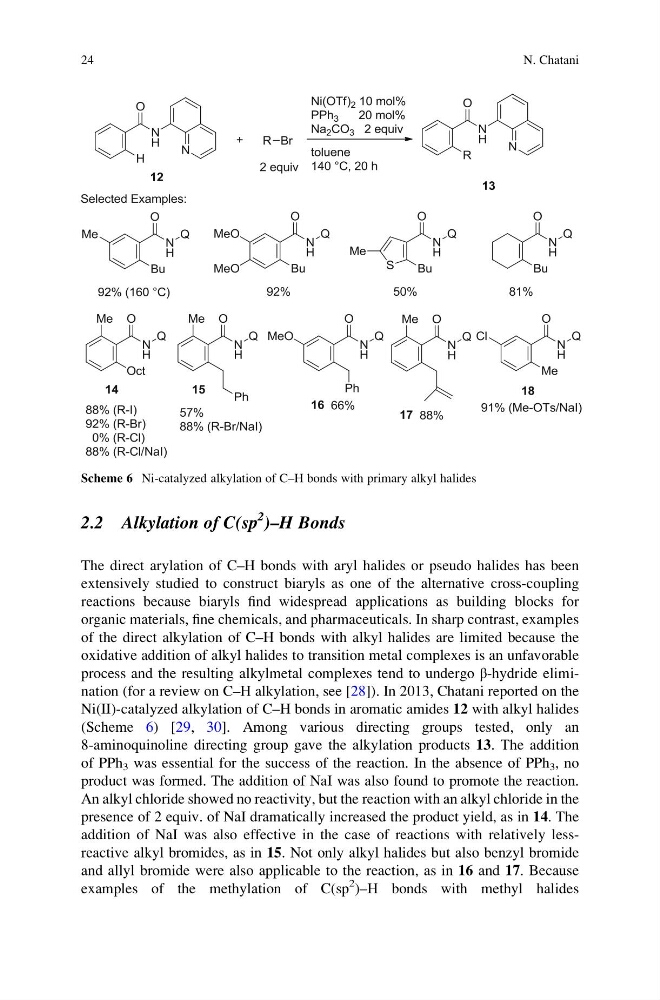
Ni(II)-catalyzed alkylation of C–H bonds in aromatic amides 12 with alkyl halides
(Scheme 6) [29, 30]. Among various directing groups tested, only an
8-aminoquinoline directing group gave the alkylation products 13. The addition
of PPh 3 was essential for the success of the reaction. In the absence of PPh 3 , no
product was formed. The addition of NaI was also found to promote the reaction.
An alkyl chloride showed no reactivity, but the reaction with an alkyl chloride in the
presence of 2 equiv. of NaI dramatically increased the product yield, as in 14. The
addition of NaI was also effective in the case of reactions with relatively lessreactive alkyl bromides, as in 15. Not only alkyl halides but also benzyl bromide
and allyl bromide were also applicable to the reaction, as in 16 and 17. Because
examples of the methylation of C(sp
2 )–H bonds with methyl halides
Scheme 6 Ni-catalyzed alkylation of C–H bonds with primary alkyl halides
24
N. Chatani
2
)–H Bonds
The direct arylation of C–H bonds with aryl halides or pseudo halides has been
extensively studied to construct biaryls as one of the alternative cross-coupling
reactions because biaryls find widespread applications as building blocks for
organic materials, fine chemicals, and pharmaceuticals. In sharp contrast, examples
of the direct alkylation of C–H bonds with alkyl halides are limited because the
oxidative addition of alkyl halides to transition metal complexes is an unfavorable
process and the resulting alkylmetal complexes tend to undergo β-hydride elimination (for a review on C–H alkylation, see [28]). In 2013, Chatani reported on the
Ni(II)-catalyzed alkylation of C–H bonds in aromatic amides 12 with alkyl halides
(Scheme 6) [29, 30]. Among various directing groups tested, only an
8-aminoquinoline directing group gave the alkylation products 13. The addition
of PPh 3 was essential for the success of the reaction. In the absence of PPh 3 , no
product was formed. The addition of NaI was also found to promote the reaction.
An alkyl chloride showed no reactivity, but the reaction with an alkyl chloride in the
presence of 2 equiv. of NaI dramatically increased the product yield, as in 14. The
addition of NaI was also effective in the case of reactions with relatively lessreactive alkyl bromides, as in 15. Not only alkyl halides but also benzyl bromide
and allyl bromide were also applicable to the reaction, as in 16 and 17. Because
examples of the methylation of C(sp
2 )–H bonds with methyl halides
Scheme 6 Ni-catalyzed alkylation of C–H bonds with primary alkyl halides
24
N. Chatani